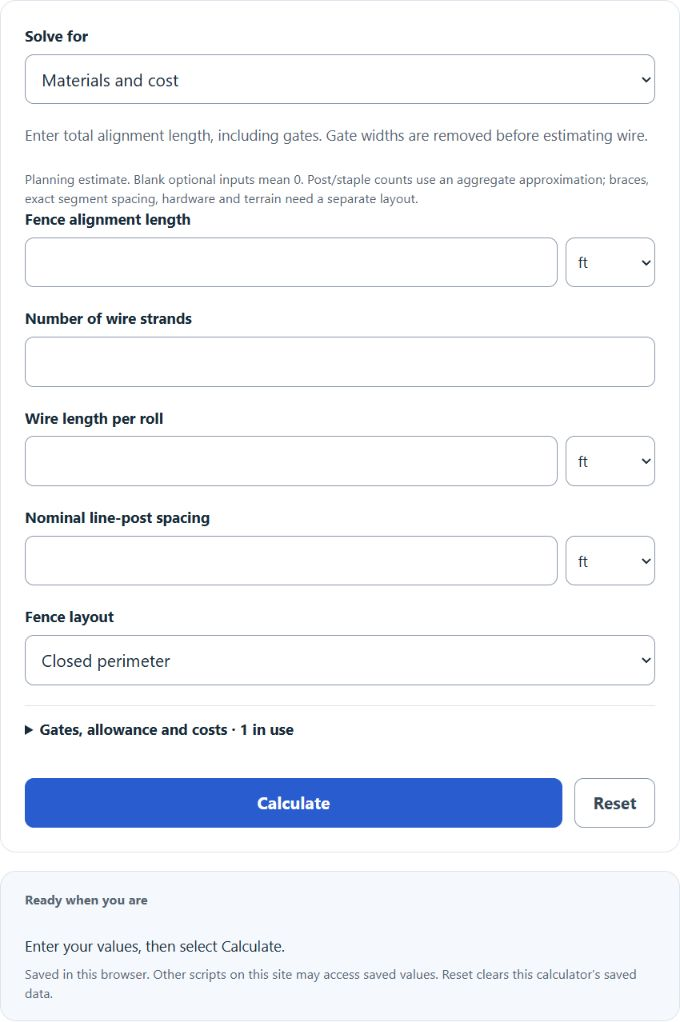
Estimate barbed wire rolls, posts, staples, allowance, unused wire, and cost, or reverse available roll inventory into fence coverage in three length units.
Related Calculators
- Fence Calculator – Posts, Pickets & Materials Estimate
- Ramp Slope Calculator
- Angle Of Internal Friction Calculator
- Swell Factor Calculator
- Curb Radius Calculator
- All Construction Calculators
Barbed Wire Fence Formula
Choose materials and cost from an alignment length, or coverage from whole-roll inventory. Enter a whole strand count directly. Alignment includes gates; the wired run excludes their widths. Blank optional adjustments and costs mean zero.
Wired run = alignment − gates × average gate width.
Wire needed = wired run × strands × (1 + allowance / 100).
Rolls required = ceiling(wire needed / wire per roll).
Unused wire = purchased wire − wire needed.
Inventory coverage = rolls × roll length / [strands × (1 + allowance / 100)] + unwired gate openings.
Fence length supports feet, meters and miles. Roll length, nominal post spacing and gate width have independent feet/meters units. Labor cost is per selected alignment input unit and applies to the full alignment. Costs include wire rolls, posts and entered labor only; currency selects a denomination, without exchange conversion.
Post and Staple Planning
These are aggregate estimates. Intervals = ceiling(net wired run / nominal post spacing). For a closed perimeter, structural posts = max(3, corners) + 2 × gates, and line posts = max(0, intervals − max(3, corners)). For an open run, structural posts = 2 + corners + 2 × gates, and line posts = max(0, intervals − 1 − corners). Total posts add the two counts; staples assume two per post per strand.
Actual segment spacing, brace assemblies and attachment methods need a separate plan. UGA Extension’s fence guide explains the importance of corner, end and intermediate bracing. Extra brace posts, gates, staples and hardware are excluded from the cost estimate.
Barbed Wire Roll Length Reference
| Roll length | Equivalent length | Use in planning |
|---|---|---|
| 1,320 ft | 1/4 mile | Common barbed wire roll size |
| 2,640 ft | 1/2 mile | Useful for longer fence runs |
| 5,280 ft | 1 mile | Reference length for large perimeter estimates |
Example Calculations
Materials and cost
Enter a 1,320 ft closed alignment, 4 strands, a 10 ft gate, 10% allowance, 1,320 ft rolls, 12 ft nominal post spacing and 4 corners. The wired run is 1,310 ft, needing 5,764 ft of wire. Buy 5 rolls, or 6,600 ft, leaving 836 ft after the allowance. The rough post estimate is 106 line + 6 structural = 112 posts, with 896 staples under the stated assumption. At $120 per roll and $8 per post, materials total $1,496 before labor and excluded items.
Coverage from inventory
Eight 1,320 ft rolls provide 10,560 ft of wire. With 4 strands and 10% allowance, that covers 2,400 ft of wired run. Add one 10 ft unwired gate to obtain 2,410 ft of alignment.
FAQs
Does allowance include extra wire?
Yes. Enter the allowance for terrain, ties, splices and waste; blank means 0%. The scenarios compare no allowance, your allowance, and ten additional percentage points. These are arithmetic planning comparisons.
How should strand count and spacing be chosen?
Enter the intended whole strand count and a nominal line-post spacing. This calculator does not infer them from fence height or certify suitability for animals or local requirements. Use the product instructions and a site layout.
Which roll length should I enter?
Use the actual product label. A Red Brand guide lists a 1,320 ft quarter-mile roll; other entered lengths are allowed.