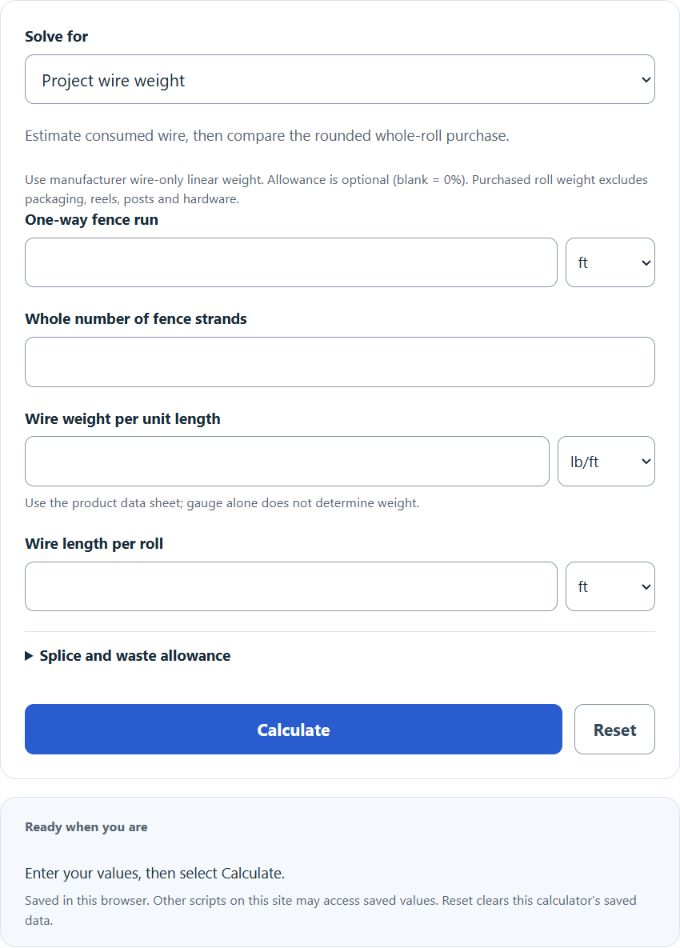
Calculate barbed wire project weight or reverse-solve fence length using strands, manufacturer linear weight, waste, roll length, and metric or US units.
- All Construction Calculators
- Delrin Weight Calculator
- Boulder Weight Calculator
- Rubber Sheet Weight Calculator
Barbed Wire Weight Formula
Choose project wire weight or fence run from a wire-weight limit. Enter the whole strand count, manufacturer linear wire weight and actual length per roll. Blank optional splice/waste allowance means 0%.
Wire length = one-way run × strands × (1 + allowance / 100).
Project wire weight = wire length × linear weight.
Whole rolls required = ceiling(wire length / roll length).
Purchased wire weight = whole rolls × roll length × linear weight.
Project weight includes the entered extra wire. Whole-roll purchase weight can be higher; their difference is unused purchased wire. Packaging, reels, posts and hardware are excluded. These are wire-mass estimates, not complete shipping loads.
Fence Run from a Weight Limit
Continuous run = weight limit / linear weight / (1 + allowance / 100) / strands. This assumes partial-roll wire is available. Whole rolls within the limit = floor(weight limit / wire weight per roll). Their coverage uses that smaller whole-roll inventory.
Linear Weight and Roll Data
Use the exact product data sheet or measured wire-only roll mass divided by roll length. Gauge alone does not determine the linear weight: strand construction, barb count and coating also matter. A manufacturer guide lists product constructions and 1,320 ft quarter-mile rolls; enter the actual product values.
The following values are hypothetical arithmetic inputs, without gauge or animal-use recommendations:
| Entered linear weight | Wire mass for 1,320 ft |
|---|---|
| 0.082 lb/ft | 108.24 lb |
| 0.097 lb/ft | 128.04 lb |
| 0.110 lb/ft | 145.20 lb |
| 0.062 lb/ft | 81.84 lb |
Worked Examples
Project weight: Enter a 1,000 ft run, 4 strands, 0.082 lb/ft, 5% allowance and 1,320 ft per roll. Installed wire is 4,000 ft; with allowance it is 4,200 ft. Consumed weight is 344.40 lb. Four whole rolls supply 5,280 ft weighing 432.96 lb, leaving 1,080 ft after the allowance.
Weight limit: With a 400 lb wire-only limit and the same strand count, linear weight, allowance and roll length, continuous coverage is about 1,161.44 ft. Only three whole rolls fit the limit; they cover about 942.86 ft after the allowance.
FAQ
Can I calculate a known wire length? Yes. Use project mode with one strand, the known total wire length and 0% allowance. For an order, multiply its roll count by roll length first.
Does the calculator include splice or waste wire? It includes the allowance you enter. Choose a project-specific value; the tool does not infer sag, installation methods or terrain.
How many strands should I use? Enter the count from your fence plan and product instructions. This calculator estimates mass and coverage; it does not choose a fence design for an animal or certify containment.
Can I mix units? Yes. Run length supports ft, m, km and miles; available weight supports lb and kg; linear weight supports lb/ft, kg/m, lb/100 ft and kg/100 m. Roll length has its own ft/m selector. Conversions use 1 ft = 0.3048 m and 1 lb = 0.45359237 kg, as defined in NIST’s conversion guide.