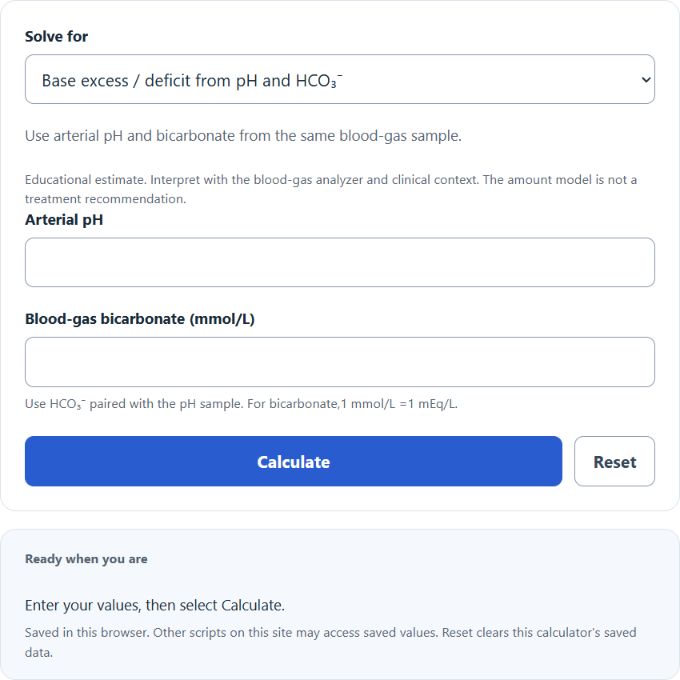
Estimate standard base excess and base deficit from arterial pH and blood-gas HCO₃⁻ (or PaCO₂), and calculate a bicarbonate amount under explicitly assumed distribution factors.
Important: This calculator provides an educational estimate of bicarbonate deficit and base deficit/base excess. It is not medical advice and does not determine whether sodium bicarbonate should be given or how it should be administered. Do not self-treat with sodium bicarbonate—use requires a qualified clinician, appropriate labs, and monitoring. Treating the underlying cause of acidosis is essential; clinicians often use partial correction with repeat blood gases/electrolytes, and bicarbonate may be inappropriate in many situations (for example, some cases of DKA or lactic acidosis) unless directed by a clinician.
Related Calculators
- Respiratory Rate Calculator
- Central Venous Pressure Calculator
- Cardiac Output Echo Calculator
- Blood Flow Rate Calculator
- All Health and Medical Calculators
Base Deficit Formula
Standard base excess is estimated as SBE = 0.9287 × [HCO₃⁻ − 24.4 + 14.83 × (pH − 7.40)], with HCO₃⁻ in mmol/L. The nonnegative deficit magnitude is max(0, −SBE); positive SBE is base excess, not a deficit. The PaCO₂ route derives HCO₃⁻ using approximate 37°C constants. Compare with your laboratory analyzer. This approximation is described in primary clinical research.
The bicarbonate amount below is a separate assumption-based model. Distribution factors vary: manufacturer product information uses a different factor and requires clinical adjustment. The calculator’s 0.3, 0.4 and 0.5 settings are not universal treatment standards.
Deficit classes refer to a specific major-trauma cohort; they do not diagnose shock or prescribe treatment for general users.
Assumed bicarbonate amount
The following bedside approximation is sometimes used to estimate bicarbonate deficit from base deficit magnitude and weight. The 0.3 factor is an approximation related to bicarbonate distribution (often treated as an extracellular fluid fraction) and may vary by reference and clinical context.
Variables:
- HCO₃⁻ is the estimated bicarbonate deficit (mEq)
- BD is the base deficit magnitude (mEq/L; enter as a positive number)
- W is the weight (kg)
This provides a rough estimate of bicarbonate deficit associated with the base deficit; it does not determine whether bicarbonate should be given or how much to administer in clinical care. For background, consult critical care/ABG textbooks or hospital protocols that cover base excess/deficit (often associated with Siggaard-Andersen concepts) and bicarbonate deficit estimation.
What is Base Deficit?
Base deficit (often reported as a negative base excess) reflects the metabolic component of an acid–base disturbance. It describes the amount of base (buffer) that would be required to titrate blood back toward a standard reference state under defined conditions, and it can be used as part of an overall assessment of metabolic acidosis severity. Decisions about bicarbonate therapy depend on the cause of acidosis, severity, and careful clinical monitoring; base deficit alone does not determine treatment.
How to Calculate Base Deficit?
The following steps outline how base deficit and bicarbonate deficit estimates are commonly approached.
- Obtain blood gas results (ABG/VBG) and relevant labs (electrolytes, lactate/ketones as appropriate).
- Use the lab/analyzer output or calculation to determine base excess/base deficit (and interpret it with pH, PaCO₂, and clinical context).
- If you are estimating bicarbonate deficit, enter weight and base deficit magnitude (as a positive number) into the calculator above.
- Review the estimate and verify values if results are outside typical physiologic ranges.
- Use results only with appropriate clinical oversight and monitoring; this tool does not evaluate respiratory compensation or mixed disorders.
Example Problem :
Use the following variables as an example problem to test your knowledge.
Estimated bicarbonate deficit (HCO₃⁻) = 150 mEq
Weight (W) = 70 kg
Base deficit (BD) = 150 / (0.3 × 70) = 7.14 mEq/L