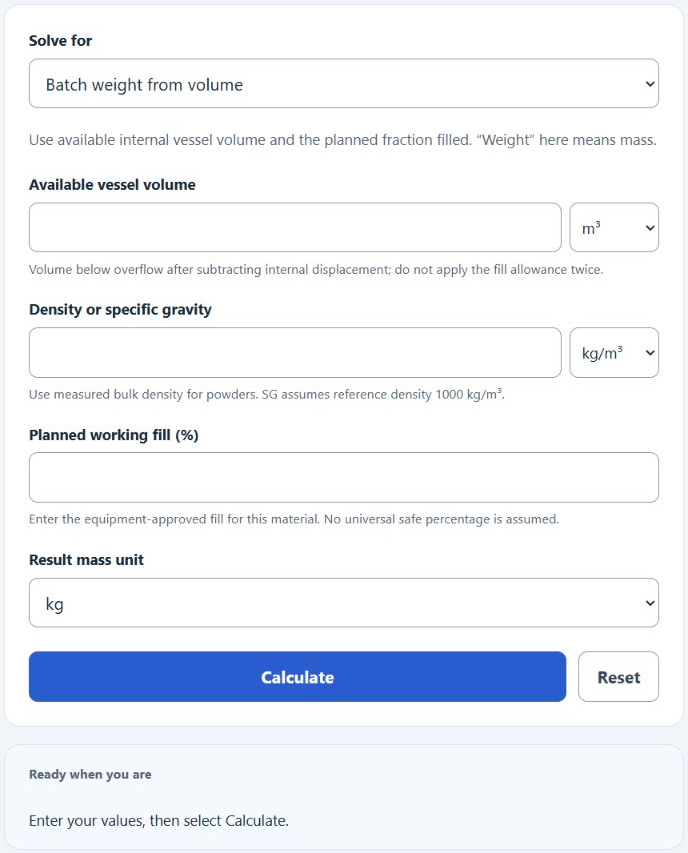
Calculate batch weight from mixer volume, density, and fill, or determine required mixer volume and tank-based weight in kg or lb.
Batch Weight Formula
- V = net mixer volume (m³)
- ρ = material density (kg/m³)
- f = working fill fraction (decimal, e.g. 0.80 for 80%)
For sizing a mixer to a target weight, rearrange to V = W / (ρ × f). For a cylindrical tank, V = π × (D/2)² × H. For a rectangular tank, V = L × W × H. The calculator converts all inputs to SI units before applying these formulas, then converts the answer back to your chosen unit. Density is treated as the bulk density of the material as charged, so for powders use bulk density, not true particle density.
Reference Tables
These legacy rounded density examples are illustrative, not measured specifications for your material. Verify actual density at the relevant temperature, composition and packing before calculating. The calculator requires your own density and working fill; it does not prescribe a safe fill.
| Material | Density (kg/m³) | Specific Gravity |
|---|---|---|
| Water / aqueous mix | 1000 | 1.00 |
| Milk | 1030 | 1.03 |
| Vegetable oil | 920 | 0.92 |
| Honey / syrup | 1400 | 1.40 |
| Flour, bulk | 590 | 0.59 |
| Granulated sugar, bulk | 850 | 0.85 |
| Dry sand, bulk | 1600 | 1.60 |
| Wet concrete | 2400 | 2.40 |
| Working Fill | Headspace remaining |
|---|---|
| 40 to 50% | 50 to 60% of vessel volume; suitability depends on the equipment and process. |
| 60 to 75% | 25 to 40% of vessel volume; not a general mixer recommendation. |
| 75 to 85% | 15 to 25% of vessel volume; verify process allowances. |
| Above 90% | Less than 10% of vessel volume; verify the manufacturer’s operating limits. |
Worked Example
You have a 2 m³ jacketed mixer running an aqueous solution at SG 1.05, with a working fill of 80%.
- V = 2 m³
- ρ = 1.05 × 1000 = 1050 kg/m³
- f = 0.80
- Batch weight = 2 × 1050 × 0.80 = 1680 kg
To run a 1680 kg batch in a different mixer at 70% fill with the same product, the required net volume is 1680 / (1050 × 0.70) = 2.29 m³.
FAQ
Should I use bulk density or true density for powders? Use bulk density. The mixer holds loose powder, not compacted solid, so bulk density gives the correct charge weight.
What does “net mixer volume” mean? It is the usable internal volume of the vessel below the overflow point, excluding agitator displacement if the manufacturer has already deducted it.
Why is the answer different from the nameplate capacity? A nameplate may specify total or working capacity; check the manufacturer’s definition. Batch mass depends on actual filled volume and material density. Do not apply a fill factor again to a capacity that already describes the filled working volume.
Does the calculator account for agitator displacement? No. Subtract internal displacement once from gross volume before using the volume mode. If the manufacturer’s net volume already excludes it, do not subtract it again. Dimension modes give gross geometric estimates.