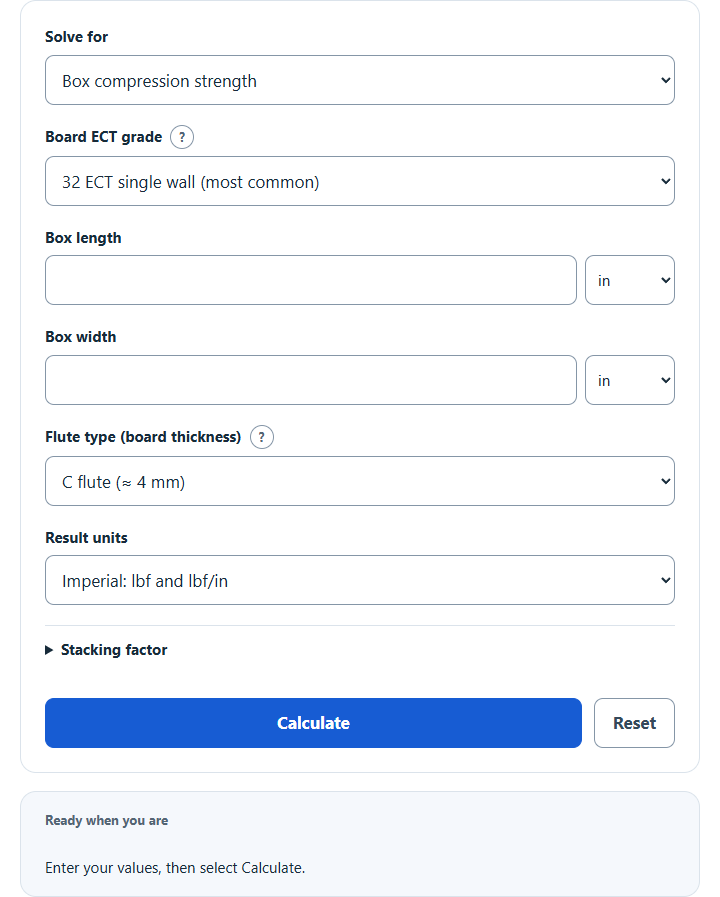
Calculate corrugated box compression strength (BCT) from the ECT grade, box size and flute type with the McKee formula, or find the ECT a target BCT needs.
- All Health and Medical Calculators
- Cardboard Box Weight Calculator
- Corrugated Board Weight Calculator
- Box Volume Calculator
Calculator Functions
| Function | What it does | What it requires |
|---|---|---|
| Box compression strength | Estimates the top-to-bottom compression strength (BCT) of a corrugated box from its board grade and size | Requires the board ECT grade (23 to 71 ECT, or a custom value in lbf/in or kN/m), the box length and width, and the flute type or a measured board thickness |
| Required ECT for target strength | Finds the edge crush strength the board needs for a box of a set size to reach a target compression strength | Requires the target compression strength in lbf or kN, the box length and width, and the flute type or a measured board thickness |
Both functions take the box length and width in inches or millimetres and show results in lbf and lbf/in or in kN and kN/m. The flute list sets the board thickness to 1.5 mm for E flute, 3.2 mm for B, 4 mm for C, 4.8 mm for A and 7 mm for BC double wall, and a measured thickness replaces it. An optional stacking factor of 1 or more divides the estimated strength and adds a factor-adjusted estimate to the results.
BCT Formulas
√(P × T) [1]
| BCT | Estimated box compression strength (lbf) |
| ECT | Edge crush strength of the combined board (lbf/in) |
| P | Box perimeter, 2 × (length + width) (in) |
| T | Board thickness, or caliper, including both facings (in) |
This is the short form of the McKee formula. As published, the short form is 5.874 × ECT × T0.508 × P0.492 [1], and box makers commonly round it to 5.87 × ECT × √(T × P) [2]. The square-root version used here gives results about 4% to 5% higher than the published exponents for ordinary box sizes, and its constant differs from 5.87 by 0.1%. Box height is not part of the formula.
Box compression strength
The main formula applies directly. A 12 in × 8 in box has a 40 in perimeter. In 32 ECT board 0.16 in thick it gives 5.876 × 32 × √(40 × 0.16) = 475.7 lbf, or 2.116 kN. With the C flute preset of 4 mm (0.1575 in) the same box gives 471.9 lbf. Millimetre sizes are converted at 25.4 mm per inch, a custom ECT in kN/m at 5.7101 lbf/in per kN/m, and the kN result at 4.4482 N per lbf.
Required ECT for target strength
[5.876 × √(P × T)]
This is the main formula rearranged, with the target compression strength as BCT. A 500 lbf target for the 12 in × 8 in box in C flute needs 500 ÷ (5.876 × √(40 × 0.1575)) = 33.9 lbf/in, so 32 ECT board falls short and the next grade up, 40 ECT, meets it.
Stacking factor
The factor is a number of 1 or more chosen for the storage conditions. A factor of 3 turns 471.9 lbf into 157.3 lbf. The calculator does not suggest a factor, and the adjusted figure is not a certified safe working load.
Limits of This Estimate
- The McKee formula is an estimate of laboratory compression strength for conventional corrugated boxes. Its buckling assumptions suit regular slotted containers with a height of at least perimeter ÷ 7. In one set of laboratory tests on B flute boxes of several shapes, McKee-type formulas missed the measured strength by about 11% or more on average [1].
- The result does not certify a safe stacking load. Moisture, damage, box construction, pallet support and storage time all lower real strength, so the actual package needs to be tested.
- The flute thicknesses are typical values, and board of the same flute varies between makers. A measured thickness is more exact, and small rounding of the inputs changes the result [2]. These estimates are based on the best available data and estimations.
Sources
- Garbowski, Gajewski and Grabski, The Role of Buckling in the Estimation of Compressive Strength of Corrugated Cardboard Boxes, Materials 13(20), 2020: short form of the McKee formula, its constant and exponents, and its error against box tests
- Association of Independent Corrugated Converters, Calculating Theoretical Box Compression: square-root form used in the box industry and the effect of rounding