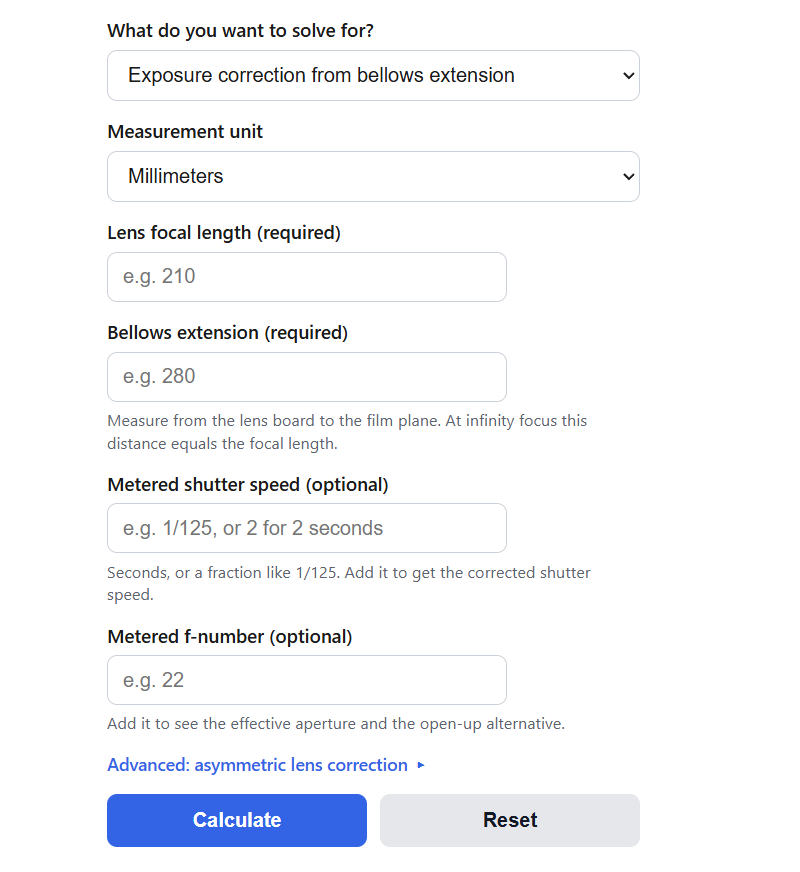
Calculate the bellows extension exposure factor, compensation in f-stops, corrected shutter speed, and effective aperture from extension or magnification.
- All Everyday Life and Education Calculators
- 500 Rule Astrophotography Exposure Calculator
- Exposure Time Calculator
Bellows Extension Exposure Factor Formula
When you rack the bellows out past the focal length to focus close, the light spreads over a larger area before it reaches the film, and the image gets dimmer by the square of the extra draw. The basic formula is:
BEF = (BE / FL)^2
Converted to f-stops of compensation:
Stops = 2 * log2(BE / FL)
When camera movements make the extension hard to measure, you can get the same factor from magnification instead:
BEF = (1 + M)^2
For lenses that are not optically symmetric, the accurate version adds the pupil magnification:
BEF = (1 + M/p)^2
Variables:
- BEF is the bellows extension exposure factor, the multiple of the metered exposure you actually need
- BE is the bellows extension, measured from the lens board to the film plane (ground glass); at infinity focus it equals the focal length
- FL is the focal length of the lens, in the same unit as BE
- M is the magnification, the size of the image on the ground glass divided by the size of the subject
- p is the pupil magnification, the exit pupil diameter divided by the entrance pupil diameter (about 1 for the near-symmetric lenses normally used on view cameras)
The default mode of the calculator takes FL and BE and returns the factor, the compensation in exact stops and to the nearest third stop, and the approximate subject distance. The magnification mode uses (1 + M)^2, with M entered directly or computed from a subject measurement and its image on the ground glass, which is the reliable method when you are using swings and tilts. The third mode reverses the geometry: give it a target magnification and it returns the bellows draw you need, BE = FL * (1 + M). In every mode, adding your metered shutter speed returns the corrected time (metered time multiplied by BEF) with the nearest standard speed, and adding your metered f-number shows both the effective aperture and the open-up alternative. The advanced option applies the pupil magnification correction.
Compensation by Extension Ratio and Asymmetric Lens Corrections
The first table covers the symmetric-lens case. Find your extension ratio (bellows draw divided by focal length) and read across. Compensation reaches a third of a stop at a ratio of about 1.12, which corresponds to a subject roughly 9 focal lengths away, so anything focused farther than that needs no correction.
| Extension ratio (BE / FL) | Exposure factor | Exact stops | Set on the lens |
|---|---|---|---|
| 1.0 (infinity) | 1.00 | 0 | 0 |
| 1.1 | 1.21 | +0.28 | +1/3 |
| 1.2 | 1.44 | +0.53 | +2/3 |
| 1.3 | 1.69 | +0.76 | +2/3 |
| 1.4 | 1.96 | +0.97 | +1 |
| 1.5 | 2.25 | +1.17 | +1 1/3 |
| 1.6 | 2.56 | +1.36 | +1 1/3 |
| 1.8 | 3.24 | +1.70 | +1 2/3 |
| 2.0 (1:1) | 4.00 | +2.00 | +2 |
| 2.5 | 6.25 | +2.64 | +2 2/3 |
| 3.0 (2:1) | 9.00 | +3.17 | +3 1/3 |
The second table shows why the simple formula fails on asymmetric designs. At 1:1 magnification the symmetric formula always predicts +2 stops, but the true compensation depends on the pupil magnification. A strong telephoto used for close work at the symmetric setting comes out more than a stop underexposed, while a retrofocus wide angle comes out overexposed.
| Pupil magnification p | Typical design | True factor at 1:1 | True stops | Error if you assume +2 |
|---|---|---|---|---|
| 0.5 | Strong telephoto | 9.00 | +3.17 | 1.17 stops under |
| 0.7 | Moderate telephoto | 5.90 | +2.56 | 0.56 stops under |
| 1.0 | Symmetric view camera lens | 4.00 | +2.00 | None |
| 1.5 | Mild retrofocus wide | 2.78 | +1.47 | 0.53 stops over |
| 2.0 | Strong retrofocus wide | 2.25 | +1.17 | 0.83 stops over |
You can estimate p yourself: look into the front of the lens and judge the diameter of the aperture opening, then look into the rear and do the same. The rear view divided by the front view is the pupil magnification. Manufacturer data sheets sometimes list it directly.
Example Problems
Example 1: You are shooting a still life with a 150 mm lens and the bellows measures 300 mm from lens board to film plane. Your handheld meter reads 1/8 s at f/22.
BEF = (300 / 150)^2 = 4, which is +2 stops. Multiply the time by 4 to get 1/2 s at f/22, or keep 1/8 s and open up two stops to f/11. If you left everything alone, the marked f/22 would behave like f/44 and the negative would come out two stops thin.
Example 2: With a 210 mm lens and heavy front tilt you cannot measure the draw, so you place a ruler in the scene. A 60 mm stretch of the ruler spans 30 mm on the ground glass, and the meter reads 1 s.
M = 30 / 60 = 0.5, so BEF = (1 + 0.5)^2 = 2.25, which is +1.17 stops, or +1 1/3 on the lens. The corrected time is 1 x 2.25 = 2.25 s before any reciprocity correction. For reference, that magnification needs 210 x 1.5 = 315 mm of draw.
Frequently Asked Questions
At what point does bellows extension start to matter?
Compensation reaches 1/3 stop once the draw exceeds the focal length by about 12 percent, which happens when the subject is closer than roughly 9 focal lengths, around 1.9 m for a 210 mm lens. Farther than that, the correction is smaller than the exposure error you would make reading the meter, so you can ignore it. Color transparency film holds about a third of a stop of latitude, so compensate from that threshold onward; black and white and color negative film forgive half a stop or more of undercorrection.
Do I need this correction with a DSLR, mirrorless camera, or TTL metering?
No. Any meter that reads through the lens sees the dimmed image and corrects automatically, which covers digital cameras, TTL film SLRs, and TTL flash. You need the factor whenever the meter does not look through the lens: handheld incident or spot meters with a view camera, manual flash calculated from guide numbers, or exposure set by the Sunny 16 rule. Guide number math is hit especially hard, because at 1:1 a flash exposure calculated from distance alone lands two stops under.
Why is the measured-extension method wrong for telephoto lenses?
Two reasons. A telephoto design places its rear nodal point out in front of the lens board, so the distance you measure from lens board to film plane is longer than the true optical extension, and the arithmetic starts from a false premise. On top of that, telephoto pupils are asymmetric, which changes how the effective aperture grows with magnification. The fix for both is to work from magnification: measure a subject feature against its ground glass image, then apply the pupil magnification in the advanced option. The same applies in reverse to retrofocus wide angles, which need less compensation than the simple formula suggests.