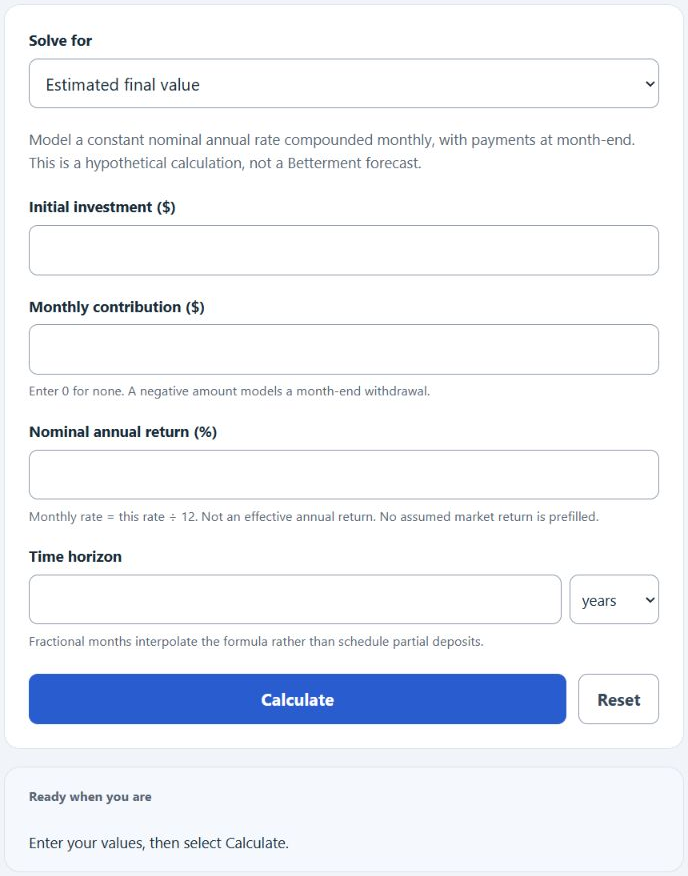
Calculate hypothetical investment growth and final value from an initial deposit, month-end contributions, a nominal annual rate, and time horizon. This independent calculator is not an official Betterment projection.
Betterment Return Formula
The following equation estimates the future value of an investment with an initial deposit and equal monthly contributions, assuming a constant nominal annual return divided by 12 to obtain a monthly rate and contributions made at the end of each month.
- Where BTR is the estimated final portfolio value, including deposits, not investment gain alone
- I is the initial investment ($)
- C is the monthly contribution ($ per month)
- r is the monthly rate of return (decimal form), calculated as r = R/12
- R is the nominal annual return (decimal form), not an effective annual return
- T is the total time (years), so 12T is the number of months. Fractional months interpolate the formula; actual deposits occur at month-end
If the return is 0% (so r = 0), this simplifies to: BTR = I + C × (12T).
What is a Betterment Return?
Definition:
This calculator models a hypothetical final investment balance using your own fixed return assumption. It does not retrieve Betterment account data, predict market performance, or reproduce Betterment’s goal-projection methodology. Select the desired result to solve for final value, initial investment, monthly contribution, or time.
How to Calculate Betterment Return?
Example Problem:
The following example outlines the steps and information needed to calculate the Betterment Return.
First, determine the initial investment. In this example, the initial investment is $5,000.
Next, determine your monthly contribution. Here, you plan to contribute $200 per month.
Next, choose a nominal annual rate assumption. This illustration uses 8%, or 0.08 in decimal form, not a forecast. The monthly rate is r = 0.08/12.
Finally, calculate the Betterment return using the formula above (with T = 10 years, so 12T = 120 months):
BTR = I(1 + r)12T + C × [((1 + r)12T − 1) / r]
BTR = $5,000 × (1 + 0.08/12)120 + $200 × [((1 + 0.08/12)120 − 1) / (0.08/12)]
BTR ≈ $47,687.41
FAQ
How do fees affect my Betterment returns?
Fees reduce investment growth. This calculator does not deduct Betterment fees, fund expenses, taxes or inflation automatically; account for the basis of your rate assumption. Check Betterment’s current fee schedule for your account rather than assuming a universal fee.
Can I change my recurring contributions or asset allocation?
Yes, most automated investment platforms, including Betterment, allow you to adjust your contribution amounts and asset allocation. Changing these factors will affect your future returns and risk exposure.
Does an 8% rate of return always hold true?
No. The 8% input is an illustrative constant nominal rate, not a promised or expected Betterment return. Actual returns vary with market conditions, allocation, fees and taxes, and losses are possible.