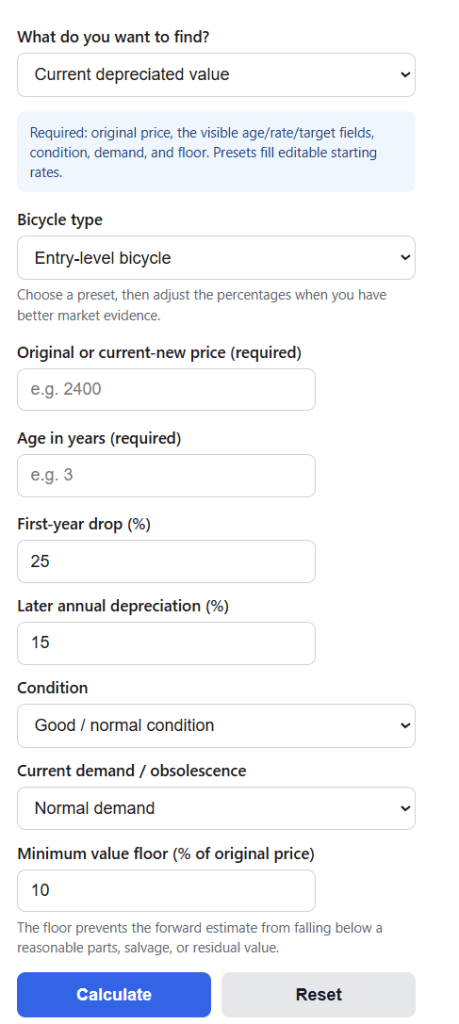
Estimate used bicycle value, annual depreciation, or bike age using first-year loss, compounded decline, condition, demand, and a residual value floor.
Bicycle Depreciation Formula
The calculator separates the larger first-year drop from the compounded depreciation that follows. For an asset at least one year old, the raw market estimate is:
Vraw = P * (1 - F) * (1 - r)^(A - 1) * C * D
The displayed value cannot fall below the selected residual floor:
V = max(Vraw, P * S)
To solve the later annual depreciation rate from a known current value:
r = 1 - (V / (P * (1 - F) * C * D))^(1 / (A - 1))
Variables:
- V is the estimated current value
- Vraw is the value before applying the floor
- P is original or current-new price
- F is the first-year drop as a decimal
- r is the later annual depreciation rate as a decimal
- A is age in years
- C is the condition multiplier
- D is the demand or obsolescence multiplier
- S is the residual floor as a fraction of original price
The presets are editable starting assumptions, not fixed market facts. For a stronger estimate, update the rates from several recent completed sales for the same model or a close replacement.
Bicycle Depreciation Starting-Rate Reference
These preset rates provide a consistent starting point for the calculator. Actual value can fall faster or slower depending on model cycles, maintenance, condition, brand demand, and local market liquidity.
| Bicycle type | First-year starting rate | Later annual starting rate |
|---|---|---|
| Entry-level bicycle | 25% | 15% |
| Mid-range road / mountain bike | 20% | 12% |
| High-end performance bicycle | 15% | 10% |
| Electric bicycle | 30% | 18% |
| Vintage / collectible bicycle | 10% | 5% |
Example Problems
Example 1: A mid-range bicycle cost $2,400, is 3 years old, has a 20% first-year drop and 12% later annual depreciation, with normal condition and demand.
V = 2400 * (1 – 0.20) * (1 – 0.12)^(3 – 1) = $1,486.85.
Example 2: A bicycle’s adjusted post-first-year value is $1,920. At age 4 it sells for $1,300.
r = 1 – (1300 / 1920)^(1 / (4 – 1)) = 12.18% per year.
Frequently Asked Questions
Do high-end bicycles depreciate more slowly?
Often, but not always. Desirable frames and components can retain value, while changing standards, crash risk, fit constraints, and expensive suspension or drivetrain service can reduce demand.
How should e-bike battery health be included?
Use a lower condition factor when the battery has reduced capacity or is near replacement. Because battery replacement can be a large part of resale value, compare the calculated result with the cost and availability of a compatible battery.
Do upgrades add their full cost to resale value?
Usually not. Buyers may value desirable wheels, suspension, or drivetrain upgrades, but used-market value rarely increases dollar-for-dollar with installed cost. Compare sales of similarly equipped bicycles.