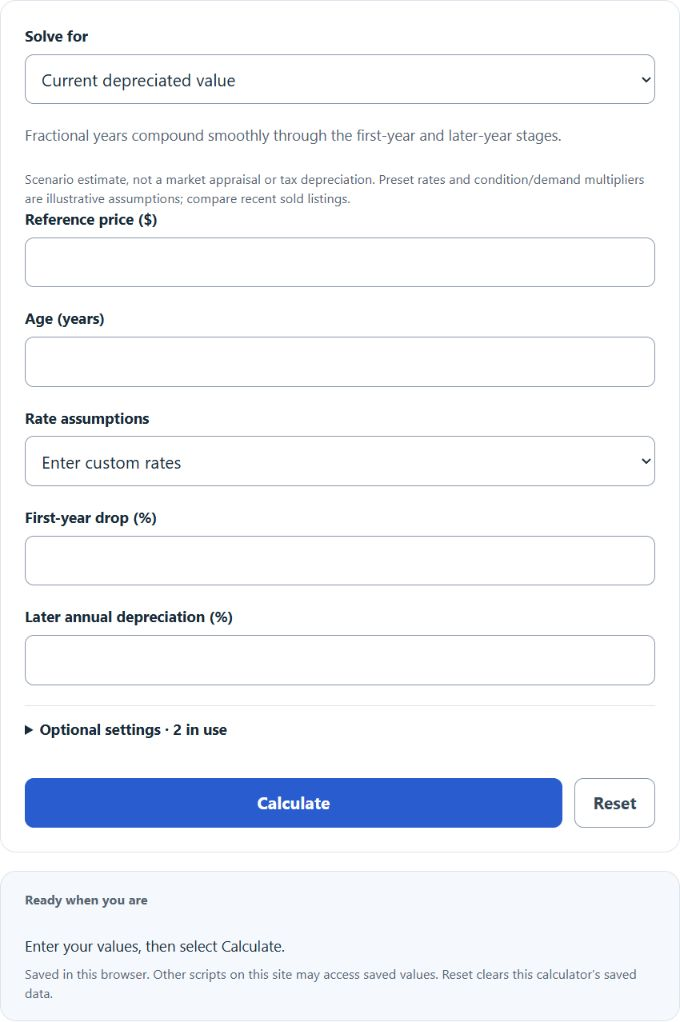
Estimate current electronics value, annual depreciation, or device age using first-year loss, later decline, condition, demand, and a residual value floor.
Electronics Depreciation Formula
The calculator separates the larger first-year drop from the compounded depreciation that follows. For an asset at least one year old, the raw market estimate is:
Vraw = P * (1 - F) * (1 - r)^(A - 1) * C * D
The displayed value cannot fall below the selected residual floor:
V = max(Vraw, P * S)
To solve the later annual depreciation rate from a known current value:
r = 1 - (V / (P * (1 - F) * C * D))^(1 / (A - 1))
Variables:
- V is the estimated current value
- Vraw is the value before applying the floor
- P is original or current-new price
- F is the first-year drop as a decimal
- r is the later annual depreciation rate as a decimal
- A is age in years
- C is the condition multiplier
- D is the demand or obsolescence multiplier
- S is the residual floor as a fraction of original price
The presets and condition/demand multipliers are illustrative assumptions, not measured market facts. For fractional ages below one year, the first-year factor is compounded over that fraction instead of applying the entire first-year loss immediately. A blank residual floor uses 0%. For a stronger estimate, update the rates from several recent completed sales for the same model or a close replacement.
Electronics Depreciation Starting-Rate Reference
These preset rates provide a consistent starting point for the calculator. Actual value can fall faster or slower depending on model cycles, maintenance, condition, brand demand, and local market liquidity.
| Device type | First-year starting rate | Later annual starting rate |
|---|---|---|
| Smartphone | 35% | 25% |
| Laptop / computer | 30% | 22% |
| Tablet | 35% | 24% |
| Television | 25% | 15% |
| Game console | 25% | 18% |
| Camera / lens | 20% | 12% |
Example Problems
Example 1: A laptop cost $1,500, is 3 years old, has a 30% first-year drop and 22% later annual depreciation, and is in normal condition with normal demand.
V = 1500 * (1 – 0.30) * (1 – 0.22)^(3 – 1) = $638.82.
Example 2: A phone’s adjusted value after the first year is $650. At age 3, its known current value is $365.
r = 1 – (365 / 650)^(1 / (3 – 1)) = 25.06% per year.
Frequently Asked Questions
Why do electronics often lose value quickly in the first year?
New models, retail promotions, warranty differences, battery wear, and rapid specification changes create an immediate used-market discount. The first-year field separates that initial drop from later compounded depreciation.
Should I use purchase price or current new price?
Use current new price when the same model is still sold at a materially lower retail price. Use original purchase price when it remains the best reference, but compare the result with recent completed used sales.
How should battery health or software support be handled?
Use the condition and demand/obsolescence selectors. A weak battery, unavailable parts, ended software support, carrier locks, or expensive repairs can lower the market value beyond age alone.