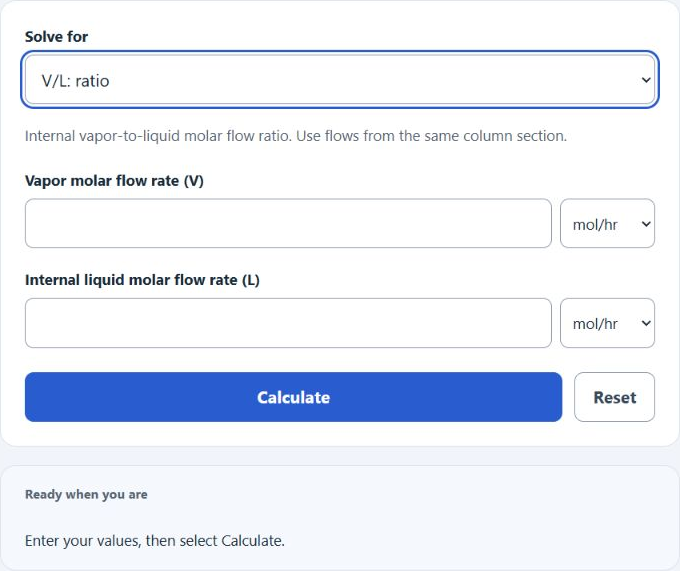
Select a value to calculate for the internal V/L ratio, bottoms-based V/B ratio, or a latent-only reboiler duty estimate. Enter the displayed inputs; flow and energy units are converted consistently.
Related Calculators
- Molar Flow Rate Calculator
- Mass Balance Calculator
- Boiling Point Calculator (Water)
- Volume Fraction Calculator
- All Chemistry Calculators
Boil Up Ratio Formula
In distillation, the term “boil-up ratio” is used in more than one way. This page covers both the internal vapor-to-liquid ratio (V/L) within a column section and the reboil (boil-up) ratio (V/B) based on bottoms product.
Variables:
- RVL is the internal vapor-to-liquid flow ratio (dimensionless)
- V is the internal vapor molar flow rate (e.g., mol/hr, kmol/hr, or lbmol/hr)
- L is the internal liquid molar flow rate (same type of units as V)
- Rv is the reboil (boil-up) ratio based on bottoms product (dimensionless)
- V̄ is the vapor boil-up rate generated in the reboiler (molar flow rate)
- B is the bottoms product molar flow rate (same type of units as V̄)
To calculate the internal V/L ratio, divide the internal vapor flow rate by the internal liquid flow rate. To calculate the reboil ratio V/B, divide the vapor boil-up rate by the bottoms product rate.
What is a Boil Up Ratio?
In distillation, “boil-up ratio” commonly refers to the amount of vapor generated in the reboiler relative to the bottoms product (V/B), which is closely tied to reboiler duty and energy use. In some contexts, people also discuss an internal vapor-to-liquid traffic ratio (V/L) in a given section of the column. Higher values generally mean higher vapor traffic, which can increase mass transfer driving forces but also increases energy consumption and may increase hydraulic limits (e.g., flooding risk) if pushed too high.
How to Calculate Boil Up Ratio?
The following steps outline how to calculate the Boil Up Ratio.
- First, decide which definition you need: internal vapor-to-liquid ratio (V/L) or reboil (boil-up) ratio (V/B).
- Next, determine the required flow rates using consistent molar flow units (e.g., mol/hr, kmol/hr, or lbmol/hr).
- Finally, calculate the ratio using the appropriate formula: RVL = V / L or Rv = V̄ / B.
- After inserting the values and calculating the result, check your answer with the calculator above (and select Duty: heat rate if you also need QR; this estimate neglects sensible heat and heat losses).
Example Problem :
Use the following variables as an example problem to test your knowledge (internal V/L ratio example).
Vapor flow rate (V) = 500 mol/hr
Liquid flow rate (L) = 250 mol/hr
Boil-up (internal) ratio: RVL = V/L = 500/250 = 2.0