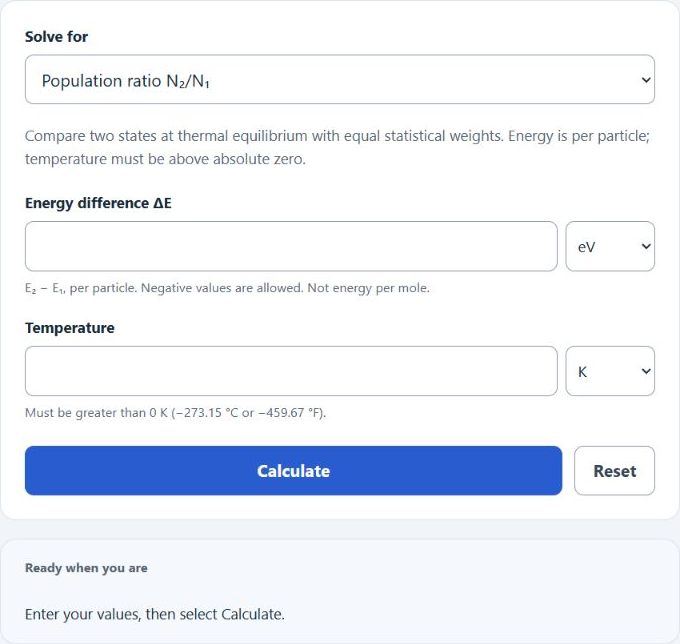
Select Boltzmann ratio, energy difference, or temperature to solve from the other two values, with unit conversions. This model assumes thermal equilibrium, equal statistical weights, and positive absolute temperature.
Related Calculators
- Initial Temperature Calculator
- Hz To Joules Calculator
- Accelerated Temperature Testing Calculator
- Intensity Calculator
- All Physics Calculators
Boltzmann Ratio Formula
For equal statistical weights at thermal equilibrium, the Boltzmann ratio gives the relative population of two energy states at a positive absolute temperature. The calculator uses the energy difference between the states, temperature, and the Boltzmann constant.
- N₂/N₁ = Boltzmann ratio, the population of state 2 divided by the population of state 1
- ΔE = energy difference between the two states, usually E₂ − E₁
- T = absolute temperature in kelvin
- k = Boltzmann constant, 1.380649 × 10⁻²³ J/K
- e = Euler’s number
- ln = natural logarithm
Select the value to solve, then enter the two visible inputs:
- Boltzmann ratio: enter ΔE and T to find N₂/N₁.
- Energy difference: enter T and N₂/N₁ to find ΔE.
- Temperature: enter ΔE and N₂/N₁ to find T.
Energy is converted internally to joules, and temperature is converted internally to kelvin before the formula is applied. The ratio must be greater than zero because the natural logarithm of zero or a negative number is undefined. A ratio of 1 does not determine a unique finite temperature: with equal energies any positive temperature fits, and with unequal energies no finite temperature fits.
Energy and Temperature Reference Values
These tables can help you check whether your inputs are in the right scale.
| Quantity | Conversion to base unit | Used by formula as |
|---|---|---|
| 1 eV | 1.602176634 × 10⁻¹⁹ J | Energy per particle |
| 1 kJ | 1000 J | Energy in joules |
| 1 kcal | 4184 J | Energy in joules |
| 0 °C | 273.15 K | Absolute temperature |
| 32 °F | 273.15 K | Absolute temperature |
| Boltzmann ratio N₂/N₁ | Meaning when ΔE = E₂ − E₁ |
|---|---|
| Greater than 1 | State 2 is more populated than state 1. This usually means ΔE is negative. |
| Equal to 1 | The two states have equal populations. This occurs when ΔE = 0. |
| Between 0 and 1 | State 2 is less populated than state 1. This is typical when state 2 is higher in energy. |
| Very close to 0 | State 2 has a much smaller population than state 1. |
Example Calculations
Example 1: Find the Boltzmann ratio
Suppose the energy difference is 1.00 eV and the temperature is 300 K.
Convert 1.00 eV to joules:
Substitute the values:
The result is approximately:
Example 2: Find the energy difference
Suppose the Boltzmann ratio is 0.01 and the temperature is 298.15 K.
Substitute the values:
The result is approximately:
FAQ
Why does temperature need to be in kelvin?
The Boltzmann equation uses absolute temperature. Celsius and Fahrenheit are relative scales, so they must be converted to kelvin before the calculation. This calculator requires temperature above 0 K. Zero would put zero in the denominator; negative absolute temperatures are outside its model.
Can the Boltzmann ratio be negative?
No. The Boltzmann ratio is a population ratio, so it must be positive. A ratio less than 1 means the second state is less populated than the first. A ratio greater than 1 means the second state is more populated than the first.
What if my energy is in kJ/mol?
The formula used here is written with the Boltzmann constant, so ΔE is treated as energy per particle. If your energy is molar, such as kJ/mol, convert it to energy per particle before using this form, or use the molar gas constant version of the equation.