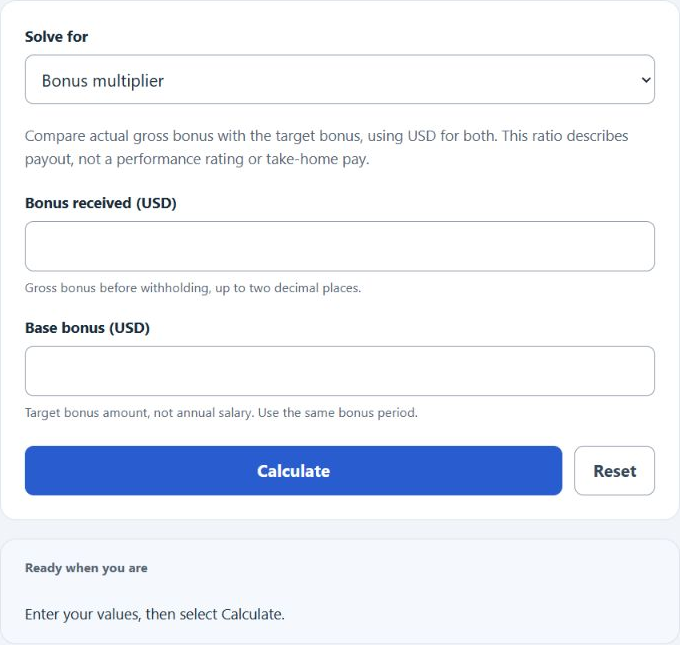
Calculate bonus received, base bonus, or bonus multiplier, and generate a table of payout amounts across multiplier ranges in USD values.
Bonus Multiplier Formula
Variables:
- BM is the Bonus Multiplier (dimensionless ratio)
- BR is the bonus received ($)
- B is the base bonus ($)
To calculate the Bonus Multiplier, select Bonus multiplier and divide the gross bonus received by a positive base bonus for the same period. A multiplier of 1.0 means payout matched target; higher or lower values describe payout relative to target, not a universal performance rating.
What Is a Bonus Multiplier?
A bonus multiplier is a scaling factor applied to an employee's base or target bonus that adjusts the final payout based on measured performance. It connects compensation directly to results by converting performance ratings, KPI achievement, or company profitability into a numerical modifier. When organizations set a target bonus of, say, $10,000 and an employee earns a 1.25x multiplier, the actual payout becomes $12,500. The multiplier is the mechanism that turns a static compensation promise into a variable reward.
Bonus multipliers are used across virtually every industry that employs variable compensation, from investment banking and management consulting to SaaS sales teams and manufacturing plant managers. They differ from flat bonuses (which pay the same amount regardless of performance) and from commission structures (which are tied to individual revenue generation). The multiplier specifically modifies a pre-set target bonus based on achievement criteria.
How Bonus Multipliers Are Structured in Practice
In most corporate compensation plans, the final bonus payout is determined by three components multiplied together: the employee's base salary, their target bonus percentage, and the bonus multiplier itself. The full formula looks like this:
Final Bonus = Base Salary x Target Bonus % x Bonus Multiplier
For example, an employee earning $120,000 with a 15% target bonus and a 1.3x multiplier would receive: $120,000 x 0.15 x 1.3 = $23,400.
A plan may combine individual and company performance factors using specified weights. Use the weighting and definitions in the actual compensation plan; there is no universal weighting by seniority.
Types of Bonus Multipliers
Organizations use several distinct multiplier types depending on what behavior they want to incentivize.
Individual Performance Multiplier: A plan may map performance ratings to payout factors. The rating thresholds and factors are plan-specific and are not inferred by this calculator.
Corporate/Company Performance Multiplier: A plan may use company results such as revenue, EBITDA, net income or return on invested capital. Its floor, cap and thresholds must come from that plan.
Business Unit or Team Multiplier: Some organizations add a mid-level multiplier based on the performance of a specific division, department, or team. This sits between the company-wide and individual multipliers and is common in large organizations with multiple operating segments.
Discretionary Multiplier: A modifier applied at the manager or executive level to account for factors not captured by formal metrics, such as leadership during a crisis, successful execution of a strategic initiative, or retention of a critical employee.
Illustrative Target Bonus Percentages by Job Level
The following ranges are illustrative examples, not verified industry benchmarks or recommendations. The calculator requires the actual target bonus amount from your compensation plan.
- Entry-level / Individual Contributor: 5% to 10% of base salary
- Manager: 10% to 20% of base salary
- Senior Manager / Director: 15% to 30% of base salary
- Vice President: 20% to 50% of base salary
- C-Suite / Executive: 50% to 150%+ of base salary
Target bonus percentages and the mix of cash and equity vary by employer and role. Use the actual plan rather than assuming a standard percentage.
Illustrative Bonus Multiplier Scenarios
The scenarios below illustrate possible plan designs. They are not industry benchmarks and do not predict an employee’s payout.
Financial Services: In a hypothetical plan, a 2.5× multiplier would pay 250% of target. The actual plan determines whether that multiplier is available.
Technology: A hypothetical 0.8× to 1.5× range would produce 80% to 150% of target. Cash and equity awards may follow different rules.
Management Consulting: A hypothetical 0.5× to 1.5× range would produce 50% to 150% of target. Use the plan’s actual factors.
Manufacturing and Industrial: A hypothetical 0.75× to 1.25× range would produce 75% to 125% of target.
Sales (across industries): Bonus multipliers may differ from commission accelerators. Use the correct payout definition for the plan being evaluated.
Seniority-Based Weighting of Multiplier Components
When a plan specifies a weighted average, weights must total 100%. This is one possible design, not a rule tied to seniority. The composite multiplier is then:
Composite Multiplier = (Individual Multiplier x Individual Weight) + (Company Multiplier x Company Weight)
For illustration, individual/company weights could be 80%/20%, 50%/50% or 20%/80%. Use the weights specified by the actual plan; no standard split is assumed here.
For example, consider a Senior Director with a 65% individual / 35% company weighting. If their individual performance multiplier is 1.4x and the company performance multiplier is 1.1x, their composite multiplier would be: (1.4 x 0.65) + (1.1 x 0.35) = 0.91 + 0.385 = 1.295x.
Tax Treatment of Bonus Payouts
Bonuses are supplemental wages for federal withholding. Subject to IRS conditions, an employer may use the optional 22% method for separately identified supplemental wages up to $1 million in a calendar year; the excess over $1 million is subject to 37%. Other withholding methods and payroll taxes may apply. See IRS Publication 15. This calculator does not estimate withholding or take-home pay.
Withholding is a payment toward tax, not the final tax liability. Actual liability depends on the tax return; no typical combined withholding percentage is assumed here.
Multiplier Approaches: Weighting vs. True Multiplier vs. Discretion
Companies factor individual performance into annual incentive plans using one of three primary approaches, and the distinction matters for understanding how the bonus multiplier functions.
Weighting Approach: The bonus pool is split into segments. For instance, 60% of the target bonus is determined by company financials and 40% by individual performance. Each segment is calculated independently and then summed.
True Multiplier Approach: The individual performance score is literally multiplied by the corporate performance score. This creates a compounding effect where strong performance on both dimensions produces an outsized bonus, and weakness on either dimension drags down the total significantly.
Discretionary Approach: Management has latitude to adjust final payouts based on qualitative factors. This is common for senior leaders and in industries where performance is harder to quantify.
The true multiplier approach creates higher potential upside (and downside) than the weighting approach. For example, if both individual and corporate multipliers are 1.5x, the weighting approach yields a 1.5x composite, while the true multiplier approach yields 1.5 x 1.5 = 2.25x.
Deferred Bonus Multipliers
Some plans defer part of a bonus or make it subject to vesting. Compare payout and target on the same basis: a current cash payment and a total award including deferred amounts are different measures. The calculator does not model vesting or investment returns.
FAQs about Bonus Multipliers
What is a bonus multiplier?
A bonus multiplier is a numerical scaling factor that adjusts an employee's target bonus based on measured performance. It is calculated by dividing the actual bonus received by the base (target) bonus. A multiplier of 1.0 means the payout matched the target exactly, while a multiplier above 1.0 indicates the payout exceeded it.
What is a good bonus multiplier?
A multiplier of 1.0× means gross payout matched the target. Whether a higher multiplier is good or achievable depends on the compensation plan; the calculator assigns no performance rating.
Can the bonus multiplier be less than 1?
Yes. A bonus multiplier below 1.0 means the actual payout was less than the target bonus. This happens when individual performance ratings fall below expectations or when company financial results miss their targets. In some plans, the multiplier can reach 0.0x if minimum performance thresholds are not met, resulting in no bonus payout at all.
How do seniority levels affect the bonus multiplier?
Weights are plan-specific. Some plans vary them by role or seniority, but there is no universal percentage. Use the documented plan weights.
What is the difference between a bonus multiplier and a bonus percentage?
The bonus percentage is the target bonus expressed as a share of base salary (for example, 15% of a $100,000 salary means a $15,000 target bonus). The bonus multiplier is the factor applied to that target to determine the actual payout. If the target is $15,000 and the multiplier is 1.2x, the actual bonus is $18,000.
Are bonus multipliers the same as commission multipliers?
They serve a similar function but apply to different compensation structures. Bonus multipliers scale a pre-set target bonus based on achievement criteria. Commission multipliers (often called accelerators) increase the commission rate once a salesperson exceeds their quota. A sales rep might earn a 1.0x commission rate up to 100% of quota and a 1.5x rate on revenue above quota.
How are bonuses taxed when the multiplier is high?
Bonuses are supplemental wages. Under IRS conditions, 22% may be used for separately identified supplemental wages up to $1 million annually; 37% applies to the excess. Withholding is not final tax liability. This calculator provides gross amounts only; see IRS Publication 15 and your payroll plan.
What company metrics typically drive the corporate bonus multiplier?
Common metrics include revenue growth, EBITDA or operating income versus plan, net income, earnings per share, return on invested capital, and free cash flow generation. Some companies also incorporate non-financial metrics such as customer satisfaction scores, safety records, or ESG targets into the corporate multiplier calculation.