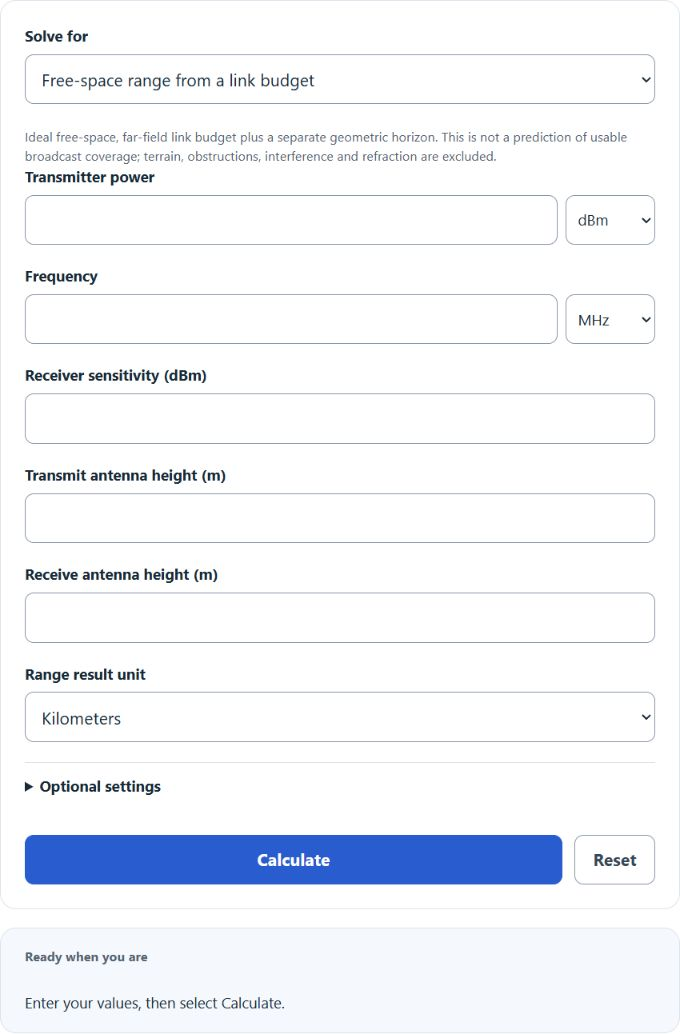
Estimate free-space broadcast range, received power, or required transmitter power, then compare the link budget with a geometric line-of-sight horizon.
Related Calculators
- Radio Coverage Calculator
- Solid Angle Calculator
- Wave Period Calculator
- Square Wave Frequency Calculator
- All Physics Calculators
Broadcast Distance Formula
The three modes solve an ideal free-space link budget for range, required transmit power or received power. Frequency is an input. Antenna gains, aggregate system losses, receiver sensitivity and required fade margin are entered separately.
Free-space path loss (MHz and km):
The rounded 32.44 constant approximates the free-space expression in ITU-R P.525.
Received power and required transmit power (powers in dBm; gains in dBi; losses and margin in dB):
Range solves these equations for distance at Pr = sensitivity + fade margin. The independent geometric horizon is approximately 3.57(√ht + √hr) km for near-surface antenna heights in meters on a smooth spherical Earth, without atmospheric refraction. It is not a guarantee of an unobstructed path. The displayed transmitter power plus antenna gain excludes losses; actual EIRP requires transmit-side losses to be identified separately.
Typical Broadcast Frequency Ranges
The following U.S. allocation examples are supported by 47 CFR73.14, 73.201 and 73.603. Allocations vary by country and service. Frequency input accepts kHz, MHz or GHz.
| Service or band | Typical frequency range | Common input unit |
|---|---|---|
| AM radio | 535–1705 kHz (station carriers 540–1700 kHz) | kHz |
| FM radio | 88–108 MHz | MHz |
| VHF television | 54–72, 76–88 and 174–216 MHz | MHz |
| UHF television | 470–608 MHz (TV channels14–36) | MHz |
| Microwave links | 1 GHz and higher | GHz |
How Power and Frequency Affect the Result
| Change | Effect in this free-space model | Reason |
|---|---|---|
| Double transmit power | Distance increases by about 1.414 times | Distance follows the square root of power |
| Quadruple transmit power | Distance doubles | √4 = 2 |
| Double frequency | Distance is cut in half | Distance is inversely proportional to frequency |
| Double distance | Required power becomes 4 times higher | Power follows distance squared |
Example
Example 1: Calculate free-space range
Enter 100 MHz, 1,000 W, sensitivity −30 dBm, both gains 0 dBi, losses 0 dB and fade margin 0 dB. The free-space range is approximately 7.551 km using the rounded constant. Antenna heights are entered separately to compare the geometric horizon.
Example 2: Calculate required transmit power
At 100 MHz and 10 km, with sensitivity −30 dBm, both gains 0 dBi, losses 0 dB and fade margin 0 dB, required transmit power is approximately 1,754 W. More margin or loss requires more power.
FAQ
Is this the same as real broadcast coverage?
No. This is a free-space estimate using your receiver sensitivity, fade margin, gains and losses. Real broadcast coverage depends on antenna height, antenna pattern, terrain, buildings, trees, ground conductivity, receiver sensitivity, interference, polarization, and regulatory limits. The result is best treated as an idealized physics estimate, not a coverage guarantee.
Why does a lower frequency give a longer distance?
In this formula, distance is inversely proportional to frequency. If power stays the same, lowering the frequency increases the calculated free-space distance. This is one reason lower-frequency signals often appear to travel farther, although real propagation also depends on many environmental factors.
Why does increasing power not increase distance by the same amount?
Distance depends on the square root of transmit power. For example, doubling power only increases the calculated distance by about 41%. To double the calculated distance, you need four times the transmit power under the same assumptions.