Calculate spherical surface area, radius, or solid angle from any two values with unit conversions for sq m, m, steradians, and deg².
- All Physics Calculators
- Interior Angle Calculator
- Exterior Angle Calculator
- Field of View Calculator
Solid Angle Formula
This calculator uses the standard solid-angle definition for a spherical patch measured on a sphere centered at the observation point. If you know any two of the three quantities, you can solve for the third with the same relationship. ([calculator.academy](https://calculator.academy/solid-angle-calculator/))
The same equation can be rearranged when the missing value is the spherical patch area or the radius. ([calculator.academy](https://calculator.academy/solid-angle-calculator/))
What the Inputs Mean
- Solid angle (Ω): the 3D angular size of the patch as seen from a point, normally expressed in steradians. ([calculator.academy](https://calculator.academy/solid-angle-calculator/))
- Spherical surface area (A): the area cut out on the sphere, not just the flat face area of an object. ([calculator.academy](https://calculator.academy/solid-angle-calculator/))
- Radius (r): the distance from the observation point to the sphere on which that patch is measured. ([calculator.academy](https://calculator.academy/solid-angle-calculator/))
In SI usage, the steradian is a named dimensionless derived unit. One steradian occurs when the spherical patch area equals the radius squared. ([govinfo.gov](https://www.govinfo.gov/content/pkg/GOVPUB-C13-60b8e508300eac3d65850cd9d112b253/pdf/GOVPUB-C13-60b8e508300eac3d65850cd9d112b253.pdf))
How to Use the Calculator
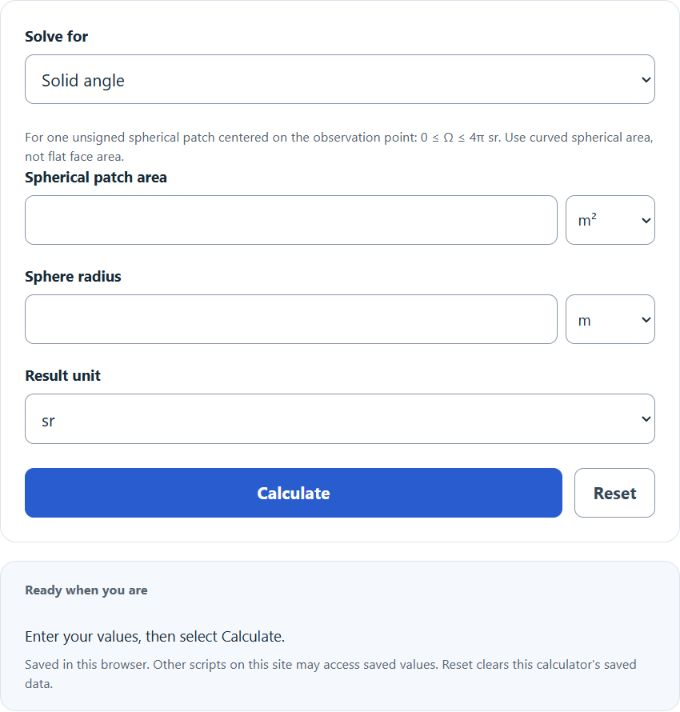
- Choose the quantity to solve, then enter its two required values. ([calculator.academy](https://calculator.academy/solid-angle-calculator/))
- Select the unit for each input; the calculator converts length and area consistently before applying the formula. ([govinfo.gov](https://www.govinfo.gov/content/pkg/GOVPUB-C13-60b8e508300eac3d65850cd9d112b253/pdf/GOVPUB-C13-60b8e508300eac3d65850cd9d112b253.pdf))
- Read the result in steradians, or interpret it in square degrees when that unit is more intuitive. ([calculator.academy](https://calculator.academy/solid-angle-calculator/))
Because the calculation is area divided by radius squared, larger patches increase the result and larger radii decrease it. ([govinfo.gov](https://www.govinfo.gov/content/pkg/GOVPUB-C13-60b8e508300eac3d65850cd9d112b253/pdf/GOVPUB-C13-60b8e508300eac3d65850cd9d112b253.pdf))
Quick Reference Values
-
A full sphere is the ordinary upper reference case for solid angle. ([calculator.academy](https://calculator.academy/solid-angle-calculator/))
Ωfull sphere = 4π sr ≈ 12.56637 sr -
A hemisphere is exactly half of the full-sphere value.
Ωₕₑₘᵢₛₚₕₑᵣₑ = 2π sr ≈ 6.28319 sr -
One steradian can be converted to square degrees for sky coverage or viewing-angle comparisons.
1 sr ≈ 3282.80635 deg² -
The full sphere in square degrees provides a useful reasonableness check for very large results.
4π sr ≈ 41252.96125 deg²
Example
If the spherical patch area is 18 square meters and the radius is 3 meters, the solid angle is 2 steradians. In square degrees, that is about 6565.61.
Input Tips
- Use the radius, not the diameter, because the equation depends on radius squared. ([govinfo.gov](https://www.govinfo.gov/content/pkg/GOVPUB-C13-60b8e508300eac3d65850cd9d112b253/pdf/GOVPUB-C13-60b8e508300eac3d65850cd9d112b253.pdf))
- Make sure the area is a spherical patch area measured from the observation point. ([calculator.academy](https://calculator.academy/solid-angle-calculator/))
- Keep length and area units consistent before interpreting the answer. ([govinfo.gov](https://www.govinfo.gov/content/pkg/GOVPUB-C13-60b8e508300eac3d65850cd9d112b253/pdf/GOVPUB-C13-60b8e508300eac3d65850cd9d112b253.pdf))
- For standard geometry problems, the result should run from zero up to the full-sphere value. ([calculator.academy](https://calculator.academy/solid-angle-calculator/))
If a result looks too large, compare it with the full-sphere reference above; if it is negative or greater than a full sphere in an ordinary setup, recheck the area definition, the radius entry, and the units. ([calculator.academy](https://calculator.academy/solid-angle-calculator/))