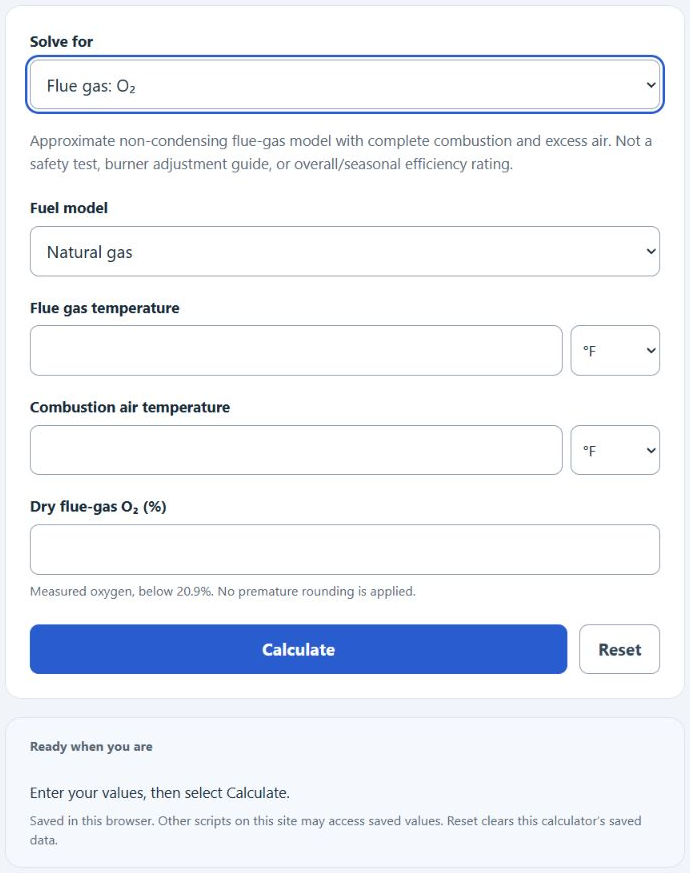
Choose a calculation for output/input efficiency, approximate non-condensing flue-gas efficiency, or annual fuel costs. Flue-gas estimates assume complete combustion with excess air and are not overall efficiency ratings or burner safety checks.
Related Calculators
- Hot Water Recovery Calculator
- 3 Phase Heater Amps Calculator
- Freezing Degree Days Calculator
- Load Percentage Calculator
- All Construction Calculators
Burner Efficiency Formula
The following formula is used to calculate the burner efficiency for a given heat output and fuel input.
Variables:
- η is the efficiency (%)
- Q is the heat output (BTU)
- F is the fuel input (BTU)
To calculate the burner efficiency, divide the heat output by the fuel input and multiply the result by 100 to get the percentage efficiency.
What is Burner Efficiency?
Burner efficiency is a measure of how effectively a burner converts fuel into heat. It is expressed as a percentage and indicates the proportion of the fuel's energy that is converted into usable heat. Higher efficiency means more of the fuel's energy is being used for heating, while lower efficiency indicates more energy is being wasted. Burner efficiency is crucial in various applications, including residential heating systems, industrial furnaces, and power generation, as it directly impacts fuel consumption and operating costs.
How to Calculate Burner Efficiency?
The following steps outline how to calculate the Burner Efficiency.
- First, determine the heat output (Q) in BTU.
- Next, determine the fuel input (F) in BTU.
- Finally, calculate the efficiency using the formula η = (Q / F) * 100.
- After inserting the values and calculating the result, check your answer with the calculator above.
Example Problem :
Use the following variables as an example problem to test your knowledge.
Heat Output (Q) = 50000 BTU
Fuel Input (F) = 60000 BTU
The output/input efficiency is approximately 83.33%. Use output and fuel energy over the same period and on the same heating-value basis.
Flue-gas estimates use generic fuel factors from the Testo Heating Field Guide (Appendix, pages 86–87), without condensation recovery or other loss corrections. CO₂-based estimates require independently confirmed excess-air operation. Cost comparisons hold useful heat demand and fuel price fixed, use overall annual efficiencies, and report cost increases when target efficiency is lower. Fuel heat-content assumptions use EIA sample conversion factors. Blank upgrade cost omits payback.