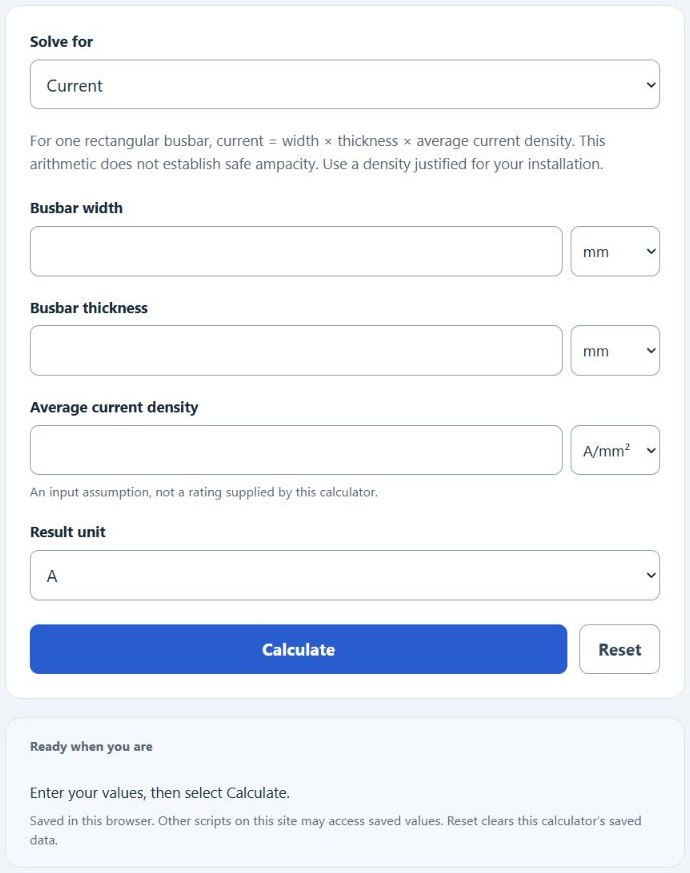
Choose current, width, thickness, or current density, then enter the three displayed inputs. Results describe one rectangular busbar under the entered density assumption; they do not establish safe ampacity.
- All Physics Calculators
- All Electrical Calculators
- Carrying Capacity Calculator
- Fusing Current Calculator
Busbar Current Formula
The busbar current calculator uses the cross-sectional area of a rectangular busbar and an average current density to estimate current capacity.
- I = busbar current, in amps
- W = busbar width
- T = busbar thickness
- J = average current density, such as amps/mm²
The calculator can also rearrange the same formula to solve for a missing value:
- Calculate busbar current: enter width, thickness, and average current density. The calculator multiplies them to estimate current.
- Calculate width: enter current, thickness, and average current density. The calculator finds the required width.
- Calculate thickness: enter current, width, and average current density. The calculator finds the required thickness.
- Calculate average current density: enter current, width, and thickness. The calculator finds the current density required for that busbar size.
Internally, width and thickness are converted to millimeters, current density is converted to amps/mm², and current is converted to amps before the calculation is made.
Current Density Selection
Current density is installation-specific. Use verified manufacturer or engineering data for the actual material, geometry, cooling and temperature limits; no universal current-density range is supplied here.
| Busbar material / condition | Selection basis | Notes |
|---|---|---|
| Copper busbar, conservative estimate | Verified thermal design data | Check the required temperature-rise limit. |
| Copper busbar, typical open-air estimate | Verified open-air rating data | Depends strongly on ventilation and spacing. |
| Aluminum busbar, conservative estimate | Verified aluminum design data | Lower conductivity than copper, so larger area is usually needed. |
| Aluminum busbar, typical open-air estimate | Verified open-air aluminum rating | Final sizing should be checked against applicable standards. |
Common Unit Conversions for Busbar Sizing
| Quantity | Conversion |
|---|---|
| 1 cm | 10 mm |
| 1 inch | 25.4 mm |
| 1 ft | 304.8 mm |
| 1 kA | 1000 amps |
| 1 A/mm² | 100 A/cm² |
Example Problems
Example 1: Calculate busbar current
You have a copper busbar that is 50 mm wide and 10 mm thick. The average current density is 1.6 A/mm².
The estimated busbar current is 800 amps.
Example 2: Calculate required width
You need to carry 1200 amps using a 10 mm thick busbar. The average current density is 1.5 A/mm².
The width under this assumed density is 80 mm; this is not a verified safe design.
FAQ
Is this busbar current result the final safe ampacity?
No. This result is an estimate based on cross-sectional area and average current density. Final busbar ampacity also depends on material, ambient temperature, enclosure type, ventilation, spacing, surface finish, temperature rise limit, and applicable electrical standards.
What current density should you enter?
Use a value supported by manufacturer ratings or an engineering thermal design for the actual installation. The reverse calculation I/(W×T) gives average current density, not an allowable limit. Copper Development Association ampacity data, for example, specify conditions such as temperature rise and surface emissivity rather than a universal density.
Why does increasing width or thickness increase current capacity?
Increasing width or thickness increases the busbar cross-sectional area. Since the formula is current = area × current density, a larger area can carry more current at the same current density.