The Food You Don’t Eat Could Cost a Family $2,913 a Year
EPA’s updated estimate turns uneaten food into an $8-a-day household cost—and shows why the heaviest waste is not always the most expensive.
By Patrick MyersPublished Data as of October 31, 2024The Number Behind the News
EPA estimates edible consumer food waste costs $728.14 per person per year—$2,912.56 for four average people. Calculator Academy rounded the headline to $2,913.Related calculations
Put the numbers to work
Explore calculators related to this story, or browse the full topic collection.
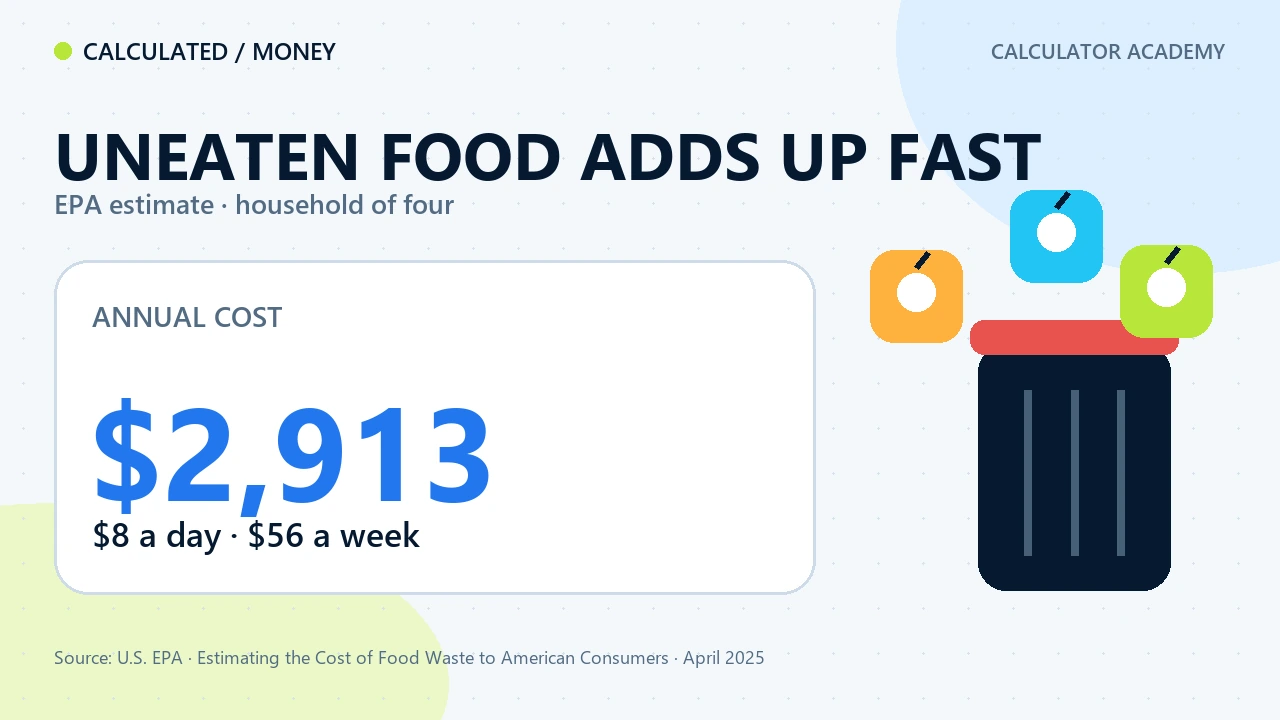
A navy and blue Calculator Academy graphic presents EPA’s updated estimate for edible food bought but never eaten. The dominant figure is $2,913 per year for four average people, with smaller equivalents of about $8 per day and $56 per week. The graphic labels the result as a national estimate rather than a household forecast.
Context
Why this matters
Food waste is easy to picture as a few forgotten leftovers. The updated national estimate is closer to a second bill hiding inside the food budget: roughly $8 every day for a household of four.
This is a national benchmark, not a prediction for one family. The useful question is how much of your own grocery spending disappears before anyone eats it.
At a glance
What the numbers show
EPA estimates $728.14 per person per year in edible food is bought but not eaten.
For four average people, that becomes $2,912.56 a year—about $242.71 a month or $56.01 a week.
The same model estimates 1,024.9 pounds of consumer food waste for four people.
Meat is the highest-cost category to waste, even though added sugar and sweeteners have the largest estimated wasted weight.
Watch the data story
Watch: What Uneaten Food Costs a Family of Four
EPA’s updated national estimate puts edible food bought but never eaten at about $728 per person each year—roughly $2,913 for four people.
What does uneaten food cost a family? The updated estimate starts small: about eight dollars a day. That becomes fifty-six dollars a week. The same model estimates nearly one thousand twenty-five pounds of food waste for four people in a year. Put the receipt together and the answer is two thousand nine hundred thirteen dollars every year—about eleven percent of total food spending. Track your own grocery baseline at Calculator Academy. National estimate; actual households vary.
A small daily leak becomes a large annual bill
Food waste rarely feels like a $2,913 decision. It looks like lettuce that wilted before dinner, leftovers nobody claimed, or ingredients bought for a plan that changed. EPA’s updated national estimate turns those small moments into one household-scale number: $2,912.56 a year for four average people.
The daily figure explains why the loss is so easy to miss. The estimate works out to $7.98 a day, $56.01 a week, or $242.71 a month. None of those amounts necessarily arrives as a separate charge. It is already buried inside grocery receipts and food-away-from-home spending.
EPA’s annual estimate for four average people, converted into monthly, weekly, and daily equivalents by Calculator Academy.
The most wasted food is not always the costliest
Weight and money tell two different stories. Added sugar and sweeteners lead the modeled waste by weight at 37 pounds per person per year. Meat leads by cost at $133.48 per person, followed by other dairy, processed fruit, fish and seafood, and fresh vegetables.
That distinction matters when the goal is to save money. Preventing one pound of a higher-priced food from being wasted can protect more of a household budget than saving the same weight of a cheaper ingredient.
The five highest modeled food-waste costs per person in EPA Table 2. Cost rank differs from rank by wasted weight.
What changed from the familiar $1,500 figure
EPA’s report updates a figure that had become common in food-waste campaigns: $1,500 a year for a family of four. That earlier estimate relied on 2010 prices. The new analysis combines USDA food-availability and loss data with 2023 retail prices and puts the comparable four-person figure at $2,913.
The increase does not mean every household suddenly wastes the same amount. It reflects a newer national model and newer prices. The practical use is as a benchmark: compare the estimate with your own grocery spending, then track the foods that are most often bought but never eaten.
Make the numbers yours
Change the inputs with a related Calculator Academy tool or inspect the underlying data.
We multiplied EPA’s per-person estimate of $728.14 by four. We divided the $2,912.56 result by 12, 52, and 365 for monthly, weekly, and daily equivalents. Category rankings reproduce EPA Table 2 values without changing them. The source describes its latest available inputs as running through October 2024; the template date is normalized to the end of that month and does not imply a daily observation.
Assumptions and limitations
This is a national model, not a forecast for a specific household. Actual waste varies with household size, income, age, shopping habits, restaurant use, and local prices. EPA scales its estimate proportionally, while real household waste may not scale linearly. The underlying USDA data include food for home use and food service, but EPA applies retail grocery prices, which may understate the cost of restaurant food. Only edible portions are counted.
Source values are cited from the U.S. EPA report. No source graphic is reproduced; Calculator Academy’s calculations and visuals are original deterministic renderings.