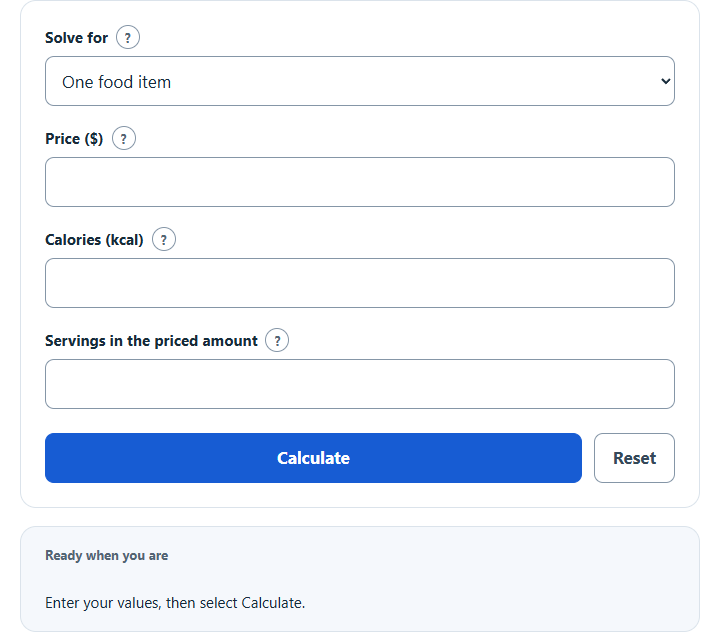
Calculate the price per calorie and cost per 100 calories of a food from its price and calories, or compare two foods to see which gives cheaper energy.
Related calorie calculators
- Steps To Calories Calculator
- Swimming Calories Calculator
- Maintenance Calories Calculator 2
- kJ To Calories Calculator
- Cost Per 100 Calories Calculator
- Calories Per Dollar Calculator
- Calories Per Hour Calculator
- Calorie Cost Calculator
- Calorie Calculator
- Calories To Grams Calculator
- Calories To Pounds Calculator
- Grams To Calories Calculator
- Wine Calories Calculator
- Coffee Calorie Calculator
- Cheat Day Calorie Calculator
- RDI Calories Calculator
- Percentage Of Calories Calculator
Calculator Functions
| Function | What it does | What it requires |
|---|---|---|
| One food item | Finds the cost per 100 calories, the cost per calorie and the calories per dollar of one food | Requires the price and the calories for the same package or portion. Servings in the priced amount is optional, for calories entered per serving |
| Compare two food items | Finds which of two foods costs less per calorie, and by what percent | Requires the price and the total calories of each item |
Prices are in dollars and calories are food calories (kcal). The price and the calories have to describe the same amount of food: the whole package, or one portion of it.
Calorie Cost Formulas
| C | Cost per 100 calories ($) |
| P | Price paid ($) |
| K | Total calories in the priced amount (kcal) |
One food item
K is the calories entered times the servings, or the calories alone when servings is blank. A $3.49 box with 12 servings of 150 kcal holds 1,800 kcal, so C = 3.49 ÷ 1,800 × 100 = $0.194 per 100 kcal. The same numbers give the cost per calorie, P ÷ K = $0.001939, and the calories per dollar, K ÷ P = 515.759 kcal. A free item costs nothing per calorie, and its calories per dollar has no value.
Compare two food items
Chigh) × 100
Each item gets its own cost per 100 calories, and the lower one is compared with the higher. Item A at $3.49 for 1,800 kcal costs $0.194 per 100 kcal. Item B at $4.99 for 2,000 kcal costs $0.25. A costs 1 − 0.1939 ÷ 0.2495 = 22.289% less per calorie.
Limits of This Estimate
- Price per calorie is only one way to price food. In a U.S. Department of Agriculture comparison, foods such as fruits and vegetables looked expensive per calorie, yet cost less than less healthy foods when priced by edible weight or by average portion [1].
- A lower cost per calorie says nothing about nutrients, dietary needs or weight management.
- Label calories are rounded, and the result is only as good as the match between the price and the calories entered.
Sources
- USDA Economic Research Service, Are Healthy Foods Really More Expensive? It Depends on How You Measure the Price (EIB-96): price of food energy as one of three price measures, and how the choice changes the comparison