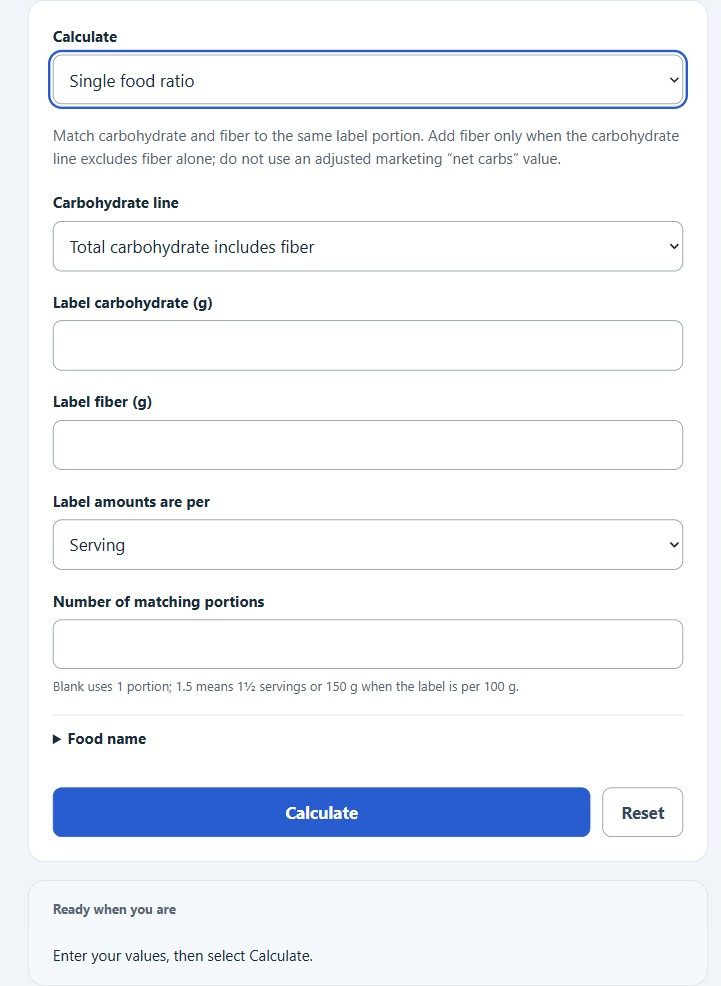
Calculate the carbohydrate-to-fiber ratio for a food, solve for missing carbs, fiber, or ratio, and combine two foods by serving or 100 g portions.
Disclaimer: This calculator is for informational purposes only and is not medical advice. If you have diabetes, gastrointestinal conditions (e.g., IBS), kidney disease, or take glucose-lowering medications, discuss dietary changes with a clinician or registered dietitian.
- All Food and Cooking Calculators
- Net Carbs Calculator
- Carbs Calculator (Carbohydrates per Day)
- %DV Calculator (Percent Daily Value)
Carbohydrate to Fiber Ratio Formula
The carbohydrate to fiber ratio compares total carbohydrates to dietary fiber. A smaller ratio means the food has more fiber relative to its carbohydrate content.
- CFR = carbohydrate to fiber ratio, written as CFR:1
- C = total carbohydrates used in grams
- F = fiber used in grams
If the nutrition label lists total carbohydrate that already includes fiber, the calculator uses the carbohydrate value as entered:
If the carbohydrate line excludes fibre alone, the calculator adds fibre back to reconstruct total carbohydrate. Do not use a marketed net-carb value that also subtracts sugar alcohols or other components:
For an amount greater than 1 serving or 1 portion, the calculator scales both carbohydrate and fiber before calculating the ratio:
- C_each = total carbohydrates per serving or per 100 g portion
- F_each = fiber per serving or per 100 g portion
- A = number of servings or 100 g portions
For the missing value mode, the same relationship is rearranged:
For combining two foods, the calculator adds the carbohydrates and fiber from both foods first, then calculates the combined ratio:
- C1 = total carbohydrates from food 1
- C2 = total carbohydrates from food 2
- F1 = fiber from food 1
- F2 = fiber from food 2
The single food mode calculates one food's ratio from label carbohydrate and fiber. The three missing-value solve modes each use the two known inputs to calculate total carbohydrate, fiber, or ratio. The combine foods mode totals two foods together so you can see the ratio for a meal or pairing, not just the separate ingredients.
Carbohydrate to Fiber Ratio Benchmarks
These are numerical comparisons. The 10:1 screen was studied in packaged grain foods, with 5:1 as a stricter comparison; neither determines overall food quality or medical suitability. Lower ratios mean more fiber relative to carbohydrate.
| Ratio result | Interpretation | What it means |
|---|---|---|
| 5:1 or lower | High fiber relative to carbohydrate | Meets both the 5:1 and 10:1 checks |
| More than 5:1 to 10:1 | Moderate fiber relative to carbohydrate | Meets the 10:1 check but not the 5:1 check |
| More than 10:1 | Lower fiber relative to carbohydrate | Does not meet the 10:1 check |
| Total carbohydrates | Fiber needed for 10:1 | Fiber needed for 5:1 |
|---|---|---|
| 20 g | 2 g | 4 g |
| 30 g | 3 g | 6 g |
| 40 g | 4 g | 8 g |
| 50 g | 5 g | 10 g |
Example Calculations
Example 1: Single food ratio
A food label shows 30 g total carbohydrate and 5 g fiber per serving.
The carbohydrate to fiber ratio is 6:1. It meets the 10:1 check but not the 5:1 check.
Example 2: Combined foods ratio
Food 1 has 20 g carbohydrate and 4 g fiber. Food 2 has 30 g carbohydrate and 2 g fiber.
The combined carbohydrate to fiber ratio is 8.33:1.
FAQ
What is a good carbohydrate to fiber ratio?
A ratio of 10:1 or lower has been studied as a screen for more favorable nutrient profiles in packaged grain foods; it is not a universal health verdict. A ratio of 5:1 or lower is stricter and means the food has more fiber for each gram of carbohydrate. For example, 30 g carbohydrate with 3 g fiber is 10:1, while 30 g carbohydrate with 6 g fiber is 5:1.
Should you use total carbohydrates or net carbohydrates?
Use total carbohydrates when the label includes fiber in the carbohydrate line. On many labels, total carbohydrate already includes fiber. If the label carbohydrate excludes fibre alone, add fibre back. Marketed net carbs may exclude other components, so adding fibre alone may not reconstruct total carbohydrate. The calculator has a label type option for this.
Why does the amount not always change the ratio?
If you multiply both carbohydrate and fiber by the same amount, the ratio stays the same. For example, 1 serving with 30 g carbohydrate and 5 g fiber is 6:1. Two servings have 60 g carbohydrate and 10 g fiber, which is still 6:1. Amount matters more when combining foods because each food may have a different ratio.