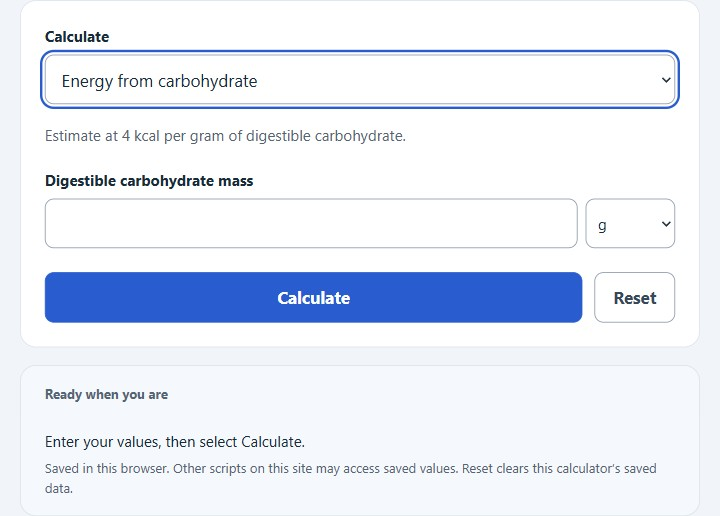
Convert carbs to calories and kJ at 4 kcal per gram of carbohydrate, or convert kcal or kJ back to grams of carbs, in grams or ounces.
- All Food and Cooking Calculators
- All Energy Calculators
- Protein to Energy Calculator
- Fat to Energy Calculator
Calculator Functions
| Function | What it does | What it requires |
|---|---|---|
| Energy from carbohydrate | Converts a mass of digestible carbohydrate to food energy in kcal and kJ | Requires the digestible carbohydrate mass in grams or ounces |
| Carbohydrate from energy | Converts an amount of energy that comes from carbohydrate back to grams and ounces of carbohydrate | Requires the energy from carbohydrate in kcal or kJ |
Both functions use 4 kcal per gram, 4.184 kJ per kcal and 28.349523125 g per ounce. The energy entered in Carbohydrate from energy is the part of a food’s energy that comes from carbohydrate, not its total calories.
Carbs to Energy Formula
| E | Energy from carbohydrate (kcal, the Calories shown on food labels) |
| C | Digestible carbohydrate (g) |
| 4 | General energy factor for carbohydrate, 4 kcal per gram |
The factor of 4 kcal per gram is the Atwater general factor for carbohydrate. Protein has the same factor and fat has 9 kcal per gram [1]. U.S. nutrition labels may calculate calories with these general factors of 4, 4 and 9, as of the April 1, 2024 edition of the labeling rule [2].
Energy from carbohydrate
The main formula applies directly: 50 g of carbohydrate supplies 4 × 50 = 200 kcal. The calculator multiplies by 4.184 to get kilojoules [1], so the same 50 g is 836.8 kJ and 1 g is 16.736 kJ. Tables that work in kilojoules usually round this to 17 kJ per gram [1]. A mass in ounces is converted to grams first, so 1 oz gives 113.4 kcal.
Carbohydrate from energy
This is the main formula rearranged: 200 kcal from carbohydrate corresponds to 200 ÷ 4 = 50 g, or 1.7637 oz. Energy in kilojoules is divided by 4.184 first, so 836.8 kJ also gives 50 g.
Limits of This Estimate
- The factor of 4 kcal per gram applies to digestible carbohydrate such as sugars and starch. Dietary fibre is assigned about 2 kcal per gram and sugar alcohols about 2.4 kcal per gram, so they need their own factors [1].
- When carbohydrate is measured directly and expressed as monosaccharide, the factor is 3.75 kcal (16 kJ) per gram instead of 4 [1].
- The result is the energy from carbohydrate alone. A mixed food also gets energy from protein, fat and alcohol.
- Label values are rounded and may use food-specific factors, so they can differ slightly from this result [2].
Sources
- Food and Agriculture Organization, Food energy: methods of analysis and conversion factors, Chapter 3: the 4 kcal per gram factor, the kJ conversion, and the factors for fibre, polyols and monosaccharide-equivalent carbohydrate
- U.S. Food and Drug Administration, 21 CFR 101.9, Nutrition labeling of food: general factors of 4, 4 and 9 calories per gram on U.S. labels