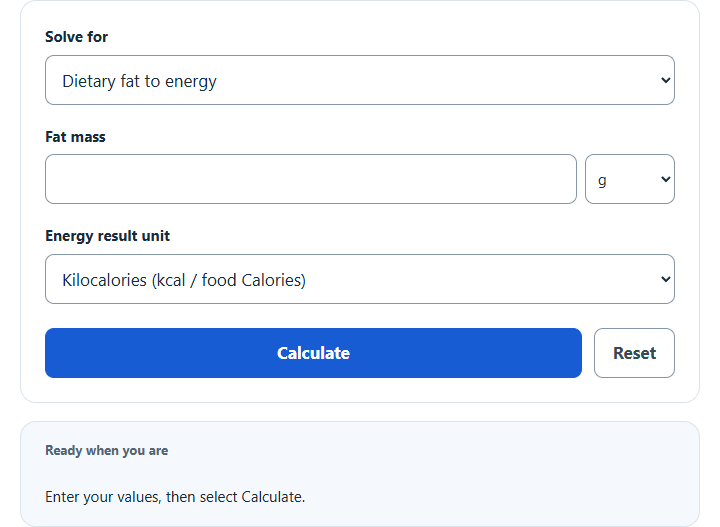
Convert grams of fat to calories at 9 kcal per gram, or to kJ or joules, work back from energy to grams of fat, or find the percent of calories from fat.
- All Food and Cooking Calculators
- All Energy Calculators
- Protein to Energy Calculator
- Carbs to Energy Calculator
- Protein to Energy Ratio Calculator
Energy from Fat Formula
The following equation uses the general dietary-fat factor of 9 kcal/g, described in FAO food-energy guidance. It estimates food energy, not body-weight change. Reverse mode divides energy by 9; percentage mode divides fat energy by the entered total food energy.
Variables:
- Where Ef is the Energy from Fat (kcal)
- F is dietary fat in grams (g); the stored-adipose mode instead uses the explicitly entered tissue factor
To calculate dietary-fat energy, multiply grams by 9 kcal/g. Stored-adipose mode multiplies tissue grams by its selected factor (illustrative default 7.7 kcal/g). These quantities are different; a fixed tissue-energy calculation does not predict weight loss, which depends on changing energy expenditure and body composition. See NIDDK’s Body Weight Planner information for the separate planning context.
| Grams of Fat (g) | Kilocalories (kcal) |
|---|---|
| 1 | 9 |
| 2 | 18 |
| 3 | 27 |
| 5 | 45 |
| 7 | 63 |
| 10 | 90 |
| 12 | 108 |
| 14 | 126 |
| 15 | 135 |
| 20 | 180 |
| 25 | 225 |
| 28 | 252 |
| 30 | 270 |
| 35 | 315 |
| 40 | 360 |
| 45 | 405 |
| 50 | 450 |
| 60 | 540 |
| 75 | 675 |
| 100 | 900 |
| *Assumes dietary fat provides 9 kcal per gram. For joules, multiply kcal by 4184 (1 kcal = 4184 J = 4.184 kJ; this table converts its kcal result rather than using the separately rounded 37 kJ/g labeling factor). | |
How to Calculate Energy from Fat?
The following two example problems outline the steps and information needed in order to calculate the Energy from Fat.
Example Problem #1:
- First, determine the total grams of fat (g). In this example, the total grams of fat (g) are measured to be 7.
- Finally, calculate the Energy from Fat using the formula above:
Ef = F * 9
Inserting the values from above and solving the equation with the input values gives:
Ef = 7 * 9 = 63 (kcal)
Example Problem #2:
Using the same process as example problem 1, we first define the needed variables outlined by the formula. In this case, the values are provided as:
total grams of fat (g) = 8
Entering these values into the formula or calculator above gives us:
Ef = 8 * 9 = 72 (kcal)