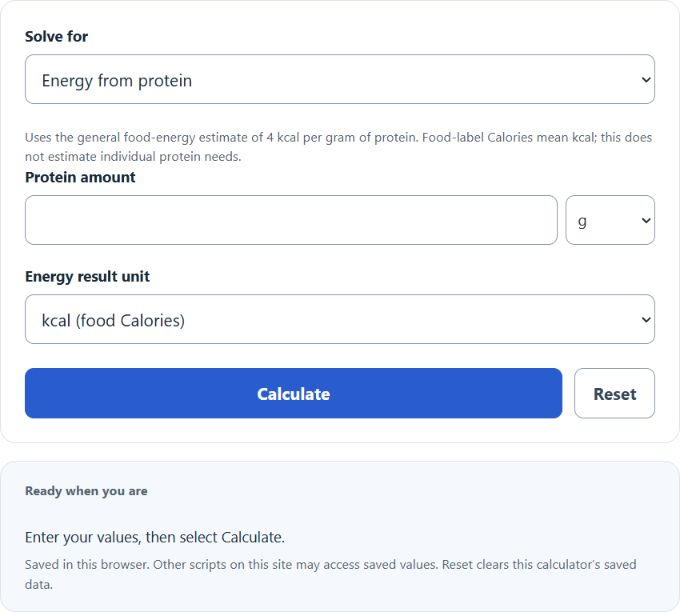
Select energy from protein, protein from its energy, or protein’s share of total energy. The estimate uses the general factor of 4 kcal per gram; food-label Calories mean kcal.
- All Health and Medical Calculators
- All Ratio Calculators
- Protein to Energy Calculator
- Fat to Energy Calculator
- Carbs to Energy Calculator
Protein to Energy Conversion Guide
This protein to energy ratio calculator converts a protein amount into the energy supplied by protein alone. It is useful for macro tracking, calorie budgeting, meal planning, and checking how much of a meal or diet’s calories come from protein.
Core Equations
E is energy from protein, P is protein in grams, and T is total calories from the meal or day. Use the percentage formula when you want a true protein-to-energy ratio instead of protein calories alone.
How to Use the Result
| If you know… | You can find… |
|---|---|
| Protein grams | Calories from protein |
| Calories from protein | Protein grams |
| Protein grams and total meal/day calories | Percent of calories coming from protein |
Protein to Energy Quick Reference
| Protein (g) | Energy (kcal) | Energy (kJ) |
|---|---|---|
| 10 | 40 | 167 |
| 20 | 80 | 335 |
| 25 | 100 | 418 |
| 30 | 120 | 502 |
| 40 | 160 | 669 |
| 50 | 200 | 837 |
| 75 | 300 | 1255 |
| 100 | 400 | 1674 |
Important: these values represent calories from protein only. If a food also contains fat or carbohydrate, its total calories will be higher.
Unit Conversion Shortcuts
-
Milligrams to grams
g = (mg) / (1000)
-
Kilograms to grams
g = 1000 × kg
-
Ounces to grams
g ≈ 28.35 × oz
-
Pounds to grams
g ≈ 453.59 × lb
Quick Checks
- 25 g protein = 100 kcal from protein.
- 50 g protein = 200 kcal from protein.
- 150 kcal from protein = 37.5 g of protein.
- 40 g protein in a 500 kcal meal provides 160 kcal from protein, which means protein supplies 32% of the meal’s calories.
Common Interpretation Mistakes
- Confusing grams of protein with calories from protein.
- Using protein calories as the total calorie value of a food.
- Calling it a “ratio” without comparing protein calories to total calories.
- Mixing kcal, kJ, mg, oz, lb, and kg without converting units first.
- Comparing food-label Calories to small-calorie units without checking the selected unit.