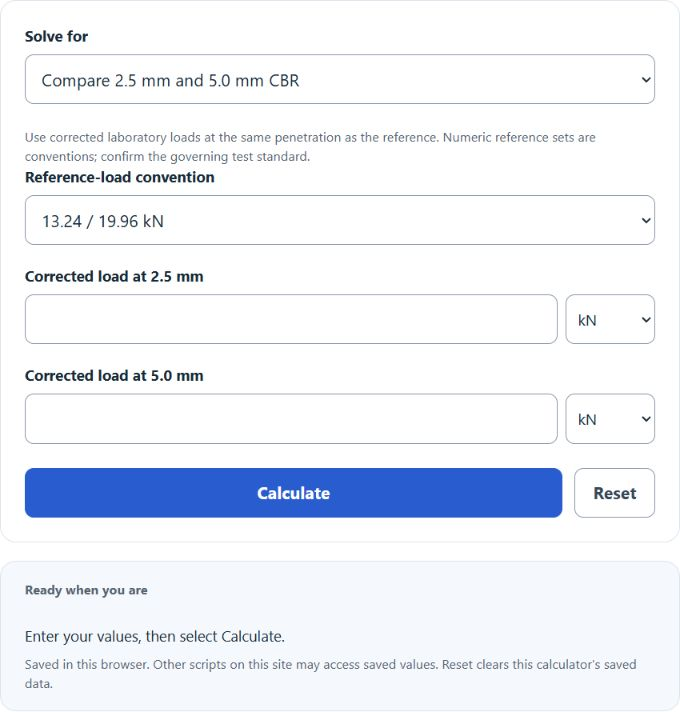
Calculate California Bearing Ratios at 2.5 mm and 5.0 mm from corrected loads, compare explicit reference conventions, or solve for a target load. Confirm reporting and retest rules with the governing standard.
Related Calculators
- Field Density Test Calculator
- Soil Triangle Calculator
- Bench Slope Calculator
- Dead Load Calculator
- All Construction Calculators
CBR Ratio Formula
The following formula is used to calculate the CBR ratio for a given unit load of a test sample and a standard sample.
Variables:
- CBR is the California Bearing Ratio (%)
- U_t is the corrected test load at the selected penetration
- U_s is the positive reference load at the same penetration, in the same units
To calculate the CBR ratio, divide the unit load of the test sample by the unit load of the standard sample and multiply the result by 100 to get the percentage.
What is a CBR Ratio?
The California Bearing Ratio (CBR) is a penetration test for evaluating the mechanical strength of natural ground, subgrades, and base courses beneath new carriageway construction. The test is performed by measuring the pressure required to penetrate a soil sample with a plunger of standard area. The CBR value is the ratio of the actual load causing the penetration to the standard load, expressed as a percentage. This ratio is used to determine the thickness of materials needed for the construction of roads and pavements.
How to Calculate CBR Ratio?
The following steps outline how to calculate the CBR Ratio.
- First, determine the unit load of the test sample (U_t).
- Next, determine the unit load of the standard sample (U_s).
- Next, calculate the CBR ratio using the formula CBR = (U_t / U_s) * 100.
- Finally, calculate the CBR Ratio.
- After inserting the values and calculating the result, check your answer with the calculator above.
Example Problem :
Use the following variables as an example problem to test your knowledge.
For an arithmetic example, choose One CBR ratio and Custom reference loads at 2.5 mm. Enter corrected test load U_t = 1,500 N.
Enter reference load U_s = 2,000 N. CBR = 1,500 / 2,000 × 100 = 75%. This custom example does not assert a standard reference load.