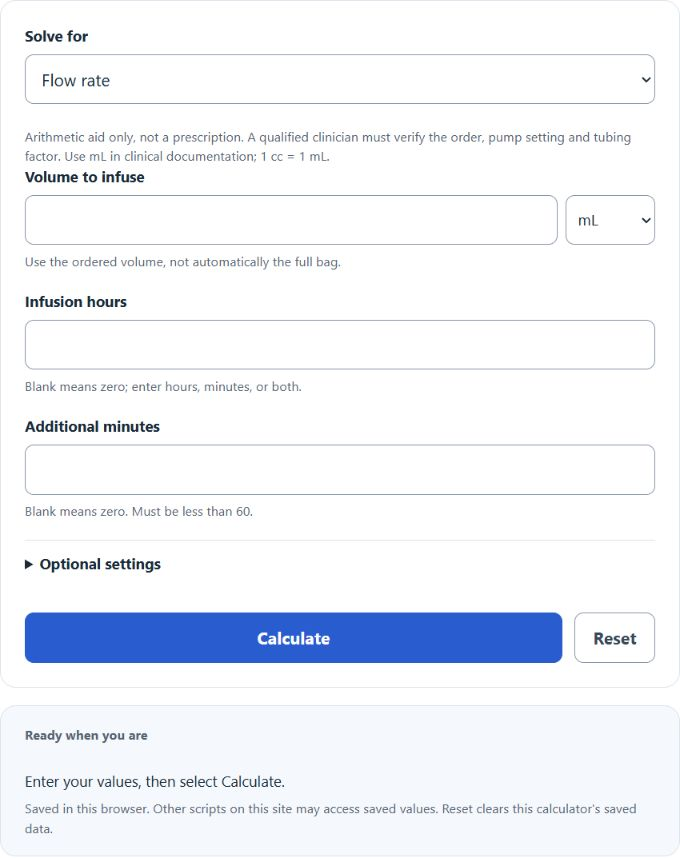
Calculate an IV flow rate in cc per hour, total infusion volume, or infusion time, with mL/hr equivalence and an optional gravity drip conversion.
Safety note: For educational purposes only; not medical advice. IV infusion settings must be verified by a licensed clinician/pharmacist using the prescriber’s order and your facility protocols (typically mL/hr) before administration. Do not use for self-treatment or emergencies.
mL Per Hour (mL/hr) Formula
Variables:
- mL/hr is the flow rate (milliliters per hour)
- mL is the total volume
- hr is the total time (in hours)
To calculate a flow rate, divide volume by time. Ensure the units match (e.g., mL and hours for mL/hr). This calculator can convert between common volume/time units automatically.
How to Calculate mL Per Hour?
The following steps outline how to calculate the mL Per Hour (mL/hr).
- First, determine the total volume (mL).
- Next, determine the total time (hr).
- Next, gather the formula from above: mL/hr = mL / hr.
- Finally, calculate the flow rate (mL/hr).
- After inserting the variables and calculating the result, check your answer with the calculator above.
Example Problem :
Use the following variables as an example problem to test your knowledge.
Total volume (mL) = 1000
Total time (hr) = 8
mL/hr = 1000 ÷ 8 = 125 mL/hr
FAQ
What is a milliliter (mL) and how does it relate to a cubic centimeter (cc)?
A milliliter (mL) is a metric unit of volume commonly used in healthcare. A cubic centimeter (cc) is equal to 1 mL; however, mL is generally preferred in clinical documentation to reduce confusion.
Why is measuring mL per hour important?
Measuring mL per hour is important in applications such as fluid delivery and medical infusions, where it helps express how much fluid is delivered over time.
Can I convert mL per hour to other units of flow rate?
Yes. For example, 1 mL/hr is equal to 0.001 L/hr. This calculator can convert between common units automatically.
How accurate do the total volume and total time measurements need to be?
The accuracy of the total volume and total time measurements directly affects the accuracy of the flow-rate calculation. Use precise measurements, especially in time-sensitive or safety-critical situations.