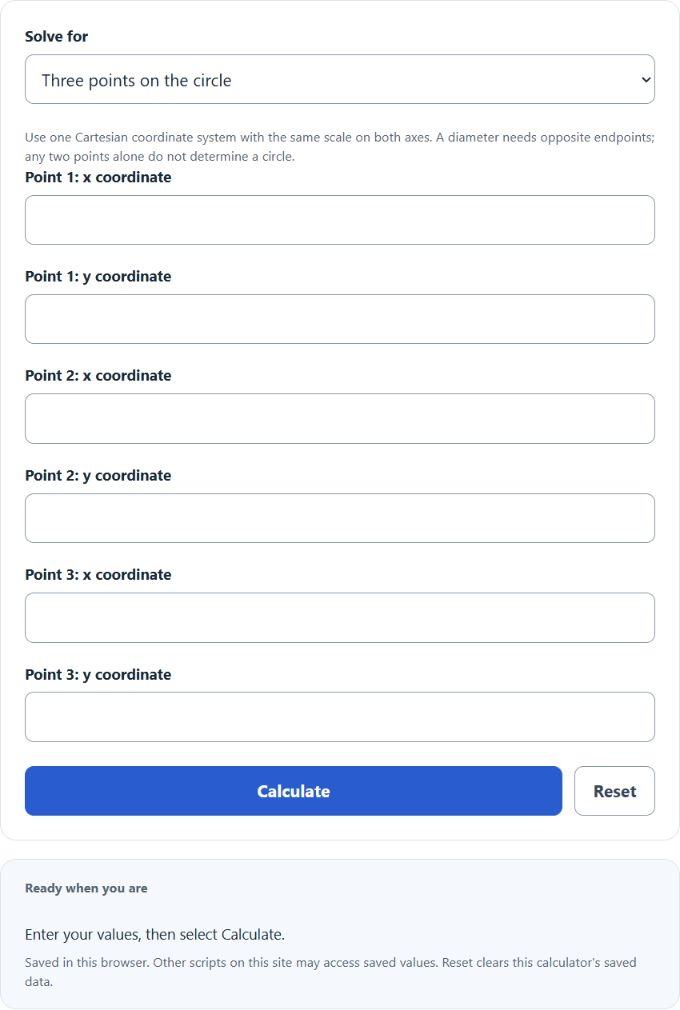
Find the center of a circle and its radius from three points on the circle, the two endpoints of a diameter, or the general equation’s coefficients.
- All Math and Numbers Calculators
- Circumference to Diameter Calculator | Find Diameter
- Circle Length Calculator
- Arc Height (sagitta) Calculator
- Circle Volume Calculator
- Circle Calculator
Calculator Functions
| Function | What it does | What it requires |
|---|---|---|
| Three points on the circle | Finds the center of the circle that passes through three points, along with its radius | Requires the x and y coordinates of three points that do not lie on one straight line |
| Two diameter endpoints | Finds the center as the midpoint of a diameter, with the radius as half its length | Requires the x and y coordinates of both ends of a diameter |
| General-equation coefficients | Finds the center and radius of a circle written as x² + y² + Dx + Ey + F = 0 | Requires the coefficients D, E and F |
Every function also lists the radius, diameter, circumference and area, and writes the circle in standard form and in general form. Coordinates can be negative or decimal, and every length comes out in the same units as the coordinates.
Center of a Circle Formulas
| h, k | Coordinates of the center |
| r | Radius |
| x, y | Any point on the circle |
Each function below finds h, k and r for this equation from a different set of known values. Circumference is 2πr and area is πr² [1].
Three points on the circle
k = y₁ + (Qa − Pc) ÷ (2d)
Here a = x₂ − x₁, b = y₂ − y₁, c = x₃ − x₁, e = y₃ − y₁, P = a² + b², Q = c² + e² and d = ae − bc. The center of a circle through three points is the circumcenter of the triangle they form, the point where the perpendicular bisectors of its sides meet [3], so it is the same distance from all three. Setting those distances equal gives two linear equations, and the two lines above are their solution. For (0, 0), (4, 0) and (0, 3): P = 16, Q = 9 and d = 12, so h = 48 ÷ 24 = 2 and k = 36 ÷ 24 = 1.5. The center is (2, 1.5) and the radius is 2.5.
Three points on one straight line give d = 0. No circle passes through them, and the calculator rejects them.
Two diameter endpoints
k = (y₁ + y₂) ÷ 2 [2]
The center is the midpoint of the diameter [2], and the radius is half the distance between its ends. For (3, 5) and (7, 9) the center is (5, 7) and the radius is √32 ÷ 2 = 2.8284. Two points fix the center only when they are opposite ends of a diameter. Through any other pair of points there are endlessly many circles, and a third point is needed.
General-equation coefficients
r = √(h² + k² − F) [1]
Completing the square turns x² + y² + Dx + Ey + F = 0 into the standard form above [1]. For x² + y² − 6x + 4y − 12 = 0, D = −6, E = 4 and F = −12, so the center is (3, −2) and r = √(9 + 4 + 12) = 5. If x² and y² carry a coefficient other than 1, divide the whole equation by it first. When h² + k² − F is zero or negative the equation does not describe a circle, and the calculator says so.
Limits of This Estimate
- Three points that are almost in a straight line put the center far away, and a tiny change in one coordinate moves it a long way. The calculator rejects points that are exactly or very nearly in line.
- The Two diameter endpoints function trusts that the two points really are opposite ends of a diameter. It cannot check that.
- Center coordinates are shown to 4 decimal places. The radius, area and equations are worked out from the unrounded values.
Sources
- Wolfram MathWorld, Circle: standard and general equations of a circle, center and radius from the coefficients, circumference and area
- Wolfram MathWorld, Midpoint: midpoint formula
- Wolfram MathWorld, Circumcircle: the circle through three points and its center