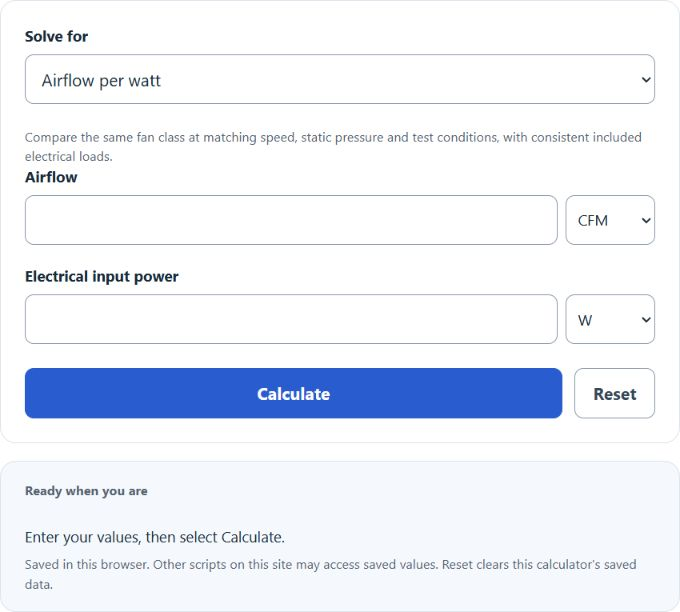
Calculate airflow efficacy in CFM per watt from fan airflow and electrical input power, or reverse-solve airflow or watts with CFM, m³/h, and L/s units.
Related Calculators
- Air Usage Calculator
- Chiller Approach Temperature Calculator
- Return Air Duct Size Calculator
- Condenser Efficiency Calculator
- All Construction Calculators
CFM Per Watt Formula
CFM per watt measures airflow efficacy. It tells you how many cubic feet of air a fan moves per minute for each watt of electricity it uses.
- E = airflow efficacy in CFM per watt, or CFM/W
- CFM = airflow in cubic feet per minute
- W = power draw in watts
The calculator has three functions:
- Airflow Efficacy: divides airflow by power draw to find CFM/W.
- Find Airflow: multiplies efficiency by watts to estimate CFM.
- Find Watts: divides airflow by efficiency to estimate required watts.
Airflow inputs may use CFM, cubic meters per hour (m³/h), or liters per second (L/s); metric inputs are converted to CFM before the calculation. If you enter power in kilowatts, it is converted to watts before the calculation.
Comparing CFM Per Watt
There is no universal good or excellent CFM/W range across all fan types. Compare the same fan class at matching speed, static pressure, test method and operating conditions. Use a consistent electrical-power boundary, including or excluding auxiliary loads in the same way. A ratio alone does not establish installed performance or suitable airflow.
Common Unit Conversions
| Conversion | Formula |
|---|---|
| Cubic meters per hour to CFM | CFM = m³/h ÷ 1.69901079552 |
| Liters per second to CFM | CFM = L/s ÷ 0.4719474432 |
| Kilowatts to watts | W = kW × 1000 |
| Watts to kilowatts | kW = W ÷ 1000 |
Example Calculations
Example 1: Find CFM per watt
A fan moves 300 CFM and uses 45 watts.
The airflow efficacy is 6.67 CFM/W.
Example 2: Find watts from airflow and efficiency
You want 500 CFM from a fan rated at 8 CFM/W.
The estimated power draw is 62.5 watts.
FAQ
What is a good CFM per watt?
A useful comparison depends on fan class, speed, static pressure and test method. Compare manufacturer data under matching conditions and with consistent included loads; a single numerical grade cannot cover all fans.
Is higher CFM per watt always better?
Higher CFM/W indicates more airflow per watt under the stated test conditions. It does not by itself guarantee better installed performance. You should also consider noise, room size, static pressure, installation type, and whether the airflow rating matches the speed setting you plan to use.
Why does fan efficiency change by speed setting?
Many fans use power less efficiently at some speeds than others. A lower speed may use much less power, but it also moves less air. The CFM/W value should be calculated using airflow and wattage from the same speed setting.