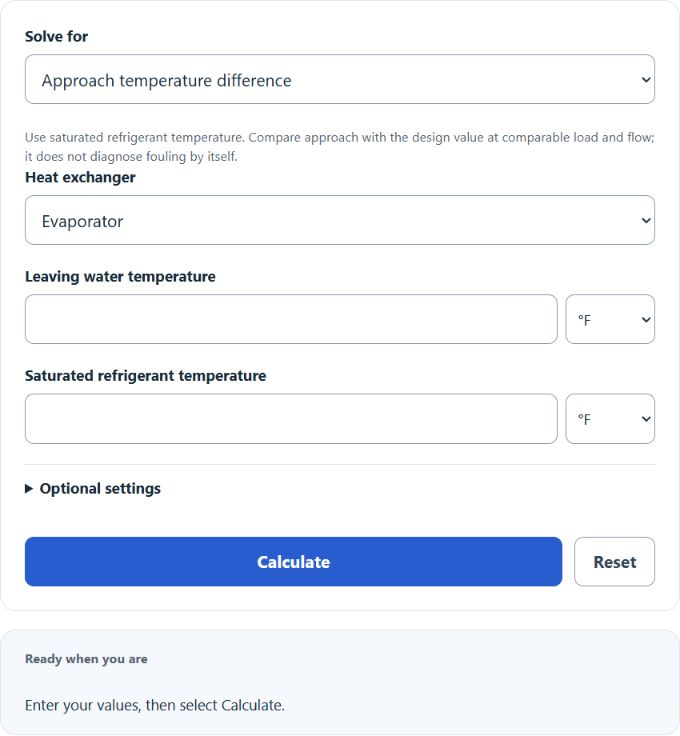
Calculate chiller approach temperature for the evaporator or condenser from leaving water and saturated refrigerant temperatures, or solve either one.
Related Calculators
- Condensate Flow Rate Calculator
- Face Velocity Calculator
- Sol-Air Temperature Calculator
- Soil Temperature Calculator
- All Construction Calculators
Calculator Functions
| Function | What it does | What it requires |
|---|---|---|
| Approach temperature difference | Finds the evaporator or condenser approach | Requires the heat exchanger, the leaving water temperature and the saturated refrigerant temperature |
| Leaving water temperature | Finds the leaving water temperature that goes with an approach | Requires the heat exchanger, the saturated refrigerant temperature and the approach |
| Saturated refrigerant temperature | Finds the saturated refrigerant temperature that goes with an approach | Requires the heat exchanger, the leaving water temperature and the approach |
Temperatures are entered in °F, °C or K and the approach as a difference in Δ°F, Δ°C or K. The heat exchanger setting, Evaporator or Condenser, decides which way the subtraction runs. An optional design or measured baseline adds the gap between the result and that baseline. Every result lists the approach, the leaving water temperature and the saturated refrigerant temperature in all units.
Chiller Approach Formulas
| A | Evaporator approach, a temperature difference |
| Tw | Leaving chilled water temperature |
| Tr | Saturated refrigerant temperature in the evaporator |
Approach is the gap between the water leaving a heat exchanger and the refrigerant inside it. The closer the two temperatures, the better the heat transfer [1]. A difference converts differently from a temperature reading: 1 Δ°C is 1 K and 1.8 Δ°F, with no 32 added.
Evaporator Approach Formula
In the evaporator the water is warmer than the refrigerant, so the approach is leaving chilled water minus saturated evaporating temperature. Chilled water leaving at 44 °F over refrigerant at 42 °F is a 2 Δ°F approach. In metric units, 7 °C over 2 °C is 5 Δ°C, which is 9 Δ°F.
Condenser Approach Formula
In the condenser the refrigerant is warmer than the water, so the order reverses: saturated condensing temperature minus leaving condenser water temperature. Refrigerant condensing at 97 °F with water leaving at 95 °F is a 2 Δ°F approach.
Approach temperature difference
This applies the evaporator or the condenser formula, depending on the heat exchanger selected. Temperatures that would give a negative approach are rejected, since that usually means the wrong exchanger or a reading that is not a saturated temperature. With a baseline of 1.5 Δ°F, a 2 Δ°F result is reported as 0.5 Δ°F above it.
Leaving water temperature
An evaporator at 42 °F saturated with a 2 Δ°F approach has chilled water leaving at 44 °F.
Saturated refrigerant temperature
A condenser with water leaving at 95 °F and a 2 Δ°F approach has refrigerant condensing at 97 °F.
How to Calculate Chiller Approach
Read the leaving water temperature and the refrigerant saturation temperature for the same heat exchanger, then subtract the lower from the higher: water minus refrigerant for the evaporator, refrigerant minus water for the condenser. Most later centrifugal and screw chillers show both approach temperatures on the control panel. Take the readings with the chiller near full load, because values taken below about 85% load may not reflect the condition of the tubes, and compare the result with the startup data for that chiller [1].
Limits of This Estimate
- A normal approach depends on the machine. One water treatment bulletin gives under 5 °F for chillers built before 1985 and 0.6 to 2.0 °F for newer chillers with high-efficiency tubes [1].
- A rising approach points to reduced heat transfer but does not name the cause. Fouled tubes, air or other non-condensable gas, low refrigerant charge, cooling tower problems and wrong water flow can each raise it [1].
- Approach changes with load, water temperature, flow and refrigerant charge [1], so a comparison only means something at similar operating conditions.
- The refrigerant temperature has to be the saturation temperature. A suction line or liquid line temperature includes superheat or subcooling and gives a wrong approach.
Sources
- Chem-Aqua, Technical Bulletin 2-048: Importance of Monitoring Chiller Approach Temperatures: the evaporator and condenser approach definitions, typical values, causes of a high approach and when to take readings