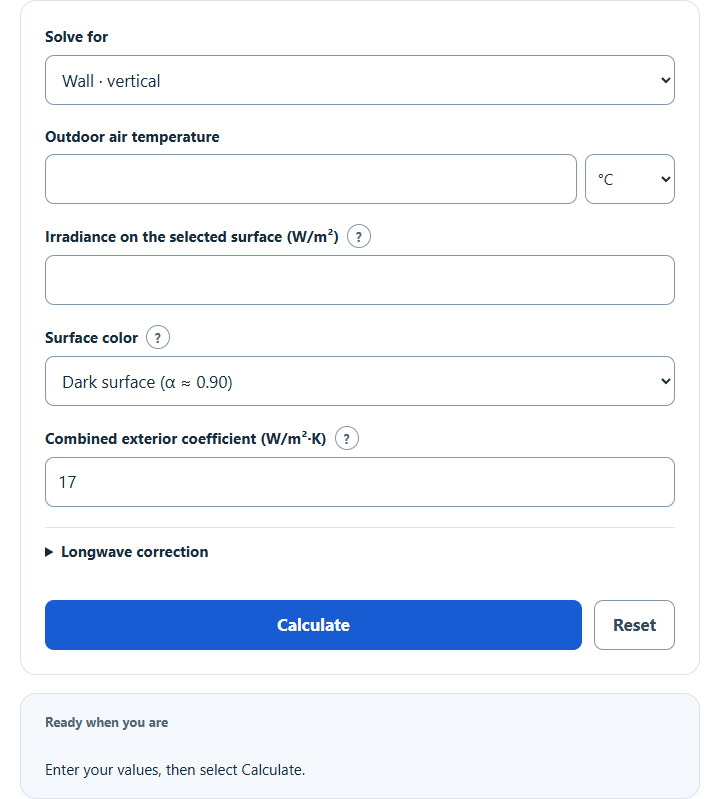
Calculate sol-air temperature for a wall or roof from outdoor air temperature and solar irradiance, using ASHRAE typical values or your own surface data.
- All Construction Calculators
- All Temperature Calculators
- Mixed Air Temperature Calculator
- Compressed Air Temperature Calculator
Calculator Functions
| Function | What it does | What it requires |
|---|---|---|
| Wall · vertical | Finds the sol-air temperature of a sunlit wall, with no longwave correction unless one is entered | Requires the outdoor air temperature, the solar irradiance on the wall, the surface color or absorptivity and the combined exterior coefficient |
| Roof · horizontal | Finds the sol-air temperature of a sunlit roof, subtracting a 3.9 K longwave correction unless a different one is entered | Requires the outdoor air temperature, the solar irradiance on the roof, the surface color or absorptivity and the combined exterior coefficient |
Air temperature can be entered in °C, °F or K, and the result is given in all three. Surface color is dark (absorptivity 0.90), light (0.45) or a custom absorptivity from 0 to 1. The combined exterior coefficient starts at 17 W/m²·K. A longwave correction ΔR in W/m² is optional and replaces the built-in wall or roof value.
Sol-Air Temperature Formulas
| Tsa | Sol-air temperature (°C) |
| To | Outdoor air temperature (°C) |
| α | Solar absorptivity of the surface, from 0 to 1 |
| I | Total solar irradiance striking the surface (W/m²) |
| ΔR | Longwave correction (W/m²): the extra heat the surface radiates to the sky. Positive values lower the result |
| h | Combined exterior coefficient for convection and longwave radiation (W/m²·K) |
Sol-air temperature is the outdoor air temperature that, with no radiation at all, would drive the same heat into the surface as the real mix of sunshine, sky radiation and outdoor air [1]. The handbook writes the correction as ε × ΔR, where ε is the emittance of the surface, and takes ε as 1 [1]; the calculator does the same. Its design value for h is 17 W/m²·K. It gives α ÷ h as 0.026 for a light-colored surface and 0.052 as the usual maximum for a dark one [1], which at h = 17 are the 0.45 and 0.90 offered here.
Wall · vertical
ΔR is taken as 0. A wall also receives longwave radiation from the ground and nearby buildings, which roughly offsets what it loses to the sky, so common practice is to drop the term for vertical surfaces [1]. A dark wall in 30 °C air under 600 W/m² has a sol-air temperature of 30 + 0.90 × 600 ÷ 17 = 61.8 °C.
Roof · horizontal
A roof faces the sky only, so the correction stays. For horizontal surfaces the handbook gives ΔR of about 63 W/m², a correction of about 4 K at h = 17, and its inch-pound edition gives the same correction as 7 °F, which is 3.9 K [1]. The calculator subtracts 3.9 K, which at h = 17 is a ΔR of 66.3 W/m². A dark roof in 30 °C air under 800 W/m² comes to 30 + (0.90 × 800 − 66.3) ÷ 17 = 68.5 °C.
Limits of This Estimate
- Sol-air temperature is an equivalent air temperature for heat-flow calculations. It is not the temperature of the surface itself and says nothing about whether the surface is safe to touch.
- The 17 W/m²·K coefficient, the two absorptivities and the roof correction are design conventions for cooling-load work [1]. Wind, surface finish and a clear or cloudy sky all change the real values.
- The irradiance has to be the total striking that wall or roof, not the figure for a horizontal surface or for a surface facing the sun directly, unless the surface is one of those.
Sources
- ASHRAE, 2021 ASHRAE Handbook—Fundamentals (SI), Chapter 18, Nonresidential Cooling and Heating Load Calculations: the sol-air temperature equation, the 17 W/m²·K coefficient, the α ÷ h values and the longwave correction for walls and roofs