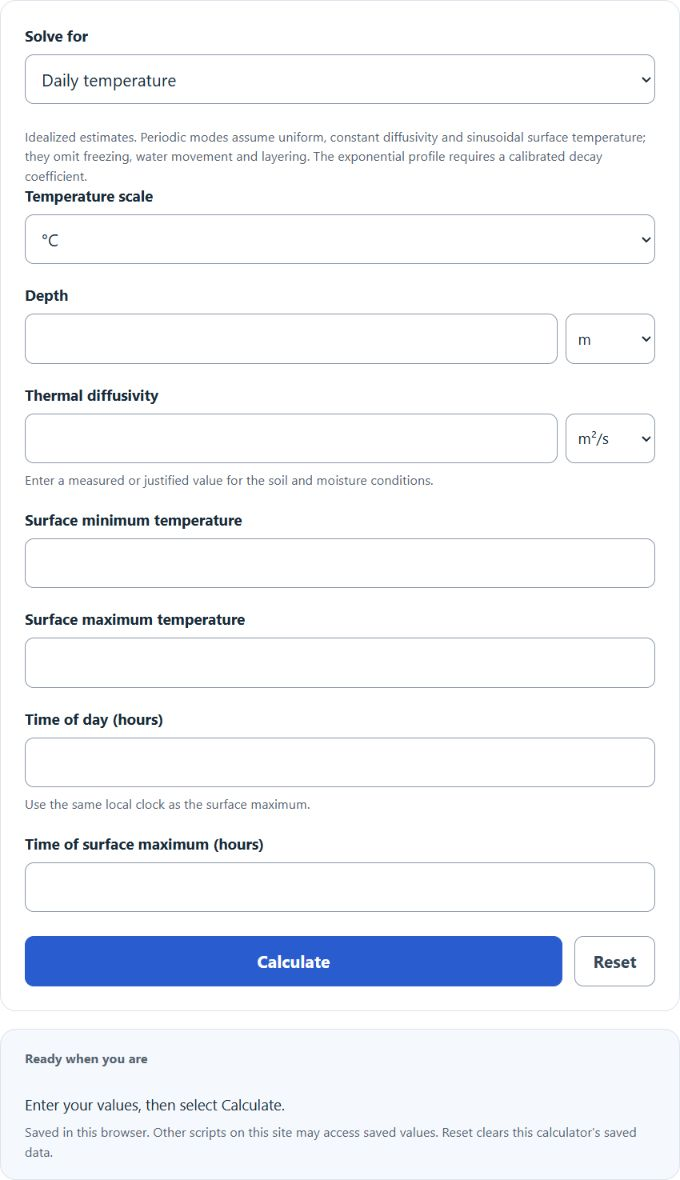
Calculate soil temperature by depth, daily or seasonal variation, and damping depth or time lag from thermal diffusivity and surface temperatures.
Related Calculators
- Soil Calculator
- Soil Volume Calculator
- Fill Dirt Calculator
- Pavement Temperature Calculator
- Degree Day Calculator
- Liquid Limit Calculator
- Swell Factor Calculator
- All Construction Calculators
Soil Temperature Formula
The following equation is used to calculate the soil temperature.
- Where T_soil is the soil temperature (°C)
- T_surface is the surface temperature (°C)
- Depth is the depth in meters (m)
Choose the quantity to solve and enter the other required values. Depth is in meters in the profile formula; Td and k must be supplied for the site.
What is a Soil Temperature Calculator?
Definition:
A Soil Temperature Calculator estimates daily or seasonal temperatures using an idealized periodic conduction model, or evaluates a separately calibrated exponential depth profile. The latter uses a user-supplied deep reference temperature Td and decay coefficient k; 10°C and k = 1/m are example values only.
How to Calculate Soil Temperature?
Example Problem:
The following example outlines the steps and information needed to calculate the soil temperature parameter.
First, determine the surface temperature. In this example, the surface temperature is 25°C.
Next, determine the depth. In this example, the depth is 2 meters, Td = 10°C and k = 1/m.
Finally, calculate the soil temperature using the formula above:
T_soil = Td + (T_surface - Td)*exp(-k*Depth)
T_soil = 10 + (25 - 10)*exp(-2)
T_soil ≈ 12.03 °C
FAQ
What factors can affect soil temperature readings?
Soil temperature can be influenced by factors such as soil composition, moisture levels, vegetation cover, and the time of day. These factors affect temperature changes, attenuation and phase lag with depth.
Why is a constant deep soil temperature of 10°C used in the calculation?
10°C is used only in the worked example. Enter a deep reference appropriate to the site; it is not a universal soil temperature.
Can this calculator be applied to all soil types?
While the calculator uses a simplified exponential decay model for estimation, actual soil temperatures may vary depending on soil type, structure, and moisture. For more precise results, a more detailed analysis might be necessary.