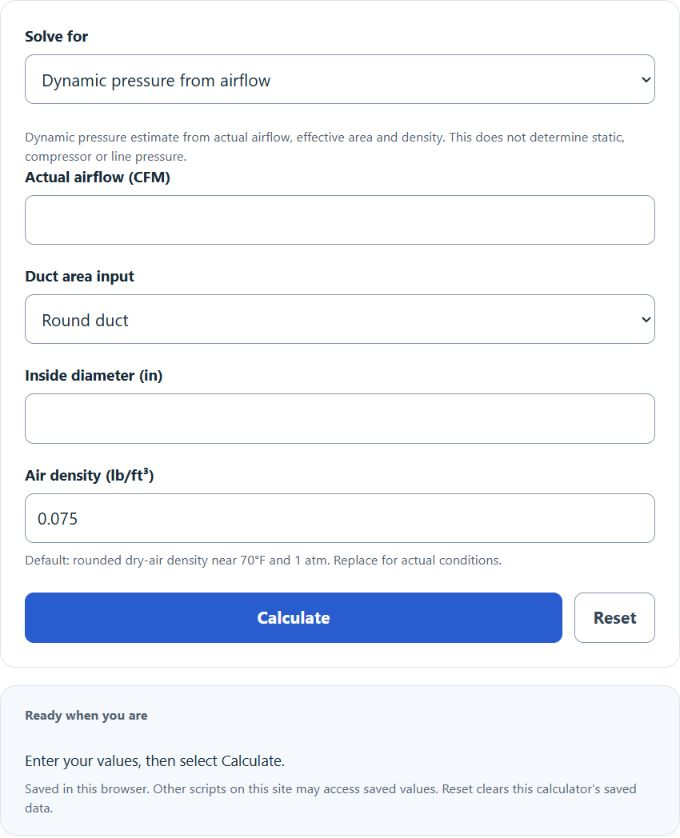
Estimate airflow dynamic pressure from CFM using duct size and air density. Get PSI, in. w.g., and Pa results with formulas and worked examples.
- All Unit Converters
- LB/HR ↔ SCFM Calculator
- Pressure to Head Calculator
- Voltage to Pressure Calculator
- kg/h to m3/min Converter
CFM to PSI Formula
The following formula is used to estimate the dynamic pressure in PSI from airflow in CFM and duct cross-sectional area.
V = CFM ÷ A × 0.3048 ÷ 60, then q = ½ρV² and PSI = q ÷ 6894.757293168. Here V is in m/s, ρ is in kg/m³, and q is in Pa.
Variables:
- q is dynamic pressure in Pa; divide by 6894.757293168 to express it in PSI.
- CFM is the airflow in cubic feet per minute
- A is effective duct cross-sectional area in square feet; ρ is the actual air density in kg/m³.
Divide actual airflow by effective area to find average velocity in ft/min, then multiply by 0.3048/60 for m/s. Convert density from lb/ft³ to kg/m³ by multiplying by 0.45359237/0.028316846592. Calculate q = ½ρV² in Pa and divide by 6894.757293168 for PSI. The familiar (velocity in ft/min ÷ 4005)² inH₂O relation is a rounded standard-air approximation; the calculator uses the entered density directly.
What is CFM to PSI Conversion?
CFM and PSI are different physical quantities. CFM measures volumetric airflow, while PSI measures pressure. Because of this, there is no single direct conversion factor between them. Instead, the conversion must be estimated using fluid-dynamic relationships that depend on airflow velocity, duct area, and air density. In HVAC applications, this typically means converting the airflow into velocity and then estimating the resulting dynamic or velocity pressure.
This converter estimates dynamic pressure only. It does not calculate compressor discharge pressure, line pressure, or total static pressure. The result is most useful for understanding how airflow and duct size affect air velocity and pressure behavior in ducts.
How to Calculate CFM to PSI?
The following steps outline how to estimate PSI from CFM for airflow in a duct.
- First, determine the airflow rate in cubic feet per minute (CFM).
- Next, determine the duct cross-sectional area in square feet (A).
- Calculate the average air velocity using V = CFM ÷ A.
- Convert velocity to m/s and density to kg/m³, then calculate q = ½ρV² in Pa.
- Divide q by 6894.757293168 to obtain PSI. For in. w.g., divide q by 249.08891.
- After inserting the values and calculating the result, check your answer with the converter above.
CFM to PSI Conversion Table (1000 CFM Examples)
The table shows dynamic pressure for 1000 actual CFM at a rounded reference density of 0.075 lb/ft³ (about 1.201385 kg/m³). Values are rounded to four decimal places.
| Duct Area | Velocity (ft/min) | Estimated Pressure (PSI) |
|---|---|---|
| 0.25 ft² (≈ 6.77 in round) | 4000 | 0.0360 |
| 0.5 ft² (≈ 9.57 in round) | 2000 | 0.0090 |
| 1.0 ft² (≈ 12 × 12 in) | 1000 | 0.0022 |
| 2.0 ft² (12 × 24 in) | 500 | 0.0006 |
These values represent velocity pressure only, which is usually much smaller than compressor pressure or many static pressure values in a system. Even so, this relationship is very useful when estimating duct performance, fan behavior, and airflow effects.
Example Problem :
Use the following variables as an example problem to test your knowledge.
Airflow (CFM) = 1000
Duct Area (A) = 1.0 ft²
Velocity (V) = 1000 ft/min
At 0.075 lb/ft³, q = ½ × 1.201384753 × 5.08² ≈ 15.501708 Pa ≈ 0.00224833 PSI, or 0.0022 PSI rounded to four decimal places.