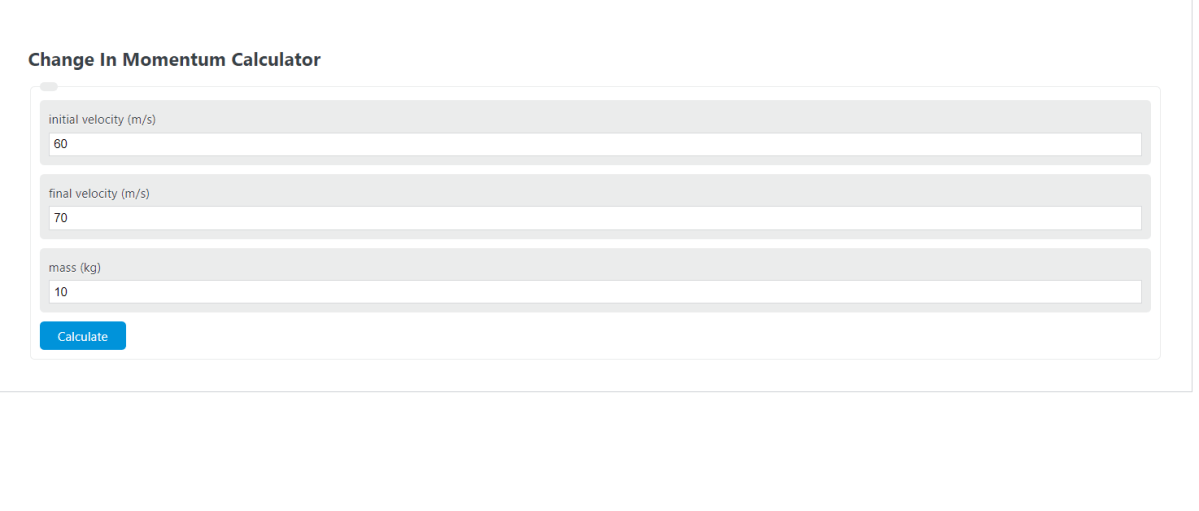
Calculate change in momentum from mass and velocities, force × time, or p2 − p1, with impulse and direction shown in kg·m/s and N·s.
- All Momentum Calculators
- All Physics Calculators
- Conservation of Momentum Calculator (Final Velocity)
- Total Momentum Calculator
Change in Momentum Formula
The calculator uses three equivalent forms of the same physics relationship. Pick the one that matches the inputs you have.
- Δp — change in momentum, in kg·m/s (equivalent to N·s)
- m — mass of the object, in kg
- v₁, v₂ — initial and final velocities, in m/s
- F — average net force during the interval, in N
- Δt — duration the force is applied, in s
- p₁, p₂ — initial and final momentum, in kg·m/s
The three calculator modes map to those three formulas:
- Mass + velocities uses Δp = m(v₂ − v₁). Enter mass and both speeds; sign of each velocity sets direction.
- Force × time uses Δp = F·Δt (the impulse-momentum theorem). Add an optional mass and you also get Δv = Δp/m.
- p₂ − p₁ uses Δp = p₂ − p₁ when you already know the momentum values directly.
Reference Values and Unit Conversions
Use these for sanity checks and for converting answers between unit systems.
| Unit | Equivalent in kg·m/s |
|---|---|
| 1 N·s | 1 kg·m/s |
| 1 g·m/s | 0.001 kg·m/s |
| 1 lb·ft/s | 0.13826 kg·m/s |
| 1 slug·ft/s | 4.4482 kg·m/s |
| 1 lbf·s | 4.4482 kg·m/s |
| Scenario | Typical Δp (kg·m/s) |
|---|---|
| Tennis ball returned at the net (0.058 kg, 25 m/s reversed) | ~2.9 |
| Baseball hit back to pitcher (0.145 kg, 40 m/s to −45 m/s) | ~12.3 |
| Soccer ball kicked from rest (0.43 kg, 0 to 25 m/s) | ~10.8 |
| Car braking to stop (1500 kg, 20 m/s to 0) | 30,000 |
| Rifle bullet leaving barrel (0.01 kg, 0 to 800 m/s) | 8 |
Worked Examples and FAQ
Example 1. A 0.16 kg hockey puck moving at 2.5 m/s is stopped by a goalie’s glove. Using mass and velocities: Δp = 0.16 × (0 − 2.5) = −0.40 kg·m/s. The negative sign shows the impulse acted opposite the puck’s motion.
Example 2. A bumper applies an average force of 800 N for 0.12 s on a cart. Using force and time: Δp = 800 × 0.12 = 96 N·s = 96 kg·m/s. If the cart’s mass is 40 kg, then Δv = 96 / 40 = 2.4 m/s.
Is impulse the same as change in momentum? Yes, numerically. The impulse-momentum theorem states J = FΔt = Δp, so 1 N·s equals 1 kg·m/s.
Why does the answer come out negative? Velocity and force have direction. If the final velocity is smaller than the initial (or points the other way), Δp is negative. The sign tells you which direction the net impulse acted.
Do I need SI units? No. Pick any unit from each dropdown. The calculator converts to SI internally and reports Δp in kg·m/s, N·s, lb·ft/s, and lbf·s.
What if the force is not constant? Use the average force over the interval. Δp = F_avg × Δt still gives the correct total change in momentum, even when the actual force varies.