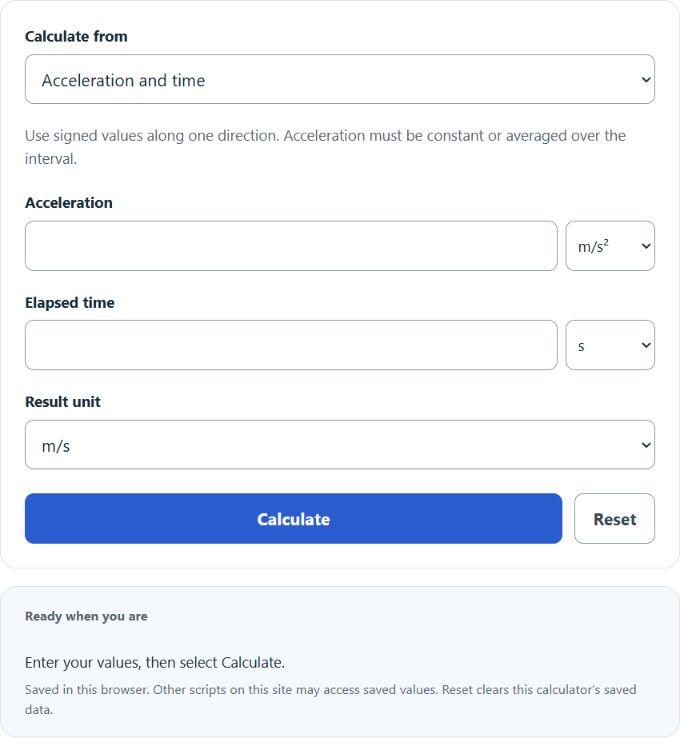
Calculate change in velocity with Δv = final − initial velocity or Δv = acceleration × time, or from impulse or net force and mass, in m/s, km/h or mph.
- All Physics Calculators
- All Velocity Calculators
- Acceleration to Velocity Calculator
- Constant Velocity Calculator
Change in Velocity Formula
The following equation is used to calculate the Change in Velocity.
- Where ΔV is the change in velocity (m/s)
- a is the constant or interval-average acceleration (m/s^2)
- ΔT is the nonnegative elapsed time (s)
For constant or interval-average acceleration, multiply elapsed time by acceleration. The other modes use Δv = final velocity − initial velocity, Δv = net impulse / mass, or Δv = average net force × elapsed time / mass; impulse and force methods assume constant positive mass.
Magnitude of a vector change in velocity
When the initial and final velocities point in different directions, choose Two velocities at an angle. Enter both nonnegative speeds and the smaller angle θ between their directions, from 0° to 180°. The magnitude is |Δv| = √(vi² + vf² − 2vivf cos θ). This differs from the signed change in speed, vf − vi.
For uniform circular motion, enter the same speed v for both values. The expression becomes |Δv| = 2v sin(θ/2): speed stays constant while velocity changes direction. For a swept angle larger than 180°, use the smaller angle between the endpoint velocity directions (reduce full turns first). The direction result is measured from the initial direction toward the final velocity. It is undefined when the change is zero or the initial speed is zero.
What is a Change in Velocity?
Definition:
Velocity is directional. The acceleration, initial/final velocity, impulse and force modes find a signed one-dimensional change using the same axis and reference frame for all values. A negative change is toward the negative direction and does not necessarily mean a decrease in speed. The angle mode instead finds the magnitude of the vector change between two directions.
How to Calculate Change in Velocity?
Example Problem:
The following example outlines the steps and information needed to calculate Change in Velocity.
First, determine the acceleration. In this example, the acceleration is found to be 150 m/s^2.
Next, determine the change in time. For this problem, the time is found to be 10 s.
Finally, calculate the Change in Velocity using the formula above:
ΔV = a * ΔT
ΔV = 150*10
ΔV = 1,500 m/s