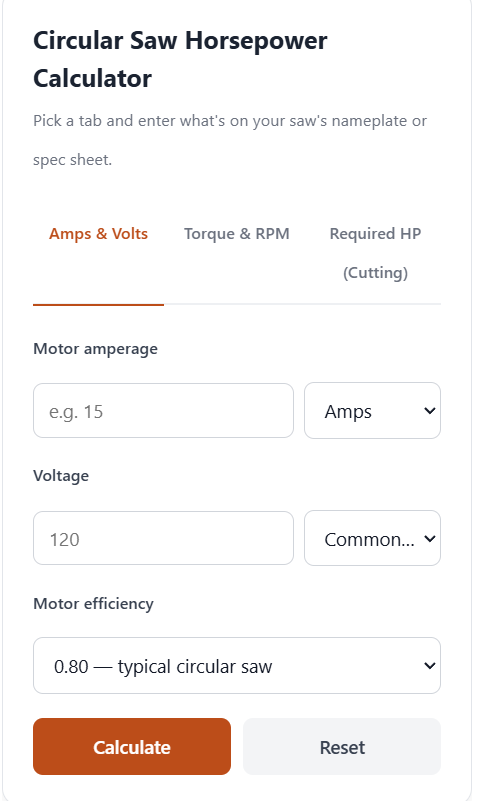
Use this calculator to estimate the horsepower of a circular saw from its electrical draw, from torque and RPM, or to predict how much horsepower a given cut will demand based on material, depth, feed, and kerf.
Related Calculators
- All Automotive Calculators
- Plywood Calculator
- Spindle Horsepower Calculator
- Drilling Horsepower Calculator
- Tapping Horsepower Calculator
Formula
Amps & Volts mode:
HP = (A × V × η) / 746
where A = amperage, V = voltage, η = motor efficiency (0–1).
Torque & RPM mode:
HP = (T × RPM) / 5252
where T = torque in ft-lb, RPM = spindle speed.
Required HP (cutting) mode:
HP ≈ (d × kw × f × k) / (10 × η)
where d = cut depth (in), kw = kerf width (in), f = feed rate (in/min), k = material factor, η = drivetrain efficiency (~0.85).
Interpretation
The result tells you where your saw sits on the power ladder and whether it can handle the cut you’re planning. Use these ranges as a reference:
- Under 1 HP — trim saws, small cordless, or 4-1/2″ compact saws.
- 1 – 2 HP — typical 7-1/4″ corded sidewinder, the most common DIY range.
- 2 – 3.5 HP — heavy-duty worm drive and pro framing saws.
- 3.5+ HP — large table saws, beam saws, and industrial panel saws.
If the required HP from the cutting mode exceeds your saw’s rated HP, expect the blade to bog down, the motor to overheat, or the breaker to trip. Drop the feed rate or cut depth until the two numbers line up.
Quick Reference: Common Circular Saw Specs
| Saw Type | Typical Amps / Volts | Approximate HP |
|---|---|---|
| Compact 4-1/2″ corded | 5 A / 120 V | 0.5 – 0.8 |
| 18V – 20V cordless 6-1/2″ | — | 0.8 – 1.3 |
| Standard 7-1/4″ sidewinder | 13 – 15 A / 120 V | 1.4 – 1.9 |
| Pro worm drive 7-1/4″ | 15 A / 120 V | 1.9 – 2.5 |
| Large 10-1/4″ framing saw | 15 A / 120 V | 2.5 – 3.0 |
| Beam / timber saw (16″) | 15 A / 120 V | 3.0 – 4.5 |
FAQ
Why does my saw’s nameplate amperage give less HP than the box advertises?
Manufacturers often quote “peak” or “maximum” HP measured at motor stall, not continuous running HP. The calculator returns running HP, which is what actually matters during a cut.
What efficiency should I pick for a standard circular saw?
Most corded circular saws use universal (brushed) motors running around 75–82% efficient. The default of 0.80 is a safe middle ground. Use 0.85–0.90 only for brushless cordless or high-end induction-driven saws.
Can I use this for a cordless saw if I only know the battery voltage and amp-hours?
Not directly — Ah is capacity, not current draw. You need the motor’s actual current under load (often in the tool’s spec sheet) along with the nominal battery voltage to estimate running HP.
Why is my required HP higher than my saw’s rating but it still cuts fine?
The cutting-mode formula assumes continuous steady-state load. Short cuts, sharp blades, and brief bursts can exceed rated HP momentarily without issue. Sustained cuts above your saw’s rating are what cause overheating and breaker trips.