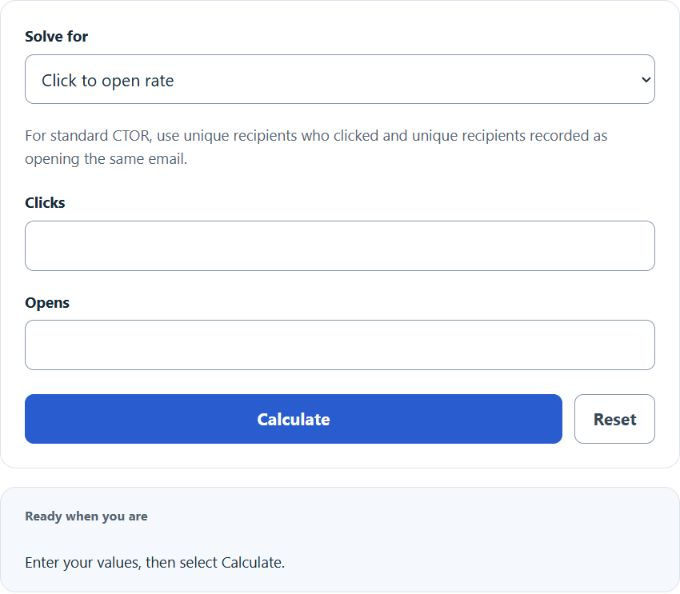
Choose the value to solve for, then enter the two matching email metrics. Standard CTOR uses unique clickers and unique recorded openers from the same email; inverse counts are implied estimates.
- All Business Calculators
- All Rate Calculators
- Close Rate Calculator
- Click-Through Rate (CTR) Calculator
Click to Open Rate Formula
The click to open rate, often shortened to CTOR, compares unique recipients who clicked with unique recipients recorded as opening the email. It is different from click-through rate because it uses opens as the denominator instead of total delivered emails.
To calculate the number of clicks from opens and CTOR:
To calculate the number of opens from clicks and CTOR:
- CTOR = click to open rate, expressed as a percentage
- Clicks = number of unique recipients who clicked a link
- Opens = number of unique recipients recorded as opening the email
The calculator works in three directions: choose CTOR, implied clicks or implied opens, then enter the two relevant values. Rounded percentages can imply fractional counts. Zero opens cannot define a rate. Total-event counts produce a total-event ratio rather than standard unique-recipient CTOR.
Click to Open Rate Arithmetic Reference
These bands describe arithmetic only, not validated engagement benchmarks. Open tracking can be affected by privacy features, blocked images and bots, so CTOR does not prove human engagement.
| Click to Open Rate | Arithmetic Interpretation |
|---|---|
| 0% to under 5% | Fewer than 5 recorded clickers per 100 recorded openers |
| 5% to under 10% | 5 to fewer than 10 recorded clickers per 100 recorded openers |
| 10% to 20% | 10 to 20 recorded clickers per 100 recorded openers |
| Over 20% | More than 20 recorded clickers per 100 recorded openers |
Clicks Needed at Different Open Counts
| Opens | 5% CTOR | 10% CTOR | 15% CTOR | 20% CTOR |
|---|---|---|---|---|
| 500 | 25 clicks | 50 clicks | 75 clicks | 100 clicks |
| 1,000 | 50 clicks | 100 clicks | 150 clicks | 200 clicks |
| 5,000 | 250 clicks | 500 clicks | 750 clicks | 1,000 clicks |
Example
Example 1: Calculate click to open rate
You have 120 clicks and 1,000 opens.
The click to open rate is 12%.
Example 2: Calculate clicks from CTOR
You have 2,500 opens and a click to open rate of 8%.
The entered rate implies 200 clicks; it does not independently establish the observed count.
FAQ
What is a good click to open rate?
There is no universal good click to open rate. Use comparable, dated campaign reports with consistent tracking and count definitions. A newsletter, sales promotion, transactional email, and account update can all have different normal ranges.
What is the difference between click to open rate and click-through rate?
Click to open rate uses opens as the denominator. Click-through rate usually uses delivered emails as the denominator. CTOR compares recorded clickers with recorded openers, while email click-through rate compares clickers with the delivered audience. Neither ratio alone establishes why recipients engaged.
Can the click to open rate be higher than 100%?
In a basic unique-clicks and unique-opens calculation, CTOR should not be higher than 100%. It can appear higher if your reporting uses total clicks, counts multiple clicks from the same person, or has tracking differences between clicks and opens.