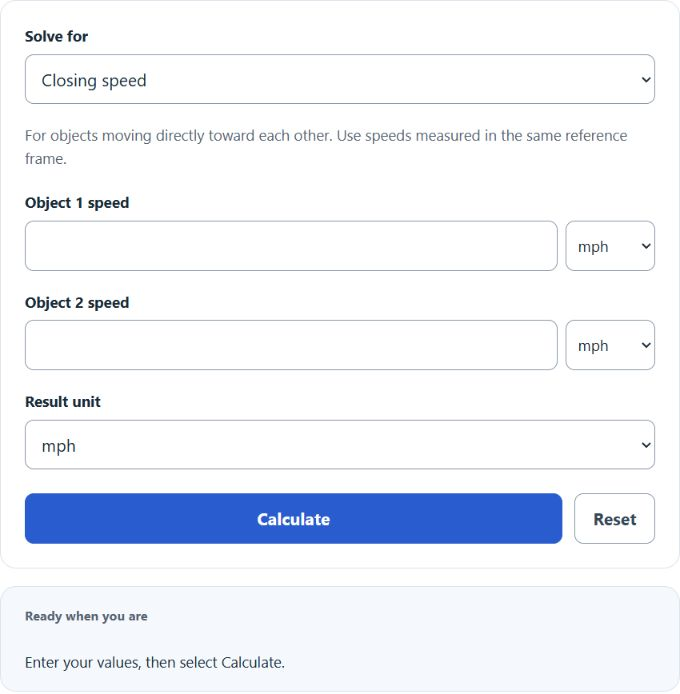
Calculate closing speed or find a missing object speed from two known values with unit conversion in mph, kph, m/s, or ft/s and see step-by-step results.
- All Physics Calculators
- Closing Distance Calculator
- Closing Ratio Calculator
- Horsepower Trap Speed Calculator
Closing Speed Formula
Closing speed is the rate at which two objects move toward each other. For two objects moving directly toward one another, the calculator uses the sum of their speeds.
- CS = closing speed
- v_1 = speed of object 1
- v_2 = speed of object 2
If one value is missing, the same formula is rearranged:
Select the value to solve for, then enter the other two values. It converts all entered speeds to meters per second internally, performs the calculation, then converts the result back to the unit you selected.
- Calculate closing speed: enter the speed of object 1 and object 2.
- Calculate speed of object 1: enter closing speed and speed of object 2.
- Calculate speed of object 2: enter closing speed and speed of object 1.
Speed Unit Conversion Factors
These are the conversion factors used to handle different speed units.
| Unit | To meters per second | From meters per second |
|---|---|---|
| mph | 1 mph = 0.44704 m/s | 1 m/s ≈ 2.23694 mph |
| kph | 1 kph = 1/3.6 m/s ≈ 0.277778 m/s | 1 m/s = 3.6 kph |
| m/s | 1 m/s = 1 m/s | 1 m/s = 1 m/s |
| ft/s | 1 ft/s = 0.3048 m/s | 1 m/s ≈ 3.28084 ft/s |
Common Closing Speed Examples
| Object 1 Speed | Object 2 Speed | Closing Speed |
|---|---|---|
| 30 mph | 40 mph | 70 mph |
| 50 kph | 70 kph | 120 kph |
| 10 m/s | 15 m/s | 25 m/s |
| 60 ft/s | 40 ft/s | 100 ft/s |
Example Problems
Example 1: Find closing speed
Two vehicles are moving directly toward each other. Object 1 is traveling at 55 mph and object 2 is traveling at 45 mph.
The closing speed is 100 mph.
Example 2: Find the speed of object 2
The closing speed is 80 mph. Object 1 is moving at 35 mph.
The speed of object 2 is 45 mph.
FAQ
What does closing speed mean?
Closing speed is how fast the distance between two objects is shrinking. If two objects are moving directly toward each other, their closing speed is the sum of their speeds.
Do you always add the two speeds?
You add the speeds when the objects are moving toward each other in opposite directions. If one object is chasing another in the same direction, the closing speed is usually the difference between their speeds, not the sum. This calculator is set up for the direct approach case where the two objects are closing on each other.
Can the result be negative?
For this direct approach model, speeds must be nonnegative. Closing speed must be at least the known object speed when solving for the other speed; incompatible inputs are rejected.