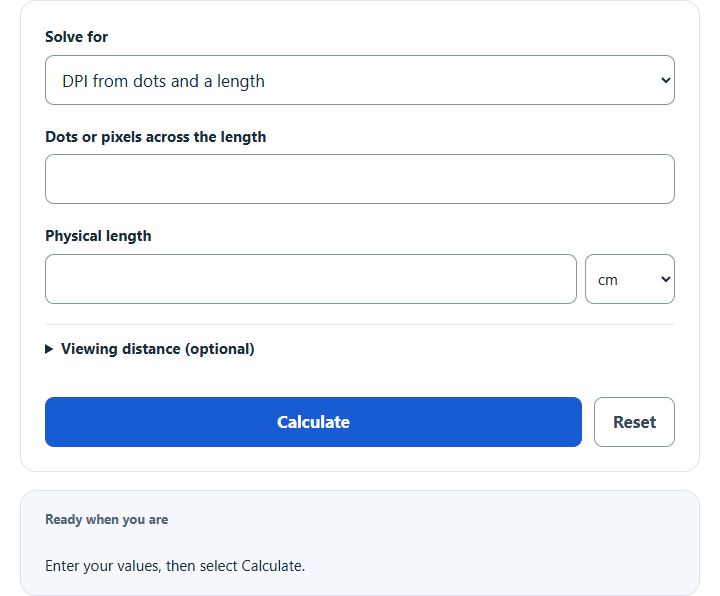
Convert cm to DPI from the number of dots or pixels across a length, convert dots per cm to DPI, or find the pixels a print size in cm needs at any DPI.
Calculator Functions
| Function | What it does | What it requires |
|---|---|---|
| DPI from dots and a length | Finds the resolution in dots or pixels per inch | Requires the number of dots or pixels across a length, and that length |
| Pixels needed for a print length | Finds how many pixels cover a length at a chosen resolution | Requires the physical length and the target resolution |
| Print length from pixels | Finds how long a row of pixels prints at a chosen resolution | Requires the pixels along one dimension and the target resolution |
| Full print size from pixel dimensions | Finds the printed width and height of an image | Requires the image width and height in pixels and the target resolution |
| Dots per cm to DPI | Converts dots per cm or dots per mm to DPI, and DPI back | Requires the resolution in dots/cm, dots/mm or DPI |
Lengths can be entered in cm, mm, in, m or ft. The target resolution starts at 300 and has presets of 72, 96, 150, 200, 240, 300 and 600. Every function except Dots per cm to DPI also accepts an optional viewing distance.
cm To DPI Formulas
| DPI | Dots or pixels per inch |
| D | Number of dots or pixels across the length |
| L | Physical length (cm) |
| 2.54 | Centimeters in one inch, an exact value [1] |
DPI from dots and a length
The main formula applies directly. 500 pixels across 10 cm is 500 × 2.54 ÷ 10 = 127 DPI. The result also gives the pixel pitch (0.2 mm), the dots per cm (50) and the length the same pixels would cover at 300 PPI (4.2333 cm).
Pixels needed for a print length
A 10 cm length at 300 PPI needs 10 × 300 ÷ 2.54 = 1,181.1 pixels, which the calculator rounds up to 1,182 whole pixels. Common lengths work out as follows.
| Length (cm) | 72 DPI | 96 DPI | 150 DPI | 300 DPI |
|---|---|---|---|---|
| 1 | 28.35 | 37.80 | 59.06 | 118.11 |
| 2.54 (1 in) | 72 | 96 | 150 | 300 |
| 5 | 141.73 | 188.98 | 295.28 | 590.55 |
| 10 | 283.46 | 377.95 | 590.55 | 1,181.10 |
| 14 | 396.85 | 529.13 | 826.77 | 1,653.54 |
| 15 | 425.20 | 566.93 | 885.83 | 1,771.65 |
| 20 | 566.93 | 755.91 | 1,181.10 | 2,362.20 |
| 21 (A4 width) | 595.28 | 793.70 | 1,240.16 | 2,480.31 |
| 29.7 (A4 height) | 841.89 | 1,122.52 | 1,753.94 | 3,507.87 |
| 30 | 850.39 | 1,133.86 | 1,771.65 | 3,543.31 |
Print length from pixels
3,000 pixels at 300 PPI print 3,000 × 2.54 ÷ 300 = 25.4 cm long, which is 10 in.
Full print size from pixel dimensions
The print length formula is applied to the width and to the height. A 3,000 × 2,000 pixel image at 300 PPI prints at 25.4 × 16.9333 cm, or 10 × 6.6667 in. The result also gives the megapixels (6 MP) and the aspect ratio (3:2).
Dots per cm to DPI
100 dots per cm is 100 × 2.54 = 254 DPI, a dot pitch of 0.1 mm. Dots per mm are multiplied by 25.4. Lines per cm and pixels per cm convert the same way, and switching the unit to DPI converts a DPI value back to dots per cm.
Viewing distance
With a viewing distance d in inches, and 1′ standing for one arcminute, a sixtieth of a degree, the result adds the resolution at which one pixel spans one arcminute of the eye’s view. At 12 in that is 286.4789 PPI. It is an illustrative reference for comparing with the calculated resolution, not a print-quality standard.
Limits of This Estimate
- DPI strictly counts printer dots and PPI counts image pixels. The arithmetic is the same for both, but a printer may lay down several dots for each image pixel.
- 300 and the other presets are editable references. The resolution a print needs depends on the printer, the detail in the image, the paper and the viewing distance.
- Changing the resolution stored in an image file without resampling changes its print size, not its pixel count.
- 96 pixels per inch is a layout ratio used on the web, not the physical pixel density of every screen.
Sources
- NIST, Guide to the SI (Special Publication 811), Appendix B.8: one inch is exactly 2.54 cm