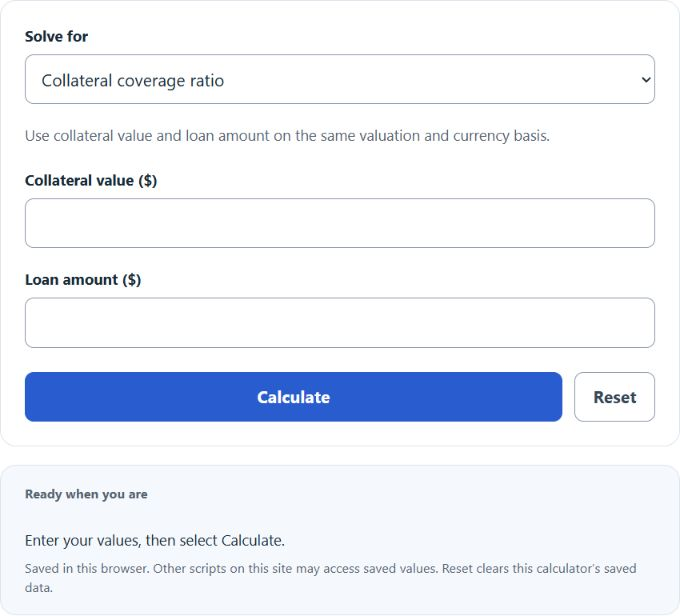
Select collateral coverage ratio, loan amount or collateral value to solve, then enter the two known values. Use one valuation and currency basis; dollar inputs accept cents and the details show the formula.
Related Calculators
- Benefit to Cost Ratio Calculator
- Equity Percentage Calculator
- Required Rate of Return Calculator
- Cost Of Common Equity Calculator
- All Business Calculators
Collateral Coverage Ratio Formula
The collateral coverage ratio compares the value of pledged collateral to the loan amount. A ratio above 1.00 means the collateral value is greater than the loan amount. A ratio below 1.00 means the collateral value is less than the loan amount.
- CCR = collateral coverage ratio
- VC = value of collateral
- LA = loan amount
Choose a solve mode rather than leaving a field blank. The calculator uses exact integer cents and decimal ratios (up to 12 decimal places). Dollar outputs round to the nearest cent, with halfway cases rounded upward. A positive loan is required. Zero collateral gives zero coverage; zero collateral and zero ratio do not determine a loan amount.
- To calculate collateral coverage ratio: enter the value of collateral and the loan amount.
- To calculate value of collateral: enter the collateral coverage ratio and the loan amount.
- To calculate loan amount: enter the value of collateral and the collateral coverage ratio.
Collateral Coverage Ratio Interpretation
The table gives arithmetic comparisons, not lender approval benchmarks. Requirements depend on the lender, eligible collateral, valuation, senior liens and applicable discounts. This calculation does not estimate liquidation recovery or establish credit approval; see the OCC collateral and LTV discussion.
| Collateral Coverage Ratio | Collateral Compared With Loan | General Interpretation |
|---|---|---|
| Below 1.00 | Collateral is less than the loan | The loan is undercollateralized based on the entered value. |
| 1.00 | Collateral equals the loan | The loan is exactly covered before fees, discounts, or liquidation costs. |
| 1.20 | Collateral is 120% of the loan | Collateral exceeds the loan by 20% of the loan amount, before adjustments. |
| 1.50 | Collateral is 150% of the loan | Collateral exceeds the loan by 50% of the loan amount, before adjustments. |
Common Ratio Conversions
You can convert the ratio to a percentage by multiplying it by 100. For example, a ratio of 1.25 is 125% collateral coverage.
| Ratio | Coverage Percentage | Meaning |
|---|---|---|
| 0.80 | 80% | $0.80 of collateral for each $1.00 of loan. |
| 1.00 | 100% | $1.00 of collateral for each $1.00 of loan. |
| 1.25 | 125% | $1.25 of collateral for each $1.00 of loan. |
| 1.50 | 150% | $1.50 of collateral for each $1.00 of loan. |
Example Section
Example 1: Calculate the collateral coverage ratio
You have collateral valued at $300,000 and a loan amount of $240,000.
The collateral coverage ratio is 1.25, meaning the collateral value is 125% of the loan amount.
Example 2: Calculate the required collateral value
You need a collateral coverage ratio of 1.30 for a $500,000 loan.
The algebraic collateral value is $650,000. This does not establish that a lender accepts the collateral or valuation; a cent-rounded inverse may need adjustment to meet an exact minimum threshold.
FAQ Section
What is a good collateral coverage ratio?
A higher ratio generally gives more protection to the lender because the collateral value is greater than the loan amount. A ratio of 1.00 means the collateral equals the loan. Many secured loans require a ratio above 1.00, but the acceptable level depends on the lender, collateral type, credit profile, and how easily the collateral could be sold.
Is collateral coverage ratio the same as loan-to-value?
No. They use the same two inputs but in opposite order. Collateral coverage ratio is collateral value divided by loan amount. Loan-to-value is loan amount divided by collateral value. For example, a $75,000 loan secured by $100,000 of collateral has a collateral coverage ratio of 1.3333 and a loan-to-value ratio of 75%.
Should you use appraised value or market value for collateral?
Use the value required for the analysis you are doing. A lender may use appraised value, discounted value, liquidation value, or another adjusted figure. If you use a higher market value, the ratio will be higher. If you use a conservative or discounted value, the ratio will be lower.