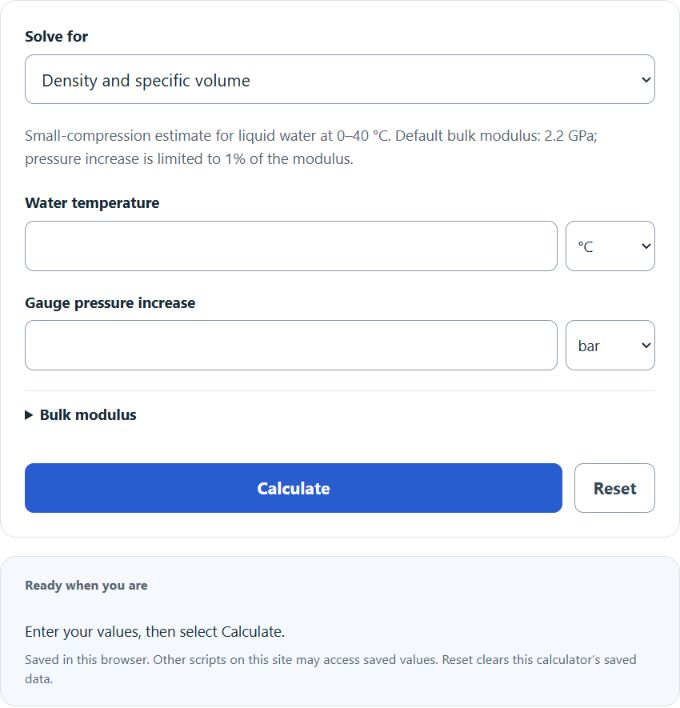
Estimate density, specific volume, and volume reduction of pure liquid water at constant temperature, using a small-compression bulk-modulus model. This calculator is limited to 0–40 °C and a pressure increase no greater than 1% of the selected modulus.
Related Calculators
- Compressed Air Velocity Calculator
- Adiabatic Compression Temperature Calculator
- Cavitation Index Calculator
- Pitot Tube Calculator
- All Physics Calculators
Compressed Water Formula
The following small-compression approximation estimates final water volume at constant temperature, with a constant bulk modulus over the pressure increment.
- Where V_f is the final volume (m³)
- V_i is the initial volume (m³)
- P is the pressure increase (bar)
- K is the bulk modulus of water (Pa)
Select density and specific volume, or final volume and compression, then enter the requested values. The default modulus is 2.2 GPa; a justified custom modulus can be entered in the optional section.
What is a Compressed Water Calculator?
Definition:
A Compressed Water Calculator estimates density and specific volume, or final volume and compression, from water temperature and a nonnegative gauge pressure increase. It uses an atmospheric pure-water density correlation and an approximate constant bulk modulus; it does not solve for initial volume or pressure.
How to Calculate Compressed Water Variables?
Example Problem:
The following example outlines the steps and information needed to calculate the final volume of water under compression.
First, determine the initial volume. In this example, the initial volume is 1.000 m³.
Next, identify the pressure increase applied to the water. In this example, the pressure increase is 10 bar.
Finally, calculate the final volume using the formula above:
V_f = V_i * (1 – (P * 1e5 / K))
V_f = 1.000 * (1 – (10 * 1e5 / 2.2e9))
V_f ≈ 0.9995 m³
FAQ
What factors can affect the calculated compressed water values?
The calculated values can be influenced by the accuracy of the bulk modulus used, temperature variations, and measurement precision of the initial and final volumes.
How accurate is the bulk modulus value used in the calculations?
The default bulk modulus (2.2×10⁹ Pa) is approximate and varies with temperature and pressure. The 1% compression limit is an implementation guard, not an accuracy guarantee. Use a validated water-property model, such as IAPWS, for precise engineering calculations.
Can this calculator be used for liquids other than water?
This calculator is specifically designed for water using its bulk modulus. For other liquids, a different bulk modulus and potentially adjusted formulas would be required.