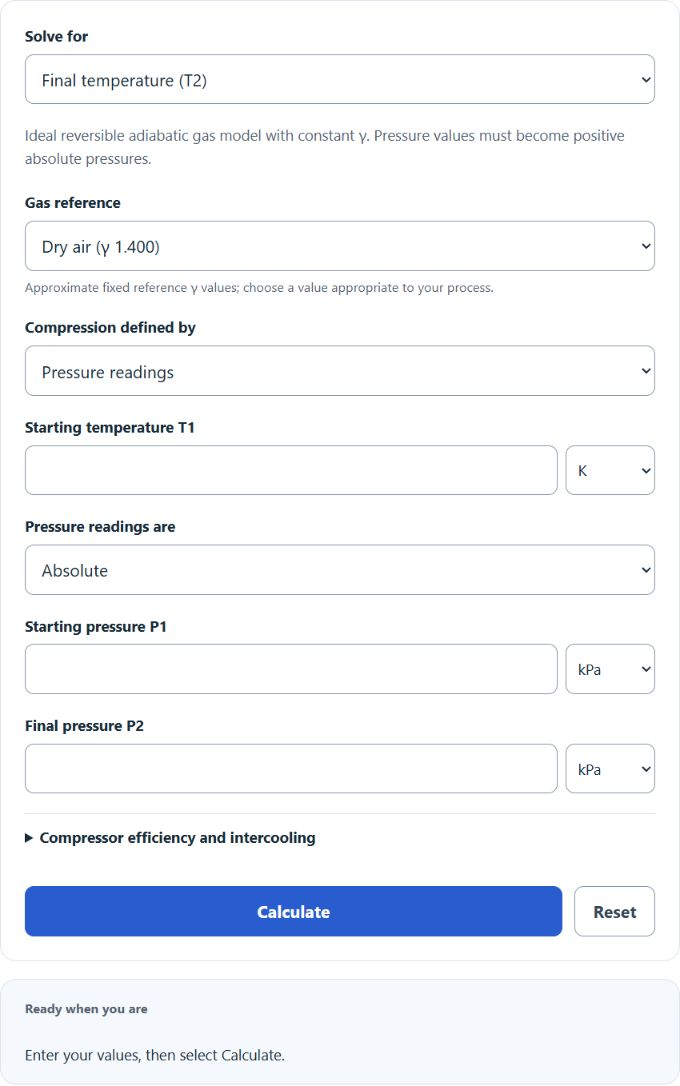
Calculate the final temperature of a gas after adiabatic compression from starting temperature, pressure ratio or volume compression ratio, and heat capacity ratio.
- All Physics Calculators
- Adiabatic Pressure Calculator
- Enthalpy Calculator
- Air Enthalpy Calculator
- Absolute Temperature Calculator
- Specific Heat Calculator
- Atmospheric Pressure Calculator
Adiabatic Compression Temperature Formula
The calculator uses reversible adiabatic ideal-gas relationships. Use absolute temperature and absolute pressure values. Temperatures entered in °C or °F are converted to kelvin for the calculation, then converted back for display.
- T₁ = initial absolute temperature
- T₂ = final absolute temperature
- P₁ = initial absolute pressure
- P₂ = final absolute pressure
- V₁ = initial volume
- V₂ = final volume
- γ = heat capacity ratio, equal to Cₚ/Cᵥ
- R = ideal gas constant, 8.314462618 J/(mol·K)
- n = amount of gas in moles
- Q = heat transfer, zero for an adiabatic process
- ΔU = internal energy change
- W by gas = work done by the gas
Calculator Modes
Final temperature: enter starting temperature and either absolute/gauge pressure readings or an ideal volume ratio. Ratios below one describe ideal expansion; leave compressor-only options blank for expansion.
Starting temperature: back-solve T1 from known T2 and the pressure or volume ratio.
Final pressure: solve P2 = P1 × (T2/T1)^(γ/(γ − 1)); the primary pressure result is absolute, with a separate gauge reference.
Volume ratio: solve V1/V2 = (T2/T1)^(1/(γ − 1)). The displayed volume ratios are ideal isentropic reference values. Lossy compressor states at a fixed pressure ratio do not have the same final volume ratio.
The closed-system energy identities above describe an ideal gas in a closed cylinder. The calculator's compressor work output is a steady-flow estimate: Cp,m × (T2 − T1), with Cp,m = γR / (γ − 1), reported in kJ/kmol. Divide by molar mass in kg/kmol (numerically equal to g/mol) for kJ/kg. Closed-cylinder internal-energy change instead uses Cv,m × (T2 − T1).
Common Gamma Values and Result Interpretation
Use a custom γ value if you have a gas-specific value at the temperature range of your process.
| Gas | Typical γ | Notes |
|---|---|---|
| Air, nitrogen | 1.400 | Common default for room-temperature diatomic gases |
| Helium, argon | 1.667 | Monatomic gases, larger temperature change for the same pressure ratio |
| Carbon dioxide | 1.289 | Lower γ, smaller temperature change for the same pressure ratio |
| Steam | 1.330 | Approximate ideal-gas value, not suitable near saturation |
| Condition | Pressure ratio P₂/P₁ | Temperature result | Energy result |
|---|---|---|---|
| Compression | Greater than 1 | T₂ is greater than T₁ | ΔU is positive, work by gas is negative |
| Expansion | Less than 1 | T₂ is less than T₁ | ΔU is negative, work by gas is positive |
| No pressure change | Equal to 1 | T₂ equals T₁ | No ideal adiabatic work or internal energy change |
Compressor Efficiency and Intercooling
Open the optional section in final-temperature mode. Blank efficiency means 100%; otherwise enter a value greater than zero and no more than 100%. MIT's compressor-efficiency definition gives ηc = (T2,ideal − T1) / (T2,actual − T1). Accordingly, actual estimated temperature rise is ideal rise divided by ηc.
For N stages, the model uses equal pressure ratios, the same efficiency in every stage, no intercooler pressure loss and cooling back to T1 before the next stage. Stage discharge is measured before its cooler. Total estimated compressor work is N × Cp,m × (Tstage − T1). The whole train rejects heat and is not an adiabatic system.
Tstage = T1 × [1 + (rp^((γ − 1)/(γN)) − 1) / ηc]
For rp > 1 and Tmax > T1, the minimum stage count is derived from that inequality:
Nmin = max(1, ceil[((γ − 1)/γ) × ln(rp) / ln(1 + ηc × (Tmax/T1 − 1))])
The calculator checks the integer count against the temperature limit and identifies counts above the 1–12 selectable range. A compression limit at or below T1 cannot be met with a finite number of stages under this model. Expansion uses a different efficiency definition; compressor efficiency and staging are not applied to it.
NASA derives the ideal pressure, temperature and volume relations. They require reversibility as well as zero heat transfer. Gas presets are approximate fixed references, not property tables across all temperatures; choose process-appropriate γ, especially for steam near saturation or gases far from ideal conditions.
Examples
Example 1: Air compressed from 1 atm to 10 atm
You have air with γ = 1.4, T₁ = 300 K, P₁ = 1 atm, and P₂ = 10 atm.
The exponent is 0.285714, so:
T₂ = 579.21 K
The compression ratio is:
Example 2: Air expanding from 10 bar to 1 bar
You have air with γ = 1.4, T₁ = 600 K, P₁ = 10 bar, and P₂ = 1 bar.
T₂ = 310.73 K
The expansion ratio is:
FAQ
Do you need absolute pressure or gauge pressure?
Choose Absolute or Gauge for pressure readings. In Gauge mode the calculator adds the entered atmospheric pressure, or 101325 Pa when blank. Do not add atmosphere yourself and also select Gauge. For example, 100 psi gauge is about 114.7 psi absolute at standard atmospheric pressure.
Why does temperature rise during adiabatic compression?
In adiabatic compression, no heat is transferred out of the gas. Work is done on the gas, increasing its internal energy. For an ideal gas, higher internal energy means higher temperature.
When is this calculation not accurate?
It becomes less accurate when the gas is not close to ideal, when heat transfer is significant, when friction and losses are important, or when γ changes strongly with temperature. Real compressors and turbines often need efficiency corrections in addition to the ideal adiabatic result.