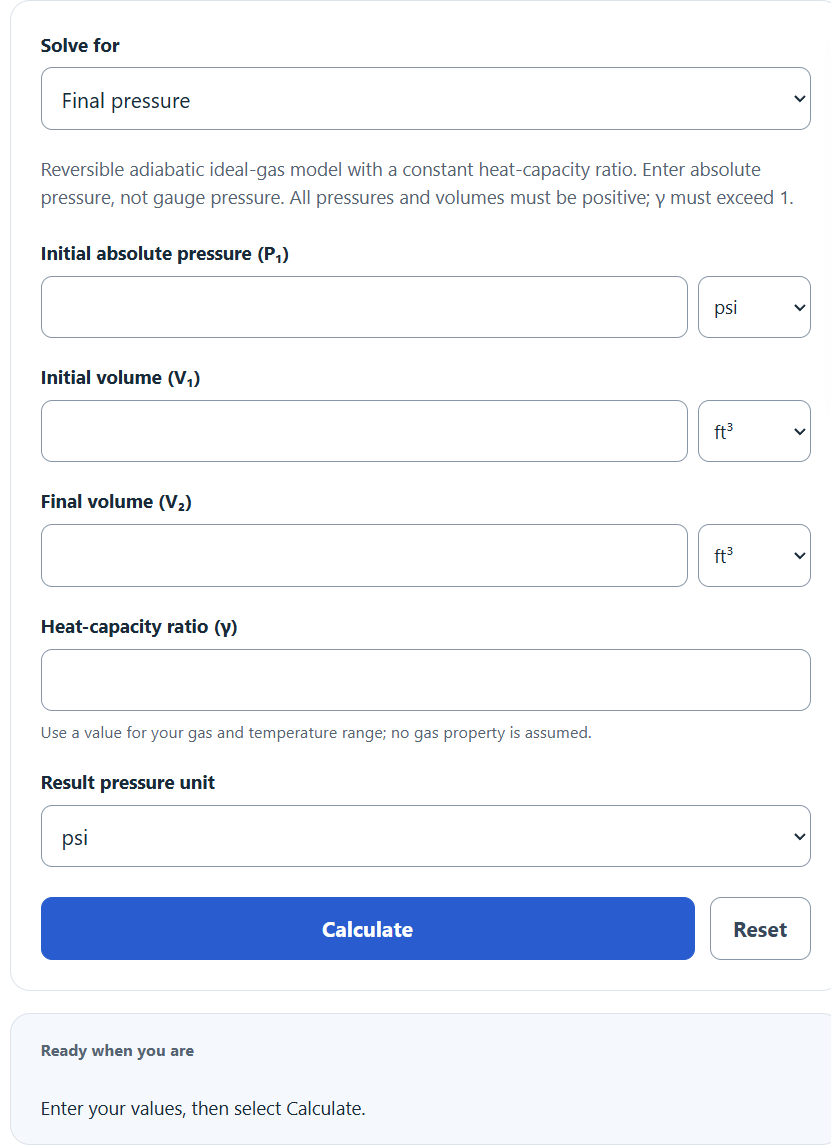
Calculate adiabatic pressure, volume or gamma from any four values using P₁V₁^γ = P₂V₂^γ with absolute pressure in psi, bar, atm, kPa or Pa and volume in ft³, m³, L or US gallons. Choose the unknown in Solve for.
- All Physics Calculators
- Adiabatic Compression Temperature Calculator
- Pressure Ratio Calculator
- Total Pressure Calculator
- Partial Pressure Calculator
- Atmospheric Pressure Calculator
- Absolute Pressure Calculator
Adiabatic Pressure Formula
The adiabatic pressure relationship used by this calculator is based on a reversible adiabatic process for an ideal gas:
- P₁ = initial absolute pressure
- V₁ = initial volume
- P₂ = final absolute pressure
- V₂ = final volume
- γ = adiabatic index, also called the heat capacity ratio
To calculate the missing variable, the formula is rearranged as needed:
Choose the unknown in Solve for and enter the other four values. The calculator converts absolute pressure to Pa and volume to m³, then converts the result to your selected unit. The unitless heat-capacity ratio must be greater than one and is assumed constant through this reversible ideal-gas process.
Common Adiabatic Index Values
The value of γ depends on the gas. Use a value that matches the gas and conditions in your problem.
| Gas type | Typical γ | Notes |
|---|---|---|
| Monatomic gases | 1.67 | Helium, argon, neon |
| Diatomic gases | 1.40 | Air, nitrogen, oxygen near room temperature |
| Triatomic gases | 1.30 to 1.33 | Carbon dioxide and similar gases, approximate |
| Water vapor | About 1.33 | Depends on temperature and pressure |
Pressure and Volume Unit Reference
| Quantity | Supported units | Base unit used internally |
|---|---|---|
| Pressure | psi, bar, atm, kPa, Pa | Pa |
| Volume | ft³, m³, L, US gal | m³ |
| Adiabatic index | Unitless | Unitless |
Example Calculations
Example 1: Calculate final pressure
Suppose air expands adiabatically from an initial absolute pressure of 100 psi and an initial volume of 2 ft³ to a final volume of 4 ft³. Use γ = 1.4.
The final pressure is about 37.89 psi.
Example 2: Calculate final volume
Suppose a gas starts at 200 kPa absolute and 10 L, then reaches 500 kPa absolute. Use γ = 1.4 and solve for final volume.
The final volume is about 5.20 L.
FAQ
What does adiabatic mean?
An adiabatic process is a process where no heat is transferred into or out of the gas. For an ideal gas in a reversible adiabatic process, pressure and volume follow the relationship P₁V₁γ = P₂V₂γ.
What value should you use for γ?
Use the heat capacity ratio for the gas in your problem. For air near room temperature, γ is usually taken as 1.4. For monatomic gases such as helium or argon, γ is usually about 1.67. If your problem gives a specific value, use that value.
Why does pressure change when volume changes adiabatically?
During adiabatic compression, the gas volume decreases and the pressure rises. During adiabatic expansion, the gas volume increases and the pressure falls. Because no heat is exchanged, the change in pressure is tied to both the volume change and the gas property γ.