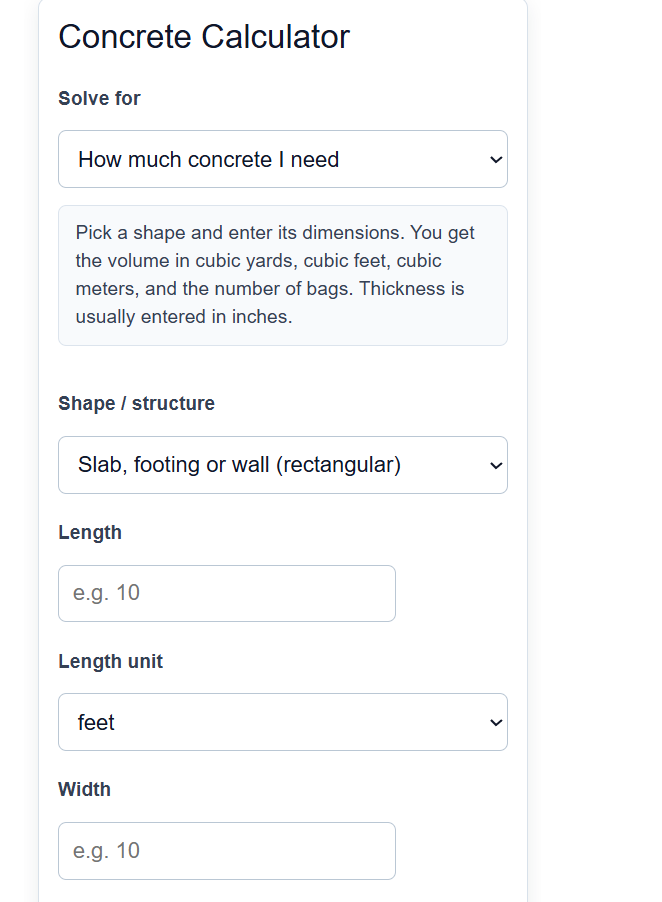
Calculate how much concrete you need in cubic yards, bags, and cost for slabs, footings, columns, and stairs.
Concrete Formula
The amount of concrete you need is the volume of the shape you are filling, converted to cubic yards. Each shape uses its own volume formula, and every length is converted to feet before the math is done.
Slab / footing / wall: CY = (L * W * T) / 27
Round column: CY = (pi * (D / 2)^2 * H) / 27
Round slab: CY = (pi * (D / 2)^2 * T) / 27
Stairs: CY = (W * Run * Rise * n * (n + 1) / 2) / 27
Bags = roundup(cubic feet / Y)
- CY = volume of concrete in cubic yards
- L = length in feet
- W = width in feet
- T = thickness or depth in feet
- D = diameter in feet
- H = height or depth of the column in feet
- Run = depth of one stair tread in feet
- Rise = height of one step in feet
- n = number of steps
- Y = the volume one bag of mix yields in cubic feet
Length, width, and thickness give the raw volume in cubic feet. Dividing by 27 converts cubic feet to cubic yards, the unit ready-mix concrete is sold in. The bag formula divides the cubic-foot volume by the yield printed on the bag and rounds up, since you cannot buy part of a bag. The calculator also adds an optional waste percentage so your order covers spillage and uneven ground.
Concrete Bag Yields and Coverage
Bagged concrete mix lists how much volume it produces once mixed. Use these yields to convert a volume into a bag count, and remember that one cubic yard is 27 cubic feet.
| Bag size | Yield (cubic feet) | Bags per cubic yard |
|---|---|---|
| 40 lb | 0.30 | 90 |
| 50 lb | 0.375 | 72 |
| 60 lb | 0.45 | 60 |
| 80 lb | 0.60 | 45 |
Bag counts round up because mix is sold in whole bags. For projects much past one cubic yard, ready-mix delivery is usually cheaper than bags.
| Slab thickness | Coverage per cubic yard | Typical use |
|---|---|---|
| 4 inches | 81 sq ft | Patios, walkways, shed floors |
| 5 inches | 65 sq ft | Driveways, garage floors |
| 6 inches | 54 sq ft | Heavy vehicle slabs |
Example Problems
Example 1: A patio slab is 12 feet long, 10 feet wide, and 4 inches thick. Convert the thickness to feet: 4 / 12 = 0.333 feet. Volume in cubic feet is 12 * 10 * 0.333 = 40 cubic feet. Divide by 27 to get 1.48 cubic yards. Using 80 lb bags, 40 / 0.60 = 67 bags.
Example 2: A round column has a diameter of 12 inches (1 foot) and a height of 9 feet. The radius is 0.5 feet, so the volume is pi * 0.5^2 * 9 = 7.07 cubic feet, or 0.26 cubic yards. That is about 12 eighty pound bags per column.
Frequently Asked Questions
How much concrete does an 80 lb bag make? An 80 lb bag of standard concrete mix yields about 0.60 cubic feet once mixed. It takes roughly 45 of those bags to fill one cubic yard, which is why bags suit small jobs and ready-mix suits large pours.
How much extra concrete should I order? Add about 5 to 10 percent for a flat slab on level ground and up to 15 percent for footings, columns, or pours over rough subgrade. The advanced waste field lets you build this allowance into the result.
How many cubic feet are in a cubic yard? There are 27 cubic feet in one cubic yard, because a cubic yard is 3 feet on every side and 3 * 3 * 3 = 27. The calculator divides the cubic-foot volume by 27 to report cubic yards.