Calculate how many concrete blocks and bags of mortar you need for a wall, with a waste factor and optional cost estimate.
- All Construction Calculators
- Construction Material Estimator Calculator
- Mortar Bag Calculator
- Concrete Calculator
Concrete Block Formula
The number of blocks comes from dividing your net wall area by the face area of one block, then adding a waste factor:
B = (A / Fa) * (1 + W)
Where the face area of a single block, including its mortar joint, is:
Fa = (L + J) * (H + J) / 144
Mortar bags are estimated from the block count, using about 3 standard 80 lb bags per 100 blocks:
Bags = B / 33.3
- B = number of blocks needed (rounded up)
- A = net wall area in square feet (wall area minus any openings)
- Fa = face area of one block in square feet
- L = block face length in inches (16 for a standard block)
- H = block face height in inches (8 for a standard block)
- J = mortar joint thickness in inches (0.375 is standard)
- W = waste factor as a decimal (0.10 for 10%)
- Bags = number of 80 lb mortar bags
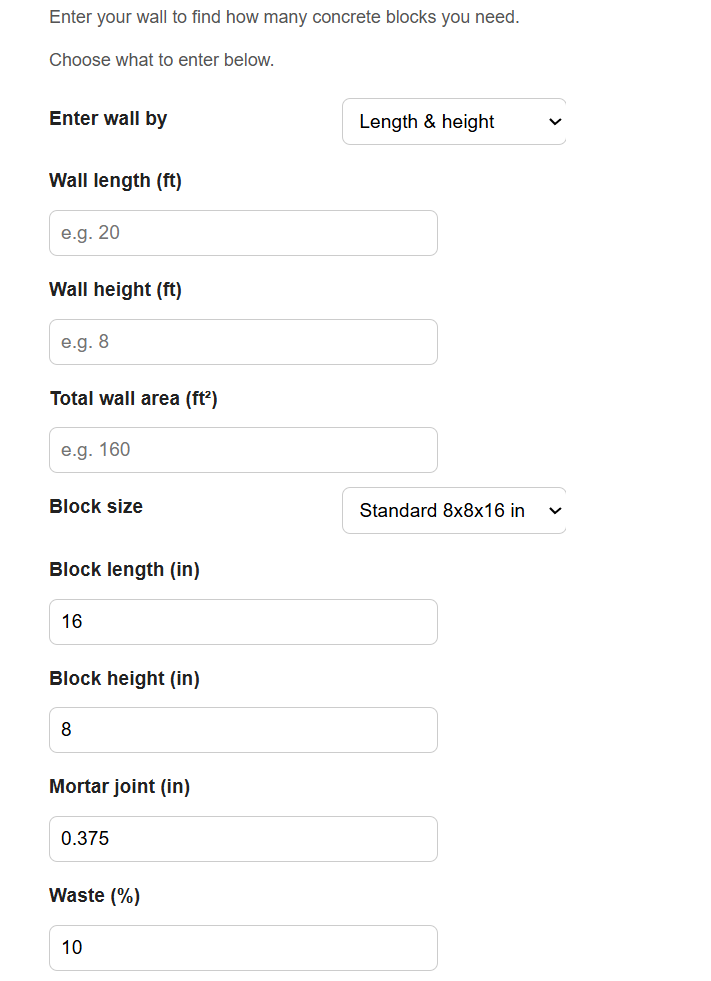
You set the wall size either by length and height or by entering the total area directly. The block size selector fixes the face dimensions, and the custom option lets you enter your own length and height. The mortar joint is added to both block dimensions so the count reflects real coverage. The waste field pads the result for cuts and breakage, and the mortar figure scales with the final block count.
Blocks and Mortar Coverage
These reference figures assume standard 8x8x16 in blocks with 3/8 in mortar joints. Use them to sanity check the calculator output.
| Item | Typical value |
|---|---|
| Block face coverage | 0.889 ft² per block |
| Blocks per ft² | 1.125 blocks |
| Mortar (80 lb bags) | 3 bags per 100 blocks |
| Waste, simple wall | 5% |
| Waste, many openings | 10 to 15% |
Common block sizes share the same 16 in by 8 in face, so the block count is the same. Width only changes wall thickness and the grout or fill needed.
| Nominal size (in) | Face (in) | Common use |
|---|---|---|
| 6x8x16 | 16 x 8 | Partition and light walls |
| 8x8x16 | 16 x 8 | General foundation and walls |
| 12x8x16 | 16 x 8 | Tall or load bearing walls |
Example Problems
Example 1. A wall is 20 ft long and 8 ft high using standard 8x8x16 blocks with a 3/8 in joint and 10% waste. The wall area is 20 * 8 = 160 ft². The block face area is (16 + 0.375) * (8 + 0.375) / 144 = 0.952 ft². Blocks before waste are 160 / 0.952 = 168.1, and with 10% waste you round up to 185 blocks. Mortar is 185 / 33.3 = about 6 bags.
Example 2. You enter a total area of 320 ft² and deduct a 21 ft² door opening, leaving 299 ft². Using the same 0.952 ft² face area, that is 299 / 0.952 = 314 blocks, and with 10% waste you round up to 346 blocks, or about 11 bags of mortar.
Frequently Asked Questions
How many concrete blocks are in a square foot? For standard 8x8x16 blocks with 3/8 in mortar joints you need about 1.125 blocks per square foot, since each block covers roughly 0.889 ft² of wall face.
How much waste should I add? Add 5% for a simple rectangular wall with no openings. Use 10 to 15% for walls with many corners, doors, or windows, since cutting blocks to fit creates more breakage and offcuts.
How many bags of mortar do I need? Plan on about 3 standard 80 lb bags of mortar mix per 100 blocks at a 3/8 in joint. Thicker joints or larger blocks use more, so treat the figure as an estimate and buy a little extra.