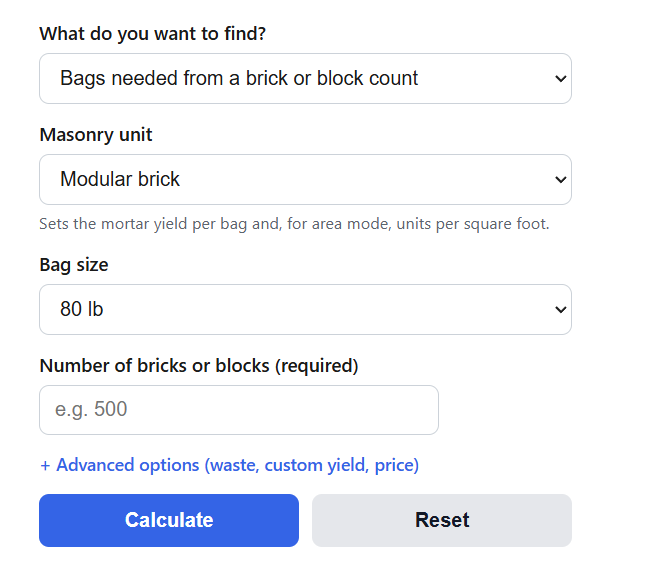
Calculate how many bags of mortar you need for a brick or block wall from a unit count or wall area, and check the coverage of the bags you already have.
Mortar Bag Formula
The calculator works three ways. To find the bags needed from a brick or block count, it divides the unit count (with a waste allowance added) by the yield of one bag and rounds up:
B = roundup(N * (1 + w) / Y)
To find the bags needed from wall area, it first converts the area to a unit count using the units per square foot for that brick or block, then uses the same bag formula:
N = A * u
To find the coverage of bags you already have, it multiplies the number of bags by the yield to get the units they will lay:
N = B * Y
Yield is quoted for an 80 lb bag. Smaller bags hold proportionally less mortar, so the calculator scales the yield by bag weight:
Y = Y80 * (bag weight / 80)
Variables:
- B is the number of mortar bags, always rounded up because bags are sold whole
- N is the number of bricks or blocks
- w is the waste allowance written as a decimal, so 10 percent is 0.10
- Y is the yield, meaning how many units one bag of mortar lays
- Y80 is the unit’s yield for an 80 lb bag, before scaling for bag size
- A is the wall area, length times height
- u is the number of that brick or block per square foot of wall face
Pick what you want to find at the top. In count mode you enter the number of bricks or blocks and get the bags needed. In area mode you enter the wall length and height and the calculator estimates the unit count first, then the bags. Coverage mode runs it backward: enter the bags you have and it tells you how many units and how many square feet they will lay. The masonry unit selector sets both the yield and the units per square foot, the bag size selector scales the yield, and the Advanced panel lets you change the waste allowance, override the yield with the figure printed on your bag, and enter a price per bag to get a cost.
Mortar Yield and Price Reference
This first table lists the standard yield the calculator uses for each unit, meaning how many pieces one bag lays. Yields vary with joint thickness and brand, so treat them as a starting point and enter your bag’s stated yield under Advanced when you have it.
| Masonry unit | Units per 80 lb bag | Units per 60 lb bag | Units per sq ft |
|---|---|---|---|
| Modular brick | 36 | 27 | 6.86 |
| Queen brick | 34 | 26 | 5.76 |
| Utility brick | 25 | 19 | 3.0 |
| 8 in block (standard) | 12 | 9 | 1.125 |
| 12 in block | 11 | 8 | 1.125 |
This second table gives approximate 2026 U.S. retail prices so you can turn the bag count into a budget, or enter your own price per bag in the calculator. Prices swing with region, brand, and whether you buy by the bag or the pallet. Note that smaller bags almost always cost more per pound of mortar, so buying 80 lb bags is usually the cheaper way to cover a large wall.
| Product | Bag size | Typical price each |
|---|---|---|
| Type N mortar mix | 80 lb | $8 to $11 |
| Type S mason mix | 80 lb | $9 to $13 |
| Mortar mix | 60 lb | $7 to $9 |
| Blended repair mortar | 40 lb | $9 to $14 |
| Type S mason mix (pallet, 56 bags) | 80 lb | $480 to $650 |
Example Problems
Example 1: Bags from a brick count.
You are laying 500 modular bricks with standard 80 lb bags and want a 10 percent waste allowance. Add the waste, divide by the 36 brick yield, and round up:
B = roundup(500 * 1.10 / 36) = roundup(15.3) = 16 bags. At $9.50 a bag that is about $152 in mortar.
Example 2: Bags from wall area.
Your wall is 20 ft long and 8 ft high and built from standard 8 in block. First convert the area to a block count at 1.125 blocks per square foot, then find the bags at a yield of 12 with 10 percent waste:
N = (20 * 8) * 1.125 = 180 blocks, so B = roundup(180 * 1.10 / 12) = roundup(16.5) = 17 bags.
Frequently Asked Questions
How many bags of mortar do I need for 100 blocks?
For standard 8 in block, one 80 lb bag lays about 12 blocks, so 100 blocks divided by 12 is 8.3, which rounds up to 9 bags with no waste. Adding a 10 percent waste allowance raises it to 10 bags. If you buy 60 lb bags instead, each lays about 9 blocks, so plan on 12 bags for the same 100 blocks.
How many bricks does an 80 lb bag of mortar lay?
Around 36 standard modular bricks with a 3/8 in joint. The real number ranges from about 30 to 45 depending on brick size and joint thickness, since larger bricks and thinner joints use less mortar per piece. Bags of concrete block are lower, near 12 for a standard 8 in block, because block joints hold much more mortar than brick joints.
Should I buy 60 lb or 80 lb bags?
An 80 lb bag holds about a third more mortar than a 60 lb bag and usually costs less per pound, so it is the cheaper choice for a large wall and means fewer bags to open and mix. The 60 lb bag is easier to lift and carry, which matters for repairs, tight sites, or anyone handling bags alone. The calculator scales the yield to the bag size you pick, so you can compare the bag count either way before you buy.