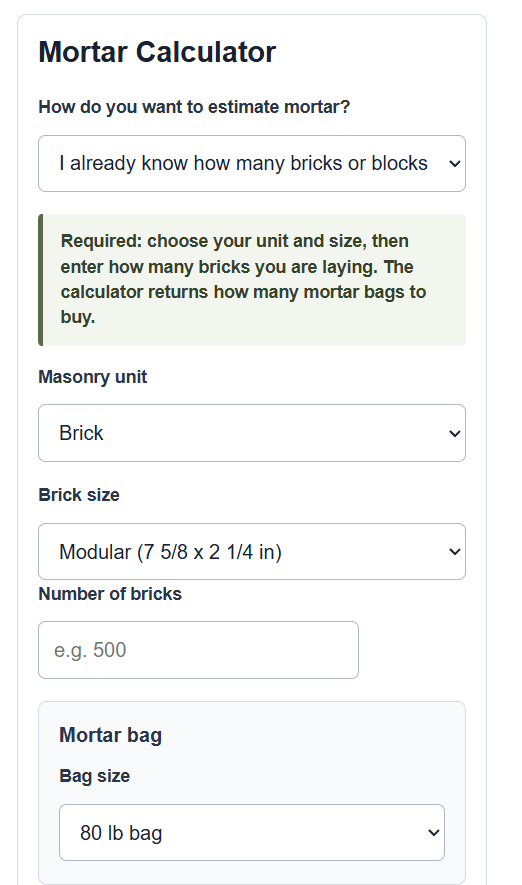
Calculate how many bags of mortar you need for a brick or concrete block wall, either from a unit count or from your wall dimensions.
- All Construction Calculators
- Mortar Bag Calculator
- Foundation Repair Cost Calculator
- Retaining Wall Calculator
Mortar Formula
The calculator finds the number of mortar bags from the number of masonry units, an estimated yield per bag, and a waste allowance.
Bags = N * (1 + W/100) / Y
When you estimate from wall dimensions instead of a known count, the number of units is found first from the wall area and the face area of one unit, then fed into the formula above.
N = A / a
- Bags = number of mortar bags required (rounded up to a whole bag)
- N = number of bricks or blocks
- W = waste allowance, as a percent
- Y = yield, or number of units one bag lays
- A = total wall area
- a = face area of one unit, including its mortar joints
The method selector lets you either enter a known unit count or have the wall area converted to a count for you. The masonry unit and size choices set the face area used for a and the default yield used for Y, since a brick and a concrete block lay a very different number of units per bag. The bag size switches the yield between an 80 lb and a 60 lb bag. The waste allowance adds a margin for spillage, joints that are thicker than planned, and broken units, and the optional custom yield lets you override Y with the exact figure printed on your mortar product.
Mortar Yield per Bag
Yield depends on the unit, the joint thickness, and the mortar brand. The values below are common planning figures for a standard 3/8 inch joint. Always check the bag for the manufacturer figure.
| Masonry unit | Units per 80 lb bag | Units per 60 lb bag |
|---|---|---|
| Standard brick | about 36 to 37 | about 27 to 28 |
| Modular brick | about 30 to 35 | about 23 to 26 |
| 8 in concrete block | about 12 to 13 | about 9 to 10 |
| 12 in concrete block | about 8 to 9 | about 6 to 7 |
Mortar is sold in several types, and the right one depends on the load and exposure of the wall.
| Mortar type | Typical use |
|---|---|
| Type N | General above grade walls and soft brick veneer |
| Type S | Below grade walls, foundations, and load bearing block |
| Type M | Heavy load and retaining walls in contact with soil |
| Type O | Light interior, non load bearing work only |
Example Problems
Example 1. You are laying 500 standard bricks, you use an 80 lb bag with a yield of 37 bricks, and you add a 10 percent waste allowance. The bag count is 500 times 1.10 divided by 37, which is 550 divided by 37, or 14.9 bags. Rounding up, you need 15 bags of mortar.
Example 2. You are building a wall that is 10 feet wide and 8 feet high with 8 in block. The wall area is 80 square feet, and each block face including its joint is about 0.89 square feet, so the wall takes about 90 blocks. At a yield of 12.5 blocks per 80 lb bag with a 10 percent waste allowance, the bag count is 90 times 1.10 divided by 12.5, or 7.9 bags. Rounding up, you need 8 bags.
FAQ
How many bags of mortar do I need for 100 bricks?
At a yield of about 37 standard bricks per 80 lb bag, 100 bricks need 100 divided by 37, or about 2.7 bags. Rounding up, plan on 3 bags before adding any waste allowance.
Does the calculator account for waste?
Yes. The waste allowance, set to 10 percent by default, increases the unit count before the bag count is found, so the result already includes a margin for spillage, broken units, and thick joints. You can raise or lower it in the advanced options.
Why does a block wall need so much more mortar than a brick wall?
A concrete block is much larger than a brick and has wider face shells and joints, so one bag lays only about a dozen blocks instead of three dozen bricks. For the same wall area you will buy several times more mortar for block than for brick.