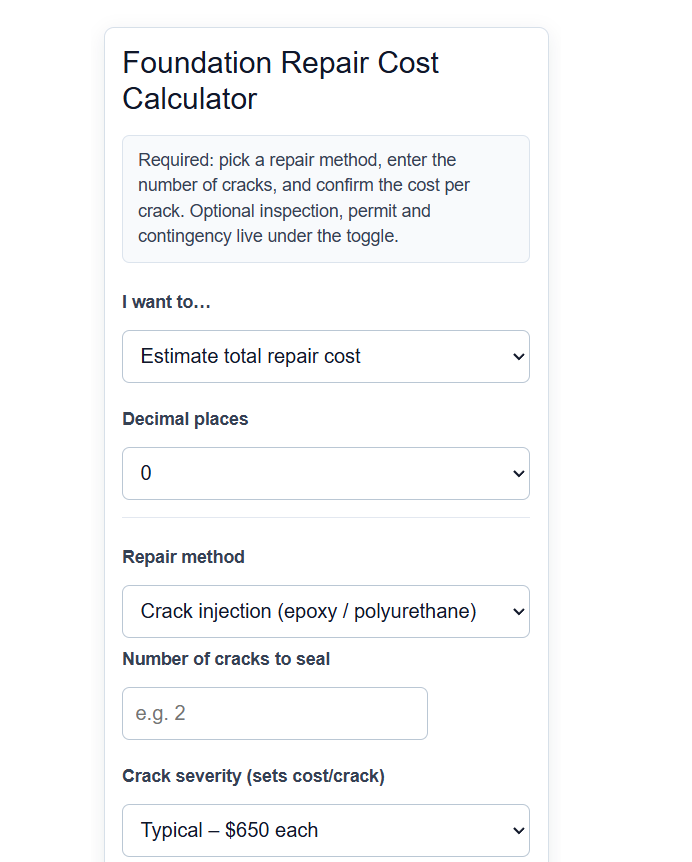
Calculate foundation repair costs by method, including pier installation, crack injection, slab jacking, underpinning, and waterproofing, plus fees and contingency.
Foundation Repair Cost Formula
When you estimate a total, the calculator multiplies the amount of work by the unit price for the repair method you pick, then adds any fixed fees and a contingency:
Total = (Q * C + F) * (1 + p)
When you instead solve for how much repair fits a budget, it rearranges the same relationship to return the quantity you can afford:
Q = (Budget - F) / (C * (1 + p))
- Total = total foundation repair cost in dollars
- Q = quantity of work (cracks, piers, slab sections, square feet, or linear feet, depending on the method)
- C = cost per unit for the chosen method and severity
- F = fixed fees added once, such as the engineer or inspection fee and the permit fee
- p = contingency rate written as a decimal (10 percent is 0.10)
- Budget = the total dollar amount you have available
The repair method controls which input the calculator asks for. Crack injection prices by the number of cracks, piering and slab jacking price by the number of units installed, slab jacking can also price by area, and bowing wall reinforcement, underpinning, and waterproofing price by the linear foot of wall, footing, or perimeter treated. Each method has preset unit prices for common severity or product tiers, and a custom option lets you type your own quote. The advanced fields add the inspection fee, permit fee, and contingency percentage so the estimate reflects the full project rather than labor and materials alone.
Typical Foundation Repair Prices by Method
These ranges reflect common 2025 to 2026 pricing in the United States. Use them as a starting point and replace them with a contractor quote when you have one. Actual prices move with soil conditions, access, and your local market.
| Repair method | Priced by | Typical unit price |
|---|---|---|
| Crack injection (epoxy or polyurethane) | Per crack | $400 to $1,500 |
| Concrete pier | Per pier | $1,500 |
| Steel push pier | Per pier | $2,500 |
| Helical pier | Per pier | $2,700 |
| Slab jacking (mudjacking) | Per section or per sq ft | $600 to $1,500 / section or $3 to $6 / sq ft |
| Bowing wall reinforcement | Per linear foot | $180 to $300 |
| Underpinning | Per linear foot | $30 to $75 |
| Waterproofing / drainage | Per linear foot | $5 to $18 |
For reference, the national average for a foundation repair runs around $5,000, with most projects landing between roughly $2,200 and $8,100. Minor crack sealing can be a few hundred dollars, while major structural work with multiple piers or full slab replacement can exceed $15,000.
| Project size | What it usually covers | Typical total |
|---|---|---|
| Minor | Sealing one or two hairline cracks | $300 to $1,500 |
| Moderate | A few piers or one area of slab jacking | $2,000 to $8,000 |
| Major | Many piers, bowing wall work, or underpinning | $10,000 to $30,000+ |
Example Problems
Example 1: Estimate a piering job. You need 6 steel push piers at $2,500 each. You add a $500 inspection fee, a $250 permit fee, and a 10 percent contingency. The repair subtotal is 6 times $2,500, which is $15,000. Adding the fees gives $15,750. Applying the 10 percent contingency gives $15,750 times 1.10, which is $17,325.
Example 2: Fit work to a budget. You have $6,000 and want crack injection at $650 per typical crack, with no fixed fees and a 10 percent contingency. The effective cost per crack is $650 times 1.10, which is $715. Dividing $6,000 by $715 gives 8.39, so you can afford 8 cracks within budget.
Frequently Asked Questions
How accurate is this estimate? The result is a planning estimate built from typical unit prices. Your real price depends on soil type, how deep piers must go, access around the house, and local labor rates. Once you have a written quote, switch the method to its custom option and enter the contractor's unit price for a number that matches your project.
Why does the calculator ask me to choose a repair method first? Different methods are priced on completely different units. Crack injection is priced per crack, piers per pier, and waterproofing per linear foot. Selecting the method tells the calculator which input to show and which preset prices apply, so you only fill in the fields that matter for your job.
What should I include in the contingency percentage? Contingency covers surprises found once work begins, such as additional cracks, deeper-than-expected piers, or extra drainage. A 10 to 15 percent buffer is common for foundation work. If you have a firm fixed-price contract, you can set it to zero.