Calculate how much concrete your steps need in cubic yards, bags, and cost from the rise, run, width, and number of steps, or size a flight from a total height.
Concrete Steps Formula
Concrete steps are estimated as a solid mass sitting on the ground. The tool slices the steps into vertical columns, one under each tread, then adds them together. For a flight of equal steps with no landing, the volume is:
V = W * Run * Rise * N * (N + 1) / 2
Variables:
- V is the total volume of concrete for the steps
- W is the step width, measured side to side
- Run is the tread depth of each step, front to back
- Rise is the riser height of each step
- N is the number of steps, which is the same as the number of risers
The N * (N + 1) / 2 term comes from stacking those columns. The column under the bottom step is one riser tall, the next is two risers tall, and the column under the top step is N risers tall. When you add a top landing, the top step uses the landing depth in place of the run, so the volume becomes:
V = W * Run * Rise * (N - 1) * N / 2 + W * P * (N * Rise)
where P is the landing depth. If you know the total height the steps must climb but not the number of steps, the design mode sizes the flight first, then applies the same volume formula:
N = roundup(Total Height / Max Riser)
 Rise = Total Height / N
To turn volume into what you buy, the calculator divides cubic inches by 46,656 to get cubic yards, and divides cubic feet by the yield of one bag to get a bag count: about 0.60 cubic feet for an 80 lb bag, 0.45 for a 60 lb bag, and 0.30 for a 40 lb bag.
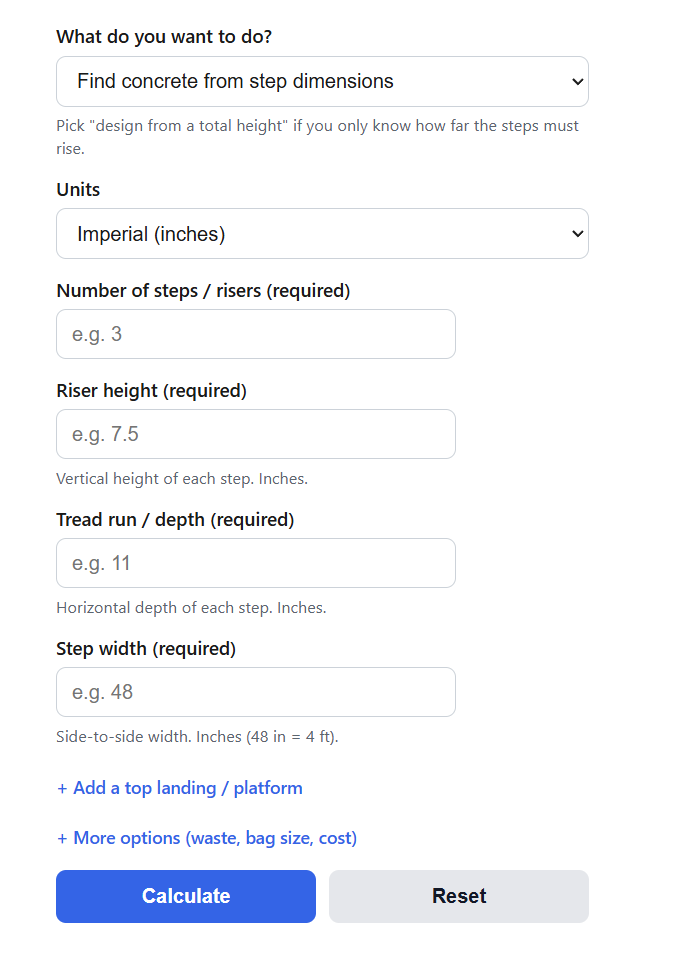
Each control on the form maps to one of these inputs. The solve-for menu switches between entering the step count directly and designing the flight from a total height. The units menu sets whether lengths are read as inches or centimeters. The optional landing field adds a deeper top step. The advanced options set the waste percentage added to your order, the bag size used for the count, and an optional price per cubic yard or per bag for a cost estimate. The results also break the pour down step by step.
Concrete Needed for Common Steps
This table lists the concrete volume and 80 lb bag count for typical porch steps built with a 7.5 inch rise and an 11-inch run. Bag counts include a 10 percent waste allowance, the same default the calculator uses.
| Steps | Width | Cubic feet | Cubic yards | 80 lb bags |
|---|---|---|---|---|
| 2 | 3 ft | 5.2 | 0.19 | 10 |
| 3 | 3 ft | 10.3 | 0.38 | 19 |
| 4 | 3 ft | 17.2 | 0.64 | 32 |
| 5 | 3 ft | 25.8 | 0.95 | 48 |
| 3 | 4 ft | 13.8 | 0.51 | 26 |
| 4 | 4 ft | 22.9 | 0.85 | 43 |
| 5 | 4 ft | 34.4 | 1.27 | 64 |
| 6 | 4 ft | 48.1 | 1.78 | 89 |
The next table shows something the total volume hides: where the concrete actually goes. For a flight of five equal steps, this is the share of the total concrete that lands in each step column, counted from the bottom.
| Step (bottom to top) | Share of concrete | Running total |
|---|---|---|
| Step 1 (bottom) | 6.7% | 6.7% |
| Step 2 | 13.3% | 20.0% |
| Step 3 | 20.0% | 40.0% |
| Step 4 | 26.7% | 66.7% |
| Step 5 (top) | 33.3% | 100% |
The top column always holds the largest share, equal to 2 / (N + 1) of the total. That is about 50 percent of a 3-step flight, 40 percent of a 4-step flight, and 33 percent of a 5-step flight. This matters at pour time. Most of the volume sits in the tall rear mass, which is exactly the part you can replace with compacted gravel or soil when you form a concrete shell instead of a solid block. Filling that core is how builders cut both concrete cost and weight on larger steps, and it is why a two-step stoop is usually poured solid while a tall flight often gets a fill core.
Example Problems
Example 1: concrete for three porch steps.
You are pouring 3 solid steps that are 36 inches wide, with a 7.5 inch rise and an 11-inch run, and no landing. Using the formula:
V = 36 * 11 * 7.5 * 3 * 4 / 2 = 17,820 cubic inches, which is 10.3 cubic feet or 0.38 cubic yards. At the default 10 percent waste that rounds up to 19 bags of 80 lb mix, or 18 bags with no waste.
Example 2: design steps from a porch height.
Your porch sits 30 inches above the ground and you want risers no taller than 7.5 inches, with an 11-inch run and a 48-inch width. The tool divides 30 by 7.5 to get 4 risers, each exactly 7.5 inches tall, for a total run of 44 inches. The volume is 48 * 11 * 7.5 * 4 * 5 / 2 = 39,600 cubic inches, or 22.9 cubic feet (0.85 cubic yards). With 10 percent waste that is about 43 bags of 80 lb mix.
Frequently Asked Questions
How much concrete do I need for concrete steps?
It depends on the width, rise, run, and number of steps, because the volume grows quickly as steps stack. One 3 foot wide step with a 7.5 inch rise and an 11-inch run takes about 0.06 cubic yards, three of the same steps take about 0.38 cubic yards, and five take about 0.95 cubic yards. Enter your own dimensions for an exact figure, then add waste before you buy.
Are concrete steps poured solid or hollow?
Both are common. Small stoops of one or two steps are usually poured solid on a compacted base. For taller steps, many builders form a concrete shell over a core of compacted gravel or soil, which lowers the concrete volume and the load on the ground. A solid pour needs no internal support. A shell over open space, such as steps with a storage void underneath, needs steel reinforcement to handle bending forces, while steps built directly over compacted fill usually do not.
What rise and run should concrete steps use?
For outdoor steps, a rise of about 6 to 7.5 inches with a run of 11 to 12 inches is comfortable and sheds water well. US building codes cap the riser at 7.75 inches and set the tread depth at a minimum of 10 inches, and they limit how much riser heights can vary within a single flight. Keeping every riser the same height is both a code requirement and the simplest way to prevent trips.