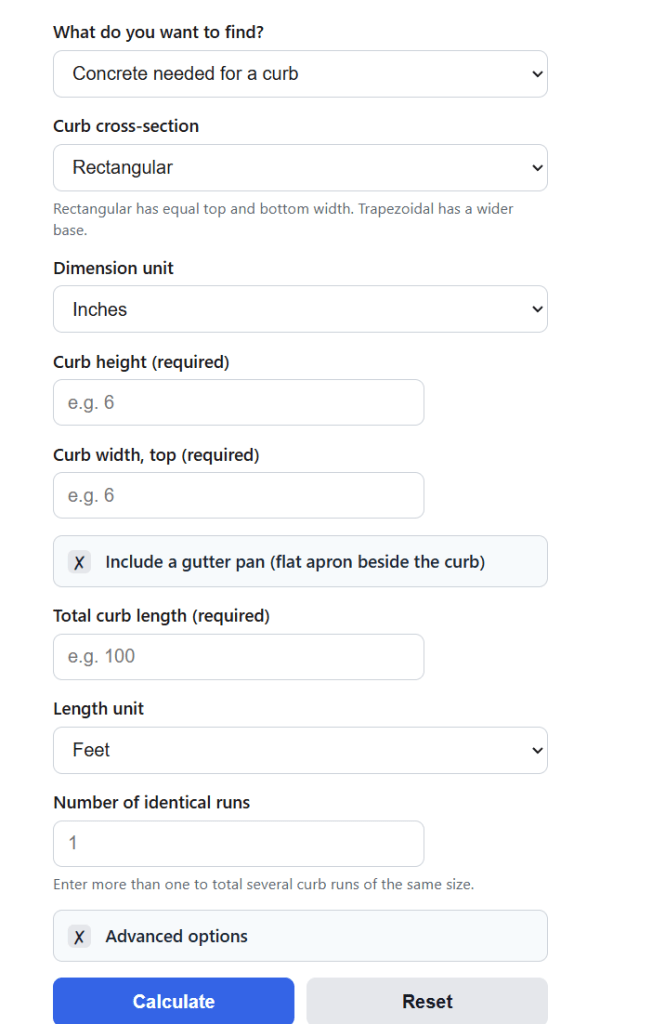
Calculate concrete for a curb in cubic yards, bags, and cost for rectangular or trapezoidal curbs, with an optional gutter pan and a reverse length mode.
Concrete Curb Formula
The calculator finds the cross-section area of the curb, multiplies it by the run length to get volume, then converts to cubic yards. Rectangular and trapezoidal curbs use different area formulas.
Rectangular curb:
CY = (H/12 * W/12 * L) / 27
Trapezoidal (tapered) curb:
CY = (0.5 * (W/12 + B/12) * H/12 * L) / 27
Gutter pan, added to either curb when present:
CY_gutter = (Gw/12 * Gt/12 * L) / 27
To work backward from a fixed amount of concrete to the length you can pour:
L = (Vft3 / (1 + waste)) / A
Variables:
- CY is the concrete volume in cubic yards
- H is the curb height in inches
- W is the curb width, measured at the top, in inches
- B is the bottom width at the base of a trapezoidal curb, in inches
- Gw and Gt are the gutter pan width and thickness in inches
- L is the total run length in feet
- A is the cross-section area of the curb in square feet per linear foot
- Vft3 is the concrete you have on hand in cubic feet, and waste is the allowance written as a decimal, so 10 percent is 0.10
- Dividing by 27 converts cubic feet to cubic yards; dividing inches by 12 converts to feet
Pick what you want to find at the top. The default mode takes your curb dimensions and returns the concrete needed in cubic yards, cubic meters, and cubic feet, along with a premix bag count and an optional ready-mix cost. Choose rectangular or trapezoidal to match your form, and turn on the gutter pan option to add the flat apron beside the curb. The reverse mode does the opposite: enter how much concrete you have, as cubic yards, cubic meters, or a number of premix bags, and it returns the length of curb that amount will pour. The waste allowance defaults to 10 percent and is added on top in the first mode and held back in the second.
Curb Length Per Cubic Yard and Per Bag
Most curb tools tell you the volume for a length you already know. This table runs the other way, so you can see how far a single cubic yard or one 80 pound bag of premix stretches for common curb profiles. Figures are for the curb only unless a gutter is listed, and use an 80 pound bag yield of 0.60 cubic feet. Multiply or divide to match your own order.
| Curb profile | Size (H x W) | ft³ per foot | Feet per yd³ | Feet per 80 lb bag |
|---|---|---|---|---|
| Landscape edging | 6 x 4 in | 0.167 | 162 | 3.6 |
| Residential curb | 6 x 6 in | 0.250 | 108 | 2.4 |
| Mountable curb | 6 x 12 in | 0.500 | 54 | 1.2 |
| Commercial barrier | 8 x 8 in | 0.444 | 61 | 1.35 |
| Residential curb + 18 x 4 in gutter | 6 x 6 in curb | 0.750 | 36 | 0.80 |
| DOT curb + 24 x 6 in gutter | 7 x 6 in curb | 1.292 | 21 | 0.46 |
The pattern is easy to remember: adding a gutter pan can cut how far a yard of concrete goes by half or more, which is why skipping the gutter in a plan leaves you badly short. This second table lists the typical dimensions behind each profile so you can confirm which row fits your job.
| Curb type | Height | Width or face | Typical use |
|---|---|---|---|
| Landscape edging | 4 to 6 in | 4 to 6 in | Garden beds, walkways |
| Residential barrier | 6 in | 6 in | Driveways, parking edges |
| Mountable | 4 to 6 in | 12 in | Low-speed streets, aprons |
| Commercial barrier | 7 to 8 in | 8 in | Roads, medians |
| Curb and gutter | 6 to 7 in | 6 in curb + 18 to 24 in pan | Municipal streets |
Example Problems
Example 1: Concrete for a residential curb.
You are pouring a 6-inch tall by 6-inch wide rectangular curb, 120 feet long, with a 10 percent waste allowance. The cross-section area is 0.5 ft by 0.5 ft, or 0.25 square feet. Volume is 0.25 times 120, which is 30 cubic feet. Adding 10 percent gives 33 cubic feet, or 33 divided by 27, which is 1.22 cubic yards. At 0.60 cubic feet per 80 pound bag, that is 33 divided by 0.60, or 55 bags.
Example 2: Length from bags you already bought.
You have 12 eighty pound bags and the same 6 by 6 inch curb, keeping a 10 percent waste buffer. Twelve bags hold 12 times 0.60, or 7.2 cubic feet. Held back for waste, the usable amount is 7.2 divided by 1.10, which is 6.55 cubic feet. Divided by the 0.25 square foot area, that pours about 26.2 feet of curb.
Frequently Asked Questions
How much concrete does a curb need per foot?
A standard 6-inch-by-6-inch residential curb uses 0.25 cubic feet of concrete per linear foot, so a 100-foot run needs about 25 cubic feet, or 0.93 cubic yards before waste. Adding an 18-inch wide gutter pan roughly triples that figure. Use the table above to match your own curb profile.
Does the calculator include the gutter pan?
Yes. Turn on the gutter pan option and enter the pan width and thickness, and the calculator adds that flat section to the curb volume. This matters because a combined curb and gutter often holds more concrete in the pan than in the curb itself, and leaving it out is the most common reason an estimate runs short.
How much extra should I order for waste?
Order 5 to 10 percent extra for most jobs. Machine slip-form pours waste less because the form controls the volume, so 5 percent is usually enough. Hand-formed curbs lose more to spillage, uneven subgrade, and over-pour at joints, so use 10 percent on runs longer than 50 feet. The waste field defaults to 10 percent.