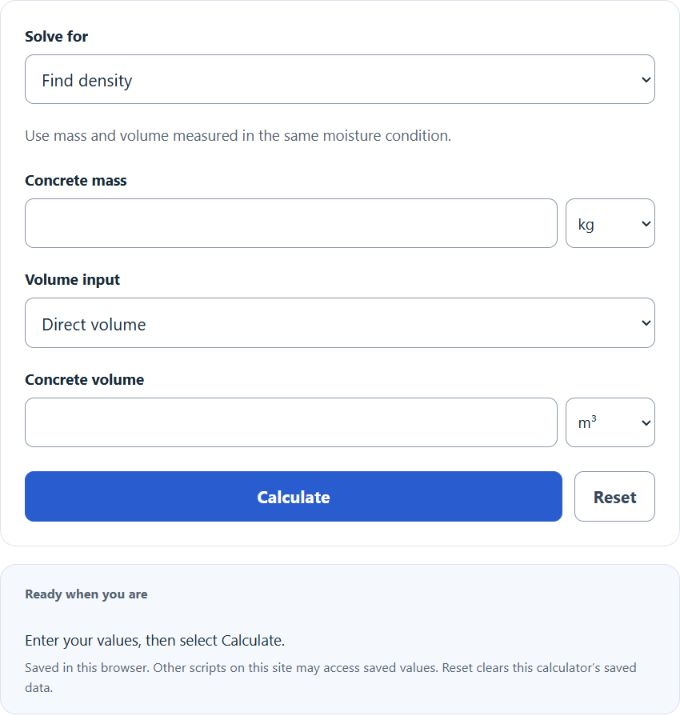
Calculate concrete density, weight, or volume from mass, dimensions, and concrete type with metric, imperial, and custom density units.
- All Construction Calculators
- All Density Calculators
- Concrete Weight Calculator
- Specific Volume to Density Calculator
- Concrete Mix Calculator
Concrete Density Formula
The calculator works from the basic density relationship and rearranges it for whichever value you need.
- density – mass per unit volume of the measured concrete (kg/m³)
- mass – mass of the concrete sample or pour (kg); weight force is measured in N or kN
- volume – space the concrete occupies (m³)
For rectangular shapes, volume = length × width × thickness. For a cylinder or core sample, volume = π × (diameter / 2)² × height. All inputs are converted to SI units before the calculation, so the unit you pick in each dropdown does not change the result. Use the actual occupied volume and measured mass in the same moisture condition. Geometric volume assumes the specified solid shape.
Typical Concrete Densities
These approximate ranges are examples, not concrete acceptance limits. Density depends on aggregate, air content, reinforcement and moisture. Use the mix specification or a measured density.
| Concrete type | Density (kg/m³) | Density (lb/ft³) |
|---|---|---|
| Aerated / foam concrete | 400 – 1,200 | 25 – 75 |
| Lightweight structural | 1,440 – 1,840 | 90 – 115 |
| Plain concrete | 2,200 – 2,400 | 137 – 150 |
| Normal-weight concrete | 2,240 – 2,400 | 140 – 150 |
| Reinforced concrete | 2,400 – 2,600 | 150 – 162 |
| Heavyweight (barite, magnetite) | 3,000 – 4,000 | 187 – 250 |
Common unit conversions used by the calculator:
| From | To | Multiply by |
|---|---|---|
| kg/m³ | lb/ft³ | 0.06243 |
| kg/m³ | g/cm³ | 0.001 |
| m³ | ft³ | 35.315 |
| m³ | yd³ | 1.308 |
| kg | lb | 2.2046 |
Worked Example and FAQ
Example. A core sample weighs 3.85 kg. Its diameter is 100 mm and its height is 200 mm.
- Volume = π × (0.05)² × 0.20 = 0.001571 m³
- Density = 3.85 / 0.001571 ≈ 2,451 kg/m³
This density is close to common normal concrete estimates, but does not establish the sample’s strength or suitability.
Why does my result look too low? Most low readings come from a unit mistake. Confirm the dimension unit matches the value you typed, and that mass is not in grams when the dropdown says kilograms.
Does reinforcement change the density? Steel reinforcement can increase a section’s average density. The 2,500 kg/m³ preset is an estimate; the actual value depends on the steel content and concrete mix.
Fresh vs. hardened density. Fresh, equilibrium and dry density differ with moisture and mixture composition; a universal fresh-to-cured correction does not apply. The calculator gives the density of the sample in its measured condition.
Which density should I use for weight estimates? Use 2,400 kg/m³ (150 lb/ft³) for most slab, footing, and wall pours unless the mix design states otherwise.