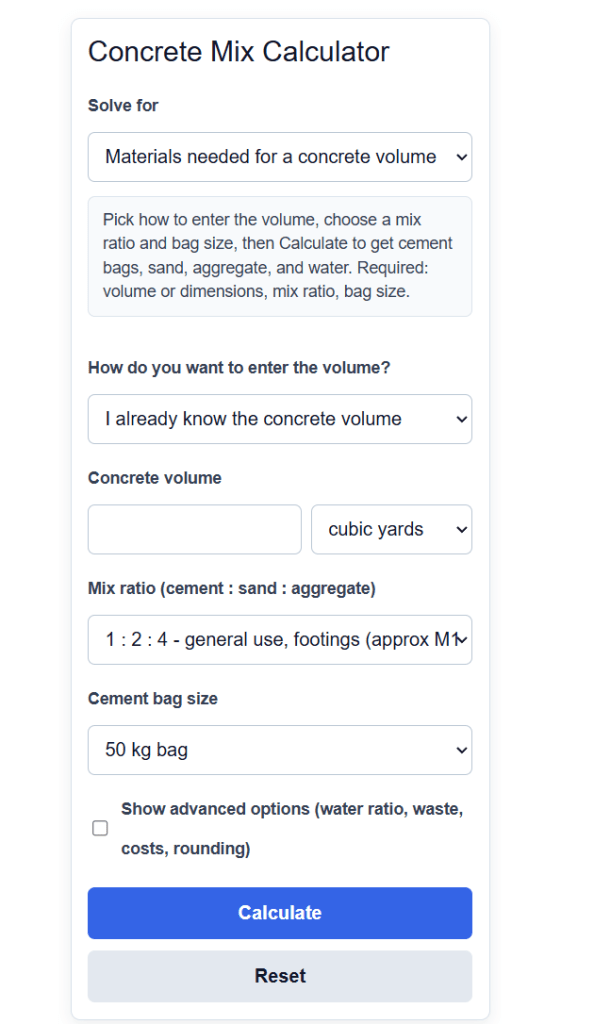
Calculate the cement, sand, aggregate, and water needed for any concrete mix ratio, or find how much concrete you can make from a number of cement bags.
- All Construction Calculators
- Concrete Curb Calculator
- Concrete Formwork Calculator
- Concrete Steps Calculator
- Concrete Footing Calculator
- Concrete Calculator
- Concrete Block Calculator
Concrete Mix Formula
A concrete mix calculation works in two stages. First you convert the wet volume of concrete you need into a dry volume of materials, then you split that dry volume across the cement, sand, and aggregate parts of your mix ratio.
Dry Volume = Wet Volume * Dry Factor
Material Volume = (Material Parts / Total Parts) * Dry Volume
Cement Bags = (Cement Volume * Cement Density) / Bag Weight
Water = Water-Cement Ratio * Cement Weight
- Wet Volume is the finished volume of placed concrete you need, taken either from a known value or from the slab or column dimensions you enter.
- Dry Factor accounts for the air voids in loose dry sand and aggregate that disappear once water is added. A value of 1.54 is standard, meaning you need about 54 percent more dry material than the finished volume.
- Material Parts are the numbers in your mix ratio, for example 1 part cement, 2 parts sand, and 4 parts aggregate.
- Total Parts is the sum of all the parts in the ratio (1 + 2 + 4 = 7 for a 1:2:4 mix).
- Cement Density is the bulk density of cement, about 1440 kg per cubic meter, used to convert cement volume into weight.
- Bag Weight is the size of the cement bag you buy, such as a 50 kg bag or a 94 lb US sack.
- Water-Cement Ratio is the weight of water divided by the weight of cement and controls the strength and workability of the mix.
When you solve for materials, the calculator runs these steps in order: it finds the wet volume, scales it to a dry volume, divides that dry volume by the ratio to get cement, sand, and aggregate quantities, converts the cement quantity into whole bags, and applies the water-cement ratio to estimate water. When you solve from a number of cement bags instead, it reverses the process to tell you how much concrete that cement can produce. A waste or overage percentage can be added so you order a little extra to cover spillage and uneven subgrade.
Common Mix Ratios and What They Are Used For
The ratio you choose sets the strength of the finished concrete. The table below lists nominal mixes by cement:sand:aggregate parts with their approximate strength grade and typical use.
| Mix Ratio | Approx. Grade | Typical Use |
|---|---|---|
| 1 : 3 : 6 | M10 | Lean concrete, blinding under footings |
| 1 : 2 : 4 | M15 | General use, footings, non-structural slabs |
| 1 : 2 : 3 | M20 | Driveways, paths, general slabs |
| 1 : 1.5 : 3 | M20 | Reinforced slabs and structural work |
| 1 : 1 : 2 | M25 | High strength columns and beams |
The next table shows how much volume a single cement bag fills, which helps you sanity check the bag count the calculator returns.
| Bag Size | Cement Weight | Approx. Cement Volume |
|---|---|---|
| 94 lb US sack | 42.6 kg | 1.0 ft3 (0.0296 m3) |
| 50 kg bag | 50 kg | 1.23 ft3 (0.0347 m3) |
| 40 kg bag | 40 kg | 0.98 ft3 (0.0278 m3) |
| 25 kg bag | 25 kg | 0.61 ft3 (0.0174 m3) |
Example Problems
Example 1: Materials for a slab. You are pouring a slab that is 10 ft long, 10 ft wide, and 4 in thick, using a 1:2:4 mix and 50 kg bags. The wet volume is 10 * 10 * (4/12) = 33.3 ft3, or about 0.944 m3. Multiply by the 1.54 dry factor to get 1.454 m3 of dry material. The total parts equal 1 + 2 + 4 = 7, so cement volume is (1/7) * 1.454 = 0.208 m3. Multiply by the 1440 kg/m3 cement density to get 299 kg, which is about 6 bags of 50 kg cement. Sand is (2/7) * 1.454 = 0.415 m3 and aggregate is (4/7) * 1.454 = 0.831 m3.
Example 2: Concrete from bags you already have. You have 10 bags of 50 kg cement and want to use a 1:2:3 mix. The cement weight is 500 kg, which is 500 / 1440 = 0.347 m3 of cement. With total parts of 6, the dry volume is 0.347 * 6 = 2.083 m3. Dividing by the 1.54 dry factor gives a finished wet volume of about 1.35 m3 of concrete.
Frequently Asked Questions
Why multiply by 1.54 to get the dry volume? Loose dry sand and aggregate contain air voids between the grains. When you add water and mix, those voids fill and the material settles, so the dry ingredients take up more space than the finished concrete. Multiplying the wet volume by about 1.54 adds back the roughly 35 percent of volume that is lost, so you order enough material. If you skip this step you will be short on every component.
How many bags of cement are in a cubic meter of concrete? It depends on the mix ratio. A standard 1:2:4 mix needs roughly 6 to 6.5 bags of 50 kg cement per cubic meter of finished concrete, while a stronger 1:1.5:3 mix needs about 8 bags. The calculator works this out exactly from the ratio, dry factor, and bag size you select.
What water-cement ratio should I use? For most general mixes a water-cement ratio between 0.45 and 0.60 by weight gives a workable mix with good strength. Lower ratios produce stronger, stiffer concrete but are harder to place, while higher ratios are easier to work but weaker. Stay near 0.5 unless your project specifies otherwise.