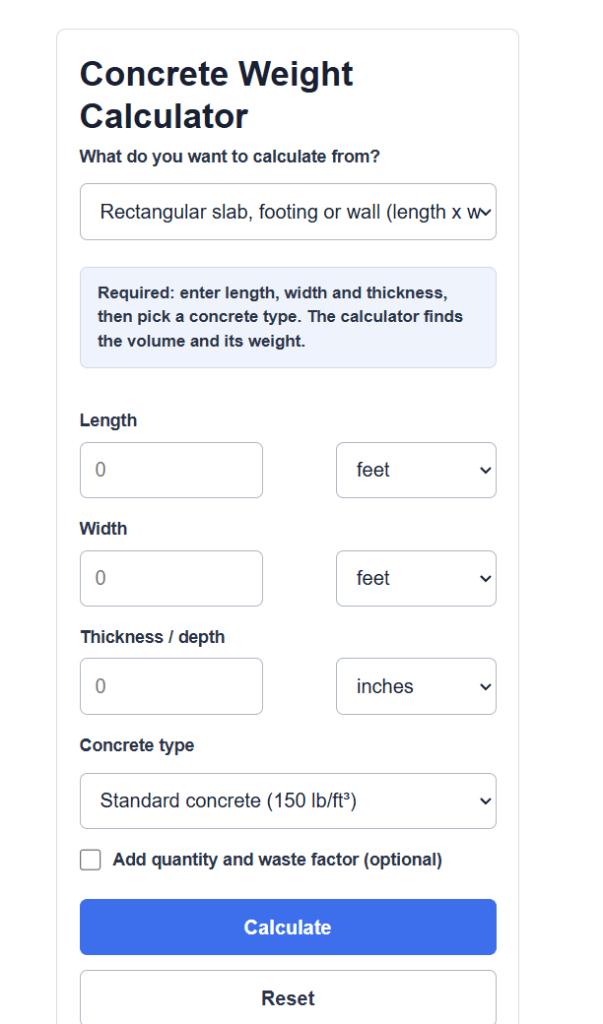
Calculate the weight of concrete for a slab, column, or known volume in pounds, tons, kilograms, and metric tons by entering your dimensions and concrete type.
- All Construction Calculators
- Concrete Steps Calculator
- Concrete Calculator
- Concrete Mix Calculator
- Concrete Footing Calculator
- Concrete Block Calculator
Concrete Weight Formula
The weight of concrete is its volume multiplied by its density. The way you find the volume depends on the shape you are pouring.
For a rectangular slab, footing, or wall:
W = L * Wd * T * D
For a round column, pier, or cylinder:
W = (pi / 4) * Dia^2 * H * D
For a volume you already know:
W = V * D
- W = weight of the concrete (pounds, then converted to tons, kilograms, and metric tonnes)
- L = length of the slab (feet)
- Wd = width of the slab (feet)
- T = thickness or depth of the slab (feet)
- Dia = diameter of the round section (feet)
- H = height or depth of the round section (feet)
- V = known volume of concrete (cubic feet)
- D = density of the concrete (pounds per cubic foot)
The calculator first works out the volume from the dimensions you enter, converting every length to feet so the volume comes out in cubic feet. It then multiplies that volume by the density you select to get the weight in pounds. The pound figure is converted to US tons (divide by 2,000), kilograms (multiply by 0.45359), and metric tonnes. If you set a number of identical pieces, the volume is multiplied by that count, and any waste or overage percentage you add increases the volume before the weight is calculated.
Concrete Density by Type
Density is the main thing that changes the weight for a given volume. Use the value that matches your mix.
| Concrete type | Density (lb/ft³) | Density (kg/m³) |
|---|---|---|
| Lightweight concrete | 115 | 1,840 |
| Standard concrete | 150 | 2,400 |
| Reinforced concrete | 156 | 2,500 |
| Heavyweight concrete | 250 | 4,000 |
The table below shows how much a standard concrete slab weighs per cubic unit, which is handy for a quick sanity check.
| Volume | Weight (standard 150 lb/ft³) |
|---|---|
| 1 cubic foot | 150 lb |
| 1 cubic yard | 4,050 lb (about 2 tons) |
| 1 cubic meter | 2,400 kg (about 2.4 tonnes) |
Example Problems
Example 1: Rectangular slab. You pour a slab 10 feet long, 8 feet wide, and 4 inches thick using standard concrete at 150 lb/ft³. First convert the thickness to feet: 4 inches is 0.3333 feet. The volume is 10 * 8 * 0.3333 = 26.67 cubic feet. The weight is 26.67 * 150 = 4,000 pounds, which is 2 US tons or about 1,814 kilograms.
Example 2: Round column. You pour a column 1.5 feet in diameter and 9 feet tall using standard concrete. The volume is (3.1416 / 4) * 1.5² * 9 = 15.9 cubic feet. The weight is 15.9 * 150 = 2,385 pounds, or about 1.19 US tons.
FAQ
How much does a cubic yard of concrete weigh? A cubic yard of standard concrete weighs about 4,050 pounds, which is just over 2 US tons or roughly 1,840 kilograms. The exact figure depends on the mix, so a lightweight mix is lighter and a reinforced or heavyweight mix is heavier.
Why does the calculator ask for a concrete type? Different mixes have different densities. Standard concrete is about 150 lb/ft³, but lightweight concrete is closer to 115 lb/ft³ and reinforced concrete is about 156 lb/ft³ because of the steel inside it. Choosing the right type, or entering your own density, gives a more accurate weight.
Should I add a waste percentage? If you are estimating how much concrete to order, adding 5 to 10 percent for waste, spillage, and uneven subgrade is a common practice. The advanced options let you add a waste percentage and a number of identical pieces so the total weight reflects what you will actually pour.